
Research shows that sales professionals at aligned companies are more than twice as likely to exceed their goals than those misaligned companies. So, how do you build an aligned company that prepares marketing and sales teams to work together and win together?
Riley Rogers: Hi, and welcome to the Win/Win Podcast. I’m your host, Riley Rogers. Join us as we dive into changing trends in the workplace and how to navigate them successfully.
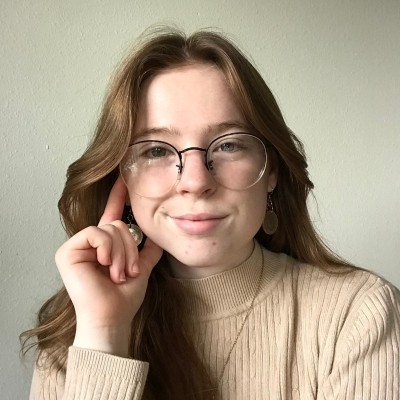
Here to discuss this topic is Holly Foxworth, vice President of Marketing and Communications at Axiom Medical. Thank you so much for joining us today, Holly. I’m super excited to dig into the work that you’re doing.
Holly Foxworth: Thank you for having me, Riley. I’m really excited to be here.
RR: For our audience, would you mind giving us a little bit of a line of sight into who you are, who Axiom is, your background, and the work you do today?
HF: So as you had mentioned, my name is Holly Foxworth and I am the Vice President of Marketing and Communications here at Axiom.
I’ve been at Axiom for 15 years now, which in marketing years, that probably sounds like eternity, but my background actually was in emergency and trauma medicine. That was what I did prior to marketing, but it’s been amazing how I’ve been able to bring those concepts from my nursing background into what it is that we do now.
I take a lot of pride in saying that, you know, I used to treat injuries, but now I have the opportunity to really be able to prevent them before they ever occur.
RR: I love that. And a very full circle moment, I can imagine.
I spoke with a guest a while back who introduced me to the concept of a squiggly career, which is you start somewhere and then it kind of takes you into a place you might not have expected and then you wind up, you know, I spent a decade as a medical professional, and now I’m here as a marketing leader.
So how did that journey lead to your current role, and then how does that clinical experience shape your work in marketing and communications as you’re, you know, working to prevent these injuries before they happen?
HF: So it started obviously in the ER as I’ve mentioned, and then transferring into occupational health, and that’s what we do here at Axiom Medical.
I always like to say that everything that I rely on in marketing all comes back to my foundation from the ER because nobody has time for fluff there.
That’s an environment where you have to be very alert to what’s going on. You need to pay attention and you need to be able to. Communicate quickly, very quickly, very clearly. And so that is also one of the same concepts that we need to have in marketing as well.
RR: One thing that I do imagine is probably pretty unique about the kind of marketing that you do is the environment that you’re working in. Axiom is there for people during very sensitive, complicated human moments in the workplace.
So how does that complicate the kind of communication you’re trying to do and the way you’re trying to go to market?
HF: It definitely is a different approach because most people are selling aspirations and we are selling intervention, and when I say intervention, I am referring to human lives that are being impacted there.
The way our business works is that when an employee is injured, then they would contact us, they’d speak with one of our nurses, and then we would go from there to help them with some first aid measures and things like that.
Those were really sensitive moments, so that may be when someone’s having a physical crisis. It could also be a mental health type of challenge as well. It’s not solely just physical, so you have to be really sensitive to the audience that you’re speaking to and make for sure that that tone of empathy comes through very, very clearly.
From a business perspective, you have to learn how to speak to your buyers, which, you know, my buyer is not actually the employees that are injured. My buyers are my HR people, my safety managers, CFOs, risk managers, things like that. So you have to be able to translate that language into something that they can understand.
RR: So it is really kind of a fine line to walk between how I communicate the business value of this and then how I communicate: “This will be valuable to you” to an end user. That’s really interesting and probably requires quite a bit of nuance. And more than that, the ability to communicate that nuance to your sales team so they can deliver that.
And I know beyond industry, beyond company, a challenge that pretty much everyone tends to encounter is the challenge of aligning marketing and sales. So, how have you built that partnership at Axiom?
HF: I love this question because you know, most organizations, whenever you look at sales and marketing, sometimes they talk about alignment, but very few actually make it to that place where you can align, and we’ve made some real progress in that area.
At Axiom, we have a very close marketing and sales team, and part of that alignment came from technology, so it was technology-driven.
Whenever you talk about alignment, everyone thinks that. It’s an issue that comes up between people or that it’s a problem with what your processes are now. This is an infrastructure issue. You need to all be on the same page and be able to access the same type of information so that we’re all speaking the same language.
So, that’s really, really been helpful in terms of strategy, especially for go-to-market, to rely on that technology.
RR: I think sometimes when you talk about alignment, it feels like this kind of abstract, spooky thing where you can say you’re doing it, but you’re not actually doing it. You know, we are aligned, but nobody really feels it.
So, I’d love to double click a little bit more into that technology piece, how it’s helping you, and more than that, how you found the right tool for the job.
HF: Like, I’m sure every other business, we’ve been through the stages, we’ve been through the mess where, you know, it’s like you don’t need a new file cabinet. The new file cabinet is not the solution here.
So having that technology not only has helped with the alignment, but it’s also helped with our brand strategy. It helps that they can speak the same language that we are and whenever we went from that first step from just being in, in files that we kept, we went to a little bit of a smaller vendor and, and that worked for a while.
As we matured as an organization, we knew that we needed a partner that was gonna be able to scale with us and scale their technology. That’s why we brought in Highspot.
I wouldn’t say it just saves time for our sales individuals, but from a marketing standpoint, it’s gold because we can actually measure things. Now, I, for one, am excited to go, you know, next week I go in the boardroom and I’m excited to be able to go in and say that, you know, marketing contributed half a million dollars to, to pipeline for the quarter, you know, or whatever that may be.
That’s the real difference in what we previously had and what we have now.
RR: I, I would be very interested in kind of a high-level view of, you know, we’re hearing time savings for sellers, more visibility for marketers. What are some of the ways that the platform really comes into play in the day-to-day?
Like what are those levers you’re pulling when you’re saying, you know, this is actually driving alignment?
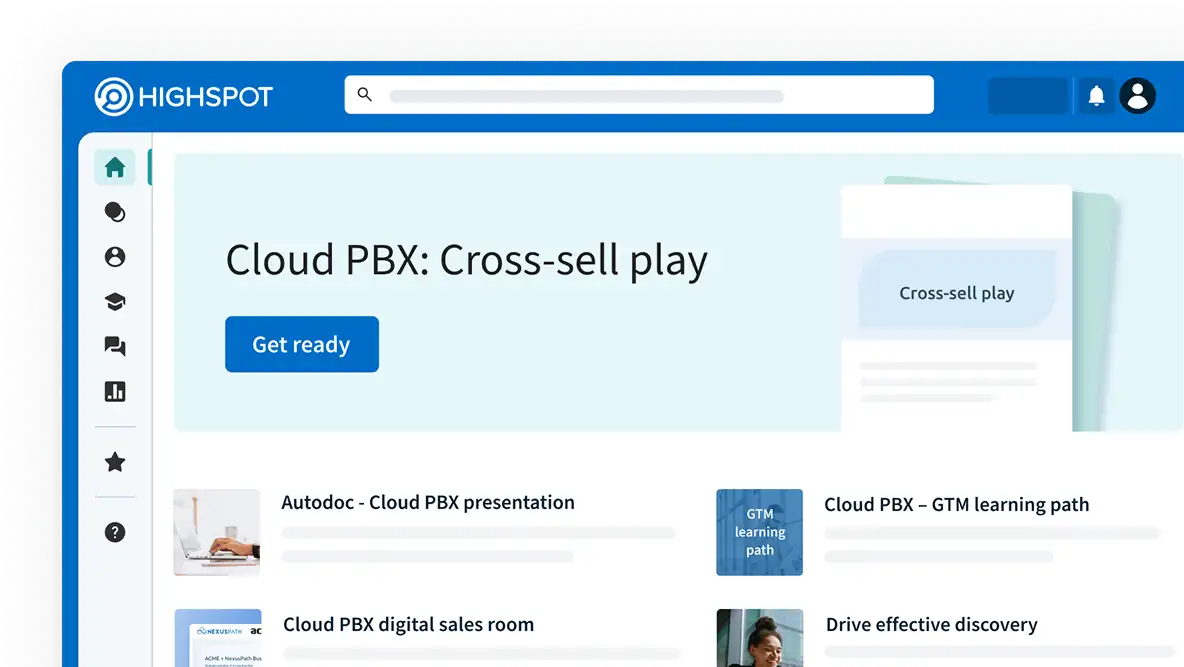
HF: So what we’ve relied on a lot, and I’ll get into Digital Rooms in just a bit, but one of the other things that’s been really helpful are the Sales Plays. Being able to go to market with one Sales Play that everyone has access to is gold.
It means the difference between success and failure. And so we now have that opportunity not only on the new logo side, but also on the account management side, so that they know what to show at what stage in the customer life cycle.
RR: I love that post-sales use case too. I think a lot of times when you talk about a Sales Play, it feels very pre-sales, but to have that supporting customer success is amazing as well.
You mentioned the Digital Room piece. I would be curious, how are you using them today?
HF: So, we were a Highspot customer right before they came out with additional rooms. So we had the pleasure of being, you know, some of the first to utilize those. And so at that point it was like: “Wait a minute, we’re doing this all wrong.”
There’s no reason why we should be sending 95,000 emails with all these attachments and nobody’s keeping up with that and nobody’s viewing it, and we have no insight into whether it’s working or not. That was the biggest change for us.
Now, whenever there’s an opportunity that’s created, we create a Digital Room, and that Digital Room follows that client throughout their entire lifecycle.
So it goes from new logo sales where they’ll load in all the information they’ve spoken about. The customer has access to all of those resources. Everything from wallet cards to posters, you know, all of our collateral and how it is that their employees need to get in touch with us, to sending them over then to implementation.
And having the Digital Room has made that so much easier because we can keep everything in one place. And that customer is already familiar with that Digital Room because they started it in the very beginning with our sales reps, so they continue that through with the implementation. They’re no longer sending out these long spreadsheets for people to fill out and send back to them.
Everything’s in one centralized location, and then as that account is handed off to either client success or IT designated account representative, then they take the ownership of that account so it changes. In the, in the fact that we have visibility now into everything that has gone on in that account from acquisition all the way through expansion.
And that’s a really big deal. And not just that, we’ve had actual clients write into us and tell us how impressed they were with our Digital Room concept. And we had one that had wrote us and said that it was the best presentation and transfer of information that they had ever seen. It was gold to us.
And that’s why I say it was a game-changer, because it was. It changed everything from that point on.
RR: When you hear that feedback from your buyers, you know you’re doing something right. And to the previous point of alignment, you know, we talked about how you’re using the tool to drive marketing and sales alignment, but.
In this way, you’re also using it to drive pre-sales and post-sales alignment. So that entire process is smoothed out a little bit and very, to your point, challenging, we’ll say, process of implementation is a lot easier. You know, we heard a little bit about how buyers responded to the introduction of Digital Rooms.
What about your sellers? How was that received when you first started using these and rolling them out?
HF: We first rolled it out to new logo sales and marketing. That was where the main focus was, and then kind of expanded from that point, and then we’ve just continued on since then. It just changes everything that we do.
RR: One thing too, that is kind of useful, from a marketing side when we’re thinking about Digital Rooms is the fact that as this Room lives throughout the entire cycle, you are getting so much engagement data flooding into your system.
That’s great for sellers because they know what’s happening in their deal. It can shape their next steps, they know what to do, but it’s also great for you because it gives you that kind of directional vision as to what’s working and maybe what’s not working as well.
As you mentioned, part of your goals are that measurement piece where you can go into the board meeting and say: “I feel confident in my impact.”
So, how are you approaching measurement today and how does Highspot, some of that engagement data, some of that influence revenue data kind of fit into how you’re looking at your work?
HF: It gives us complete visibility. It’s the difference between knowing that we’re just producing content and throwing it across the fence and hoping that it works to now being able to now say: “Okay, this that we created, we can now measure that, and this has impacted deals. A, B, C, and D.”
We have individual Scorecards for if there’s initiative that we’re wanting to run, whether there’s a Play, whatever it may be. We can run individual Scorecards on teams, we can run it on individual sales reps. We can also associate that with our revenue cycles.
So, it tells us not only what’s working, but it also tells us where the gaps are because we get reporting back, telling us what internal staff are searching for inside of Highspot, and if there’s something there that they’re looking for that we haven’t created collateral for, then that gives us an indication that gives us the green light to say: “Hey, maybe we need to take a look at this and this is something that we need to add to through our bank of collateral.”
RR: That’s such a great use case too, because oftentimes, you know, you frame it as the: “I know it works. I know it’s not working.”
But you can’t know what you don’t know. Right? And so when you don’t have that line of sight into the field of what they wish they had, there’s no way to provide it. Be super curious about an example where you found a gap and were like: “Oh, I can’t believe we didn’t know we needed this.”
HF: It happened last week as a matter of fact. We had our report that came from Highspot that showed what terms they’re searching for and all that for the first time is said “clinic,” and I saw that and I thought: “Are you kidding me?”
We have never put anything together about specifically about clinics, you know, and that’s such a key piece of what, what we do, because we vet very specific clinics to make for sure that they have the same philosophy as we do, and that they’re gonna treat these injured workers that we may have to refer to them in the same fashion that is our expectation.
And so whenever I saw “clinic” on there, it made me think that is so important. And I don’t think that we’ve ever created anything that’s been client-facing specifically that’s been about what that vetting process looks like for a clinic.
So yeah, we had a really, really recent use case for that one.
RR: That’s such a funny story. So from day-to-day things like this where you’re like: “Oh, this would be a very useful asset” to we’re hearing great things from buyers about how Digital Rooms are easing the sales cycle, all of these things coming together, it sounds like there’s a lot of success going on.
In all of this time, as you’ve been building and evolving your Highspot environment, when you look back, what improvements stand out the most? What wins are you proudest of?
HF: The biggest wins that I’m proudest of are that we now have a strategy that sticks.
We have a strategy that follows us throughout the entire organization. Everyone’s on the same page. Being able to have that platform, and I don’t know that I mentioned it before, but we not only rolled this out to our sales team, we also rolled that out to our operations team, our nurse client liaisons.
So everybody in our organization has access to Highspot. So that I would say is our biggest win is to be able to get everybody on the same page and all moving in the same direction.
RR: Yeah, absolutely. And then I would love to know also, as a marketing leader, we talked about some of that visibility. What has that been doing for you, as you’re thinking about impact?
HF: When people think of marketing, sometimes they think of activities or they think of, we’re just producing things. No, we’re a revenue engine. We are a revenue engine. So now we have the information that supports that, and we can walk into a boardroom and confidently show that we’ve contributed in this specific way and this many deals.
It takes us from that passive kind of involvement to really just driving the whole go-to-market strategy.
RR: And it really helps you reaffirm that not only do we have a seat at the table, but we deserve it. Because to your point, we are moving a lot in, in the revenue cycle, quarter over quarter, and it’s sometimes hard to prove, but once you can, it’s really, really powerful.
So, as we’re closing out. I’d like to kind of go a little bit back to the beginning. You built a career translating very deep industry expertise into marketing leadership.
As other folks in specialized fields are looking to move into strategic roles, what advice would you share?
HF: Don’t sand down your edges. Don’t try to conform to what a traditional marketer is.
You have expertise, especially from, whether that’s from a technical background or it’s a clinical background, that is a huge asset in terms of marketing because you have the ability to bring something new to the table that other marketers may not already have.
RR: I love that phrase: “Don’t sand down your edges.” I feel like we get a lot of advice on the Win/Win Podcast and all of it is wonderful, but that is one I have not heard before, and that is a very powerful perspective. I think all your accumulated experiences make you a stronger, impactful professional, and you can translate that kind of wherever you want it to go. Perfect place to close on.
Holly, thank you so much for joining us today. It’s been a really enlightening, interesting session to hear a little bit more about you and the work you’re doing at Axiom.
HF: You bet. Well, thank you for having me on Riley. I appreciate all you do and, and all that the Highspot team does as well.
RR: Amazing. To our audience, thank you for tuning into this episode of the Win/Win Podcast. Be sure to tune in next time for more insights on how you can maximize go-to market success with Highspot.