

Key Takeaways
- Successful sales pipeline management requires close coordination across go-to-market (GTM) to ensure shared visibility, consistent execution, and full-funnel accountability for marketing, sales, and enablement.
- A healthy sales pipeline is one that maintains strong early-stage volume, accurate stage progression, and deal quality high enough to support reliable revenue forecasting and strategic resource planning.
- Realizing an effective pipeline management approach is what ultimately empowers your GTM teams to drive sales velocity, increase win rates, and scale repeatable performance across every stage of the buyer journey.
Most go-to-market teams struggle with visibility. Think about it: If you and your GTM organization can’t see exactly which leads are stalling where or what’s helping reps advance conversations, you’re walking blindfolded through the buying process.
That’s why a well-managed sales pipeline is non-negotiable.
Effective sales pipeline management really hinges on one thing: your ability to identify, engage, and advance potential customers before they ghost you.
Your sellers’ goal is to hit revenue targets—plain and simple.
That means you need reliable data and the right tools—including and especially an AI-powered, agentic GTM platform that is purpose-built for sales, marketing, enablement, and revenue teams like yours—to better qualify leads, engage the right prospects, and identify bottlenecks in your B2B selling process.
What is a sales pipeline?
A sales pipeline is a structured view of potential customers across defined stages, showing how prospects progress from brand and product awareness to purchase readiness and decision-making. A strong sales pipeline keeps qualified leads organized by stage, forecasts outcomes accurately, and reveals gaps that threaten revenue attainment goals. Effective pipeline management aligns stages, data, and actions to accelerate conversion rates across long, complex sales cycles.
B2B sales pipeline stages
The exact stages of a sales pipeline may differ slightly from one org to the next, but, for the most part, companies use the following opportunity lifecycle phases to keep tabs on where a given target account is in their B2B buying journey:
- Generating leads via sales and marketing activities: The foundation of most sales pipelines begin with lead-generation campaigns and activities from marketing and proactive prospecting by sales reps on LinkedIn and similar channels via targeted social selling efforts.
- Qualifying prospects based on pre-defined criteria: Lead qualification confirms if a prospective target account fits the ideal customer profile, has buying power or influence, and is far enough into the customer decision-making process to keep deals moving forward.
- Conducting a product demo and/or sharing solutions: This stage confirms whether decision-makers know the value of the offering of interest to them and are ready to explore a tailored solution that aligns with their business-related wants, needs, and challenges.
- Delivering the detailed sales proposal to buying groups: Your official sales offer must include all necessary technical, legal, data-security, and pricing details to drive buying committee alignment and support executive review, a part of the sales process that can be intensive.
- Negotiating terms and a deal framework with buyers: Sales negotiations clarify deal structure and terms, resolve lingering objections held by one or more buying stakeholders, and secure agreement across legal, procurement, and final business decision-makers.
- Finalizing purchase agreements and signing contracts: The goal here is fairly simple: Get economic buyers to sign on the dotted line, so to speak, with no loose ends.
- Supporting clients post-purchase (customer success): This involves ensuring new clients, who expect attentive service and assistance, have everything they need to thrive long-term and coordinating cross-functionally with CS on an ongoing customer engagement strategy.
Deciding on your particular pipeline sales stages requires coordination among go-to-market and revenue leaders to ensure everyone’s on the same page about how to properly analyze and take action on sales pipeline reports.
This collaboration also helps marketing and sales leaders establish service level agreements around lead generation and handoff so each GTM team remains accountable for their distinct roles in getting more opps in reps’ hands.
Why having a consistently healthy sales pipeline is critical for GTM success
The importance of data quality can’t be overstated, when it comes to sales pipeline management (not to mention every other facet of GTM operations).
When you have clean, unified, always-up-to-date, easily accessible data that flows across your entire sales tech stack, you realize a number of benefits:
- A healthy pipeline provides real-time visibility into deal volume, stage progression, and where reps’ sales efforts are paying off or falling flat.
- It ensures you stay on track to hit sales targets and revenue goals by keeping early-stage and late-stage opportunities balanced across timeframes.
- You can monitor the progress of all the deals currently ‘in flight’ by individual rep and intervene early when things start to slow, stall, or veer off course.
- Accurate forecasts depend on a well-managed pipeline with clean data, clear definitions, and consistent tracking across sales teams and territories.
- A reliable pipeline shows what leads to closed-won and causes ‘dead’ deals so you can double down on what works and cut out sales tactics that don’t.
- You need the number of deals at each stage to properly staff, plan, and resource around growth across your various geographies, segments, and products.
- Strong pipeline visibility helps GTM leaders gauge deal velocity and pinpoint areas for improvement in your sales strategy before problems scale.
Spoiler alert: You won’t always have a fully healthy sales pipeline.
Sometimes, deals dry up, stages clog, managers over-forecast, or your early-stage lead volume just isn’t enough to support next quarter’s targets.
But the moments when you recognize issues with your sales data (think latency issues in bidirectional syncs between your sales CRM system and other tools) or the way reps identify, engage, and attempt to convert buyers that give you the opportunity to clean up your pipeline and adjust your GTM approach at large.
“It’s easy to lead when things go well, the pipeline is strong, and deals are closing,” Jani Hirvonen of Google’s Global Channel Partnerships business recently wrote for Fast Company. “The real test is what happens when results stall, pressure increases, and the path forward is challenging.”
How AI-powered tools and insights enhance sales pipeline management for GTM
“Streamlining workflows and eliminating silos brings the go-to-market organization together,” per Highspot’s State of Sales Enablement Report 2025. “By unifying the tech stack through integrations and consolidation, teams can more easily define, execute, and optimize their go-to-market initiatives.”
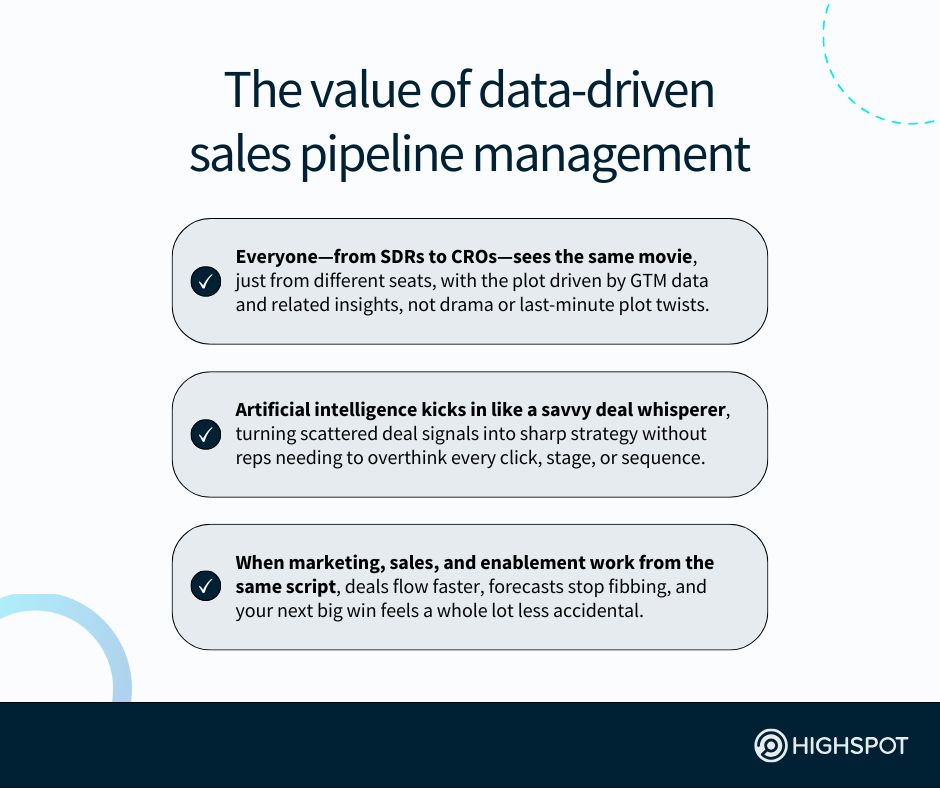
Consolidation of tools and centralization of data is undoubtedly important to your GTM success. But so too is adopting AI for sales, marketing, and enablement teams so they can work faster, show up smarter, and win more deals.
With an AI-forward approach to sales pipeline management, you:
Empower reps to close deals with greater efficiency using guided AI sales agents
Sellers know their sales quota like the back of their hands. What they need to meet (and, ideally, exceed) their monthly and quarterly targets based on sales pipeline assigned to them is greater insight into what particular sales messaging and content leads react to and which buying signals mean “act now.”
The SDRs who outperform peers know what prospects just read, when product demos are viewed, where buying committee members are in their decision-making process, and what assets and plays moved similar deals across the line recently so they can use that as a reference point in their buyer engagement.
More to the point, they rely on what leads’ most recent activity reveals, cross-checked against CRM insights and deal trends from similar sales motions.
Highspot Nexus, our AI and analytics engine featuring customizable AI sales agents, help reps decode those inputs in seconds, delivering context-rich guidance that help them advance leads to the next stage of the B2B sales funnel effortlessly using well-governed, enablement-approved collateral.
From content suggestions, to reminders tied to what decision-makers shared on the last call, sellers who use Highspot Agents align quickly to buyer intent.
They also move with purpose, since they’re coached in real time by our AI sales coaching tool that is trained through on deal intelligence and patterns.
Equip sales managers to evaluate pipeline health with actionable, AI-driven insights at scale
Sales leaders succeed when they know which deals are at just the beginning of the deal cycle, which are close to a final decision, and which are decaying. They also keep a close eye on accounts that haven’t been touched in two weeks.
To evaluate potential deals effectively, you need signals beyond sales stages—things like recent buyer actions, rep consistency, and gaps in coverage.
You don’t fix pipeline health staring at sales forecast percentages.
You do so by analyzing how many deals hit key milestones across product lines or teams and tracking proposal timing, reps’ average deal progression, and how quickly buying groups respond to marketing-created collateral or custom outreach.
The best B2B sales strategies rely on fast, role-aware data to catch lagging deals early and route coaching time toward moments that matter most.
With those inputs at hand, managers can better allocate sellers’ time, develop custom sales training and learning paths, and help reps focus based on actual evidence.
Activate marketing teams to create content that deeply engages potential buyers in every stage
The best marketing orgs behave more like strategists than suppliers. They produce content aligned to stage, audience, and what drives the next meeting. They don’t rely on form fills.
Rather, they track how content correlates with meetings booked, deals won, and which plays show up across multiple wins. Based on customer data from recent sales engagement and CRM data, marketers adjust fast, cutting stale assets and doubling down on impact.
Buyers who understand the value of the offering of interest click, share, and re-open the same assets across their deal cycle—and that tells you everything.
Great marketers write fewer briefs and spend more time reviewing how many deals closed using what they created and what needs reinvention. Those insights help marketing operate less like a content factory and more like a revenue lab.
Help RevOps leaders track pipeline coverage and optimize GTM strategy with unified analytics
Revenue operations teams anchor strategy by connecting pipeline coverage, conversion patterns, and capacity planning into one operating view shared across leadership.
With revenue intelligence layered across systems, leaders gain actionable insights into deal distribution, risk concentration, and execution gaps across regions or segments.
Unified analytics help forecast revenue growth for the months and quarters ahead, tying pipeline shape directly to hiring plans, territory design, and sales goals.
RevOps leaders monitor coverage ratios, deal aging, and progression speed to identify where execution lags and where scale investments pay off fastest.
Those in-depth insights support decisions that scale what works across teams, motions, and markets without overcorrecting based on short-term variance.
When data stays connected end to end, revenue operations becomes the force that aligns execution, planning, and growth with discipline and ensure RevOps is able to effectively predict future sales with complete confidence.
Enable training teams to understand what moves deals forward and reinforce key behaviors
Training leaders succeed when they connect skills development directly to pipeline progress, using evidence from live deals rather than abstract competency models.
They study which assets, plays, and messaging appear most often in wins, then refine programs to drive the behaviors that win across roles and deal sizes.
Sales enablement teams pair learning data with opportunity outcomes to better engage active opportunities in their sales pipeline and reinforce proven execution patterns.
Tools like Highspot’s AI Role Play give sellers a practice environment grounded in real-world situations pulled from peer activity and high-performing deals.
Those sessions help sellers prepare for future scenarios seen in past deals, building fluency across objections, pricing pressure, and stakeholder dynamics.
When training mirrors pipeline reality, teams improve sales performance while accelerating sales velocity across complex, multi-threaded buying cycles.
Sales pipeline management FAQs
How can artificial intelligence impact my team’s sales pipeline management today?
Certain AI systems help GTM teams react faster, flag risk earlier, and adjust deal focus using live pipeline signals tied to stage progress and buyer actions. Some AI sales tools streamline tasks like lead qualification by prioritizing follow-up, highlighting urgency, and shortening the gap between insight and rep action.
Which sales tools help reps better manage and optimize their pipeline in real time?
The best tools combine guidance, alerts, and visibility through sales dashboards that highlight priority deals and recommended next steps across active opportunities. Agentic go-to-market platforms like Highspot help guide seller execution across pipeline stages with real-time, AI-powered pipeline insights.
How do successful B2B sales managers use dashboards to manage their team’s pipeline?
The top GTM managers rely on sales intelligence to review deal pacing, pipeline coverage, and risk patterns, then direct coaching and resources toward opps that matter most. They track sales pipeline metrics like stage conversion, deal aging, and close rates to keep teams aligned with performance expectations.
How can I use pipeline data to refine my sales process steps and close more deals?
Your go-to-market teams can analyze data from your CRM system, engagement tools, and other GTM systems to spot weak transitions, repeated objections, and stages where progress slows. Those insights can guide updates to your sales process and improve sequencing, prioritization, and consistency.
Can we automate selling actions based on real-time sales pipeline signals or gaps?
Yes, some sales tools analyze stage transitions, buyer interest, and historical trends to suggest relevant moves that align with how similar deals progressed. These systems prompt reps with timely next steps that help maintain pace, reduce delays, and strengthen quality of execution across opportunities in flight.
How can sales pipeline insights drive more focused rep coaching for managers?
Sales metrics tied to your pipeline reveal which SDRs move deals quickly and slowly and which stages consistently show drop-offs. Your managers can use that data to pinpoint where each rep needs support to hit sales targets and tailor coaching to match execution gaps with winning tactics from top performers.
What impact does poor sales pipeline hygiene have on our win rates and sales cycle?
Inaccurate close dates, outdated stages, and inflated deal sizes distort forecasts and delay critical decisions across revenue enablement and RevOps teams. Low-quality, disconnected pipeline data creates blind spots that extend sales cycles, limit resource planning, and reduce trust in rep inputs during planning.
How do I link specific sales pipeline stages to buyer intent and engagement activity?
Review which specific collateral buyers viewed, shared, or requested during each stage of the sales cycle to map what signals true interest versus passive curiosity. Teams that track email clicks, meeting requests, and repeat views can identify patterns that align with stage progression across successful deals.