
According to research from Promotional Products Association International, the promotional products industry is digitizing, and it is digitizing fast.
Last year, online sales represented 25% of total industry sales, which is a 19% increase year over year. As the industry shifts, promotional product organizations like Polyconcept North America are as well. So, how do you manage the change?
Riley Rogers: Hi, and welcome to the Win/Win Podcast. I’m your host, Riley Rogers. Join us as we dive into changing trends in the workplace and how to navigate them successfully.
Here to discuss this topic are Nicole Zuniga, sales enablement manager, and Lanya Trypupenko, marketing lead acquisition specialist at PCNA.
Thank you so much for joining us today. We’re really excited to have you here and to dig into all the wonderful work you’re doing at PCNA. Before we kick off, I’d love to learn a little bit about you both, your background, and your role.
Nicole, would you like to start us off?
Nicole Zuniga: Sure. So I am sales enablement manager. I run our Highspot platform. I do have sales background experience, and I often go out to customer events and dive back into my sales role when we’re doing those.
But mainly when it comes to Highspot, I’m trying to create a lot of or limit a lot of that gray area between sales and marketing and make it really easy for not only our sales reps to be able to provide guidance and value to our customers, but then our customers take a lot of that same content and reuse it for working with their customers.
RR: Wonderful. Well, we’re happy to have you here. Lanya, would you mind telling us a little bit about yourself?
Lanya Trypupenko: I am currently the marketing lead acquisition specialist, also known as the new account specialist. So I onboard the majority of our new accounts and just make sure they have all the information and everything they need to kinda get started and be successful with PCNA.
And then my background, I’ve worked in marketing and account management for ten plus years, always with different types of products, such as jewelry, eyewear, telecommunications, and now promotional products.
RR: Fantastic. Well, I am really looking forward to digging into all of that experience and how it shows up for you at PCNA.
Before we get into the nitty-gritty details, Nicole, would you mind giving us a high-level overview of PCNA’s business, what you sell, who you sell it to, especially knowing that you guys have a little bit of a unique sales structure?
I’d love if you could walk us through it and kind of set that foundation for our listeners.
NZ: Absolutely. So anybody who has received a piece of swag or some sort of giveaway, that is what we do. So we are a promotional product supplier. We import, design, and decorate promotional items, a 50 cent pen all the way up to a $300, um, leather tote bag or leather, uh, duffel bag. So we have quite an array of products that we offer.
And we work with a distributor network, so it’s a very unique way that we do business. Instead of us working directly with the public, our distributors will then market to, could be marketing firms, it could be directly very large corporations, it could be small businesses. And so we are promoting to the promoter of our products.
RR: I think folks listening in will probably be a little bit astonished by the scale that you’re dealing with. There are, you know, potentially thousands of products. They change seasonally. They just change depending upon the type of buyer that you’re targeting, the budget that you have, all sorts of factors.
When you’re working at a scale like this and you’re working to enable at a scale like this, what starts to break down? What cracks do you see as you’re helping your teams take all of these products to market?
NZ: You’re looking at, especially when you look at seasonality or even upcoming national days, their buying events coming, and that kind of takes out, like, that first layer of, “I don’t know where to start.”
The hardest question or the hardest thing to get is, um, “Give me, like, five or 10 ideas for this price range,” but not knowing what is the use case, what is the theme, who is the audience. So, that’s what a lot of our resources are for, to whittle out some of those questions to then get down to the nitty-gritty of what is going to hit with the customer.
Let’s talk about breast cancer awareness. It’s not necessarily going to be a one-for-one. It depends on what our distributors are working on with their customers. It could be maybe they just want a simple sport pack to be able to give out to their customers. It could be a plastic cup. It could also be a really nice piece of apparel.
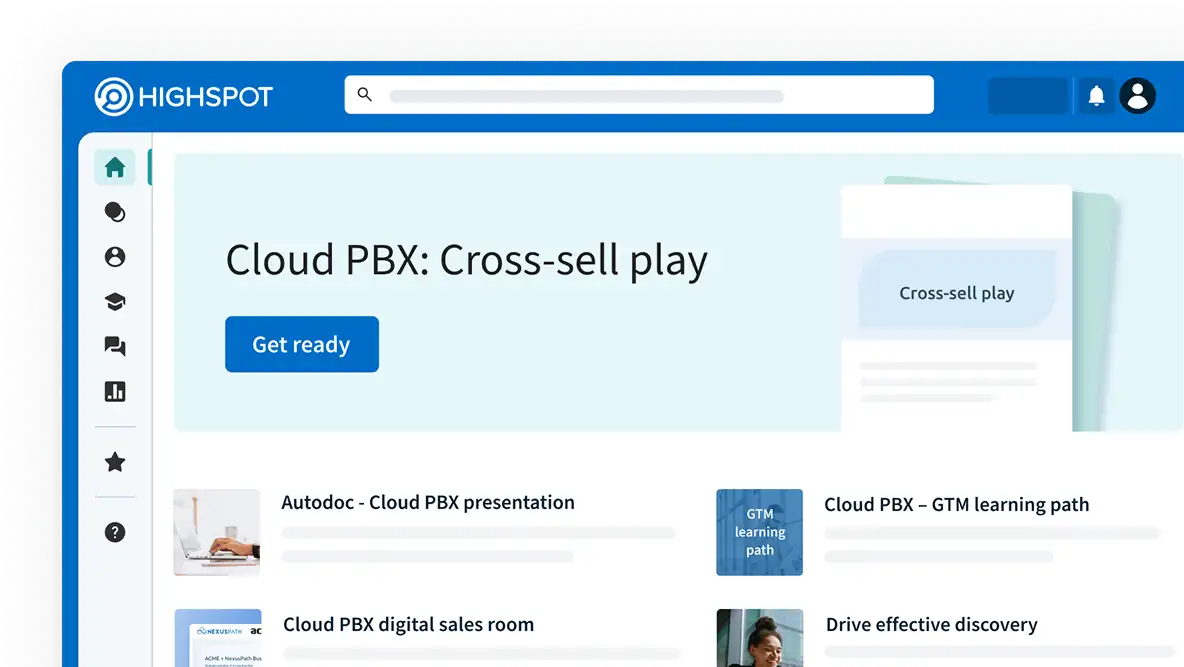
So we’re trying to provide a lot of those ideas. Typically, we have flyers of product ideas for those buying moments, and that’s mainly what’s housed in Highspot, to make it easier to just have a collection of ideas to inspire more of those discussions with our distributors and then also distributors with their customers.
The Sales Plays have been very, very important to us. It’s like a single source of truth now, that with our training, it helps keep everybody on the same page. It’s like how we position it, where we win, competitive insights, how to talk about it. When I was on the sales team, it was like, “What did they say? Who said that?” And it was a game of telephone.
So, now we have a one-stop shop, one resource that has all of the things all weaved together—the what to know, what to do, what to say, what to show. When I developed our quarterly sales playbook, put it in the same exact format, so that way everybody’s used to that exact same format of all the resources that we provide, which is kind of like a big Sales Play for everyone for the quarter for messaging.
RR: So it seems like the challenge is really less about navigating through an endless array of options, and more so about creating an efficient system for packaging and sharing out relevant materials that sellers can find and run with, depending upon the type of customer that they’re speaking with.
So with that little bit of frame of reference for the business about how PCNA operates, as well as what’s difficult about how it operates, Lanya, I’d love to hear from you about how some of these challenges show up in your work.
LT: Yeah. I would say my initial challenges are really in making sure that, like, the customer has the information that they need from the beginning, that they understand PCNA, and then getting to the place where they’re kind of comfortable placing the order, that they can kind of self-service, you know, go look for product themselves.
Of course, as the accounts do grow, it’s also important for me to be able to assist them based on their specific business and industry needs.
So, that’s kind of where the tools, like the Highspot tools that Nicole puts together, are super helpful because then I can go in and just grab something that’s maybe specific to, like, someone that has a healthcare client versus someone that has a corporate client.
RR: So we’ve heard a few challenges here, I think ones that make a lot of sense for the environment you’re working in. One thing I’m curious about is that while some of these challenges sound familiar, one thing that might not be familiar to a lot of folks is that you work in a pretty unique environment. It’s still very hands-on.
Nicole, as you mentioned, you’re often at trade shows. You’re supporting events. You’re boots on the ground with the sales teams handling in-person selling right alongside them.
So, what led you to decide that it was time to take a more digital approach, and why did Highspot come into the picture?
NZ: Going back to that gray area, we had resources. It was not easy to find. Our website is focused on finding and searching products, and even our own internal people have a hard time finding content on the website.
And the thing we really loved about Highspot is it reduces that searching time. People are able to find things really quickly.
We can put them into certain spots within Highspot. We can tag them. And the filters—I always say to anybody that I work on with hands-on training—filters are your friend, and it makes it really easy to quickly find the things that you’re looking for. And then when we send out things, like it could be our new summer lookbook, there are so many products in there, but the insights that someone gets of like, “They told me they were really interested in bags, but they spent five minutes over here on this golf,” that is a great way of a little lead generation to then set up and further those conversations and figure out that maybe that’s really what they were looking for.
Of course, using the, “Did you get my email first?” because you don’t wanna necessarily, oh, sound the alarms that you were looking at every single thing they were looking at. But that really helps us narrow down those options to then provide more value and get quickly to what the customer wants.
RR: I can definitely see that making a lot of sense as you look across a changing industry and realize, maybe there are some things that we could do differently, especially, you know, as you said, having been through the ringer as a seller yourself.
I also love that use case of engagement insights shaping your next steps, because to your point, you know, sometimes your customers come in with an idea of what they want, and then you share all sorts of wonderful, shiny options with them, and they go, “Well, hold on a minute. There’s a lot more I could get there.” So that’s really clever, and I like that a lot.
Lanya, I know that this kind of shows up a lot in your work. I’d love to hear how some of these digital-first tactics, things like Digital Rooms, impact the way you engage with or navigate accounts.
LT: So the way I onboard new accounts is a variety of different engagement methods. One of them is a cadence that I’ll take on new accounts, and I’ll drop them into this cadence.
It’s always an email first, then a phone touch call, and then, you know, a number of emails at the end there. And then, of course, customers can book calls with me whenever they want, whenever they’re available.
But in that original introductory email, I always have Highspot links in there, so important information that they need from the beginning.
One of them is our PCNA+ benefits program, which is, like, super important for them to know from the beginning that they have these specific benefits. They’re at a specific level, and they can use them anytime throughout the year. And then as they kind of go forward in the cadence, there is an email that also has a Digital Room.
That’s actually one that Nicole creates monthly with, you know, all this great information. And then that, I will go in, and I’ll edit it and kind of cater it more towards the new accounts, so then they also will have their PCNA+ benefits in there, as well as some additional information that’s just for new accounts.
So, they kind of have everything all in one space.
RR: And you’re certainly not the only one with a compelling Digital Room use case. Nicole, on the marketing side, you’re using Digital Rooms to support trade shows and events.
So, what does that look like for you, you know, when you’re building the Room, sharing it in an event, and then continuing to use it after the event?
NZ: So I actually just came back from one, and I’ll be working on my follow-up today. It starts with, I take that same Digital Room that’s been created, like, kind of like our monthly newsletter. That’s how we position it to our sales team. It kind of is taking our website, which is, think about your entire syllabus for the quarter or, like, whatever session you’re in for school, and then the CliffsNotes is our Digital Room.
So then I take that, and I will tailor it to that event: removing the content that maybe we didn’t talk about or that doesn’t necessarily make sense, and then I will link the things that we talked about with our agenda within that Digital Room.
And I already know what we’re gonna talk about when we get to these events ’cause it’s like a speed dating thing, and we already kind of set up, like, what we’re gonna talk about, unless they have something that they want to address with us.
So I take that, I make it a link share, and then I will put that link into a QR code. We then put it onto a flyer, and the flyer has, like, why PCNA, just some of, like, our high-level stuff, and then that flyer goes within a bag or something that we hand out to every single person. And it makes it really easy for my follow-up.
I take that exact same Digital Room, and then I will tweak it. So we do a thing called Brand Book, where we can take our look books and put a customer’s logo on every single product throughout. So then I will put that in there, a special link. That’s where I customize it per customer, and then we will send it out as the follow-up.
I copy their account rep on it, so that way they have their contact information. And once that’s sent over and I have the handoff and we have the follow-up for the sales team to take that lead and maybe there are some other tasks and items to help really dig into that account.
I will then switch and transfer the Digital Room over to them so they get all the insights and they can see, and then their information is hanging at the bottom, and I’m not their, their backbone. Their rep is their backbone.
RR: It sounds like you found a really tidy way of building an end-to-end event experience inside of that Digital Room. You know, at the event, it starts high level, aligned to the message and products you’re sharing at the event, so that anybody that happens to look at it would find value in it.
But then after the event, it becomes a very hyper-personalized experience where they can go in, see the vision and the value of their logo on your offerings. And as they build interest from that very personalized experience, you, as enablement, can hand it off naturally to the right person so that they can bring that account through to a successful purchase or to successful growth.
That’s a really great use case, and I’ve certainly heard folks using Digital Rooms for events, but I really like your approach here. Thinking broadly about how PCNA is using Digital Rooms and using Highspot, it really does sound like both of these strategies, you know, the onboarding Digital Rooms and the event-focused Digital Rooms, are really paying off for the organization.
Just looking at the data, PCNA drives really significant external engagement on a regular basis: 14,000 external views, over 400 hours of buyer engagement last we checked. It’s a lot. So what would you say has changed as a result of adding Highspot and these new digital-first tactics into your workflow?
Nicole, would you mind starting us off?
NZ: I think, so we do two forms of measurement. One of them is I like to look and see what someone is engaging with. I’m curious, you know? I usually call engagement—and this is probably not the most professional way—but it’s professional creeping. So you can see exactly what someone is looking at, because that engagement insights, you know, it’s a way to see that you’re actually hitting the mark.
And then we will also measure the sales of, or like how much more account growth we’ve seen from like six to 12 months after those events. So it’s really nice to see that engagement data is also aligning with the sales data afterwards, that we really are making those touchpoints with the customers, and also to see how long they look at those resources after the date.
There have been times where they are still looking at it six to 12 months afterwards, because it’s like the page that we made for them, they think it’s kind of like a website we made for them. So that has been really, really impactful. And then seeing our sales reps with that adoption and the ease of a Digital Room, that really, really helps.
And then, I mean, just I think being able to find what you’re looking for just in general, the sales reps love it. Anybody who’s new starts, it’s like, “Oh my gosh, this is so amazing. I love how I can find things really quickly.” And if I can’t find stuff, I go to Highspot. I think those are some of the big things that have really changed the way we work here.
RR: Yeah. And those are certainly big things. I’d love to double-click into what you shared there about using engagement data from your Digital Rooms and taking post-event interest and mapping it to sales outcomes down the line.
Can you walk us through how you’re making that connection between engaging with a content item or a specific product and then, you know, successful account growth?
NZ: So we get a list of who’s going to be attending. We pre-run sales numbers, so that way we pull our data from Salesforce, who the account manager is, how much, I think there’s like five years of sales data in there. Having like a little bit of insight so before we go to that event, and then as we kind of take notes throughout, we also will track them just knowing that they are a part of like this cadence of reporting.
And then I like to look at the engagement data, because I want to see if what we said during that meeting really matters. There was one lady who was really excited about one piece of content, and then she downloaded all the other pieces of content and really wasn’t as interested in it.
So I also report that out to our leadership team to show what things are really making an impact, and that also helps the marketing team in general. Like, is this something that’s really impactful? Should we be doing it next year? And if they’re not downloading it or we’re not seeing sales off of the things that we’re pitching, then maybe that’s not the right direction for us
RR: Amazing. Lanya, from your perspective, I’d love to hear what you feel has changed by introducing these digital tactics, things like Digital Rooms, into your workflow.
LT: Yeah. I would say what’s different is that new accounts now can have access to, like, really important information that’s curated for them, and it’s all in one place, so they’re, like, able to be informed more easily. They, you know, I can just send links to them instead of having to go in and pull individual documents and attachments.
And so it’s great for them. I actually get feedback from customers sometimes when they get the Digital Room from email that’s like, “This is so great. Thank you for all this information.”
And then for me, I know Nicole touched on this before, it’s really a huge time-saver, ’cause I don’t have to go into, like, different places and, you know, pull different things to send to them. I don’t really have to go, like, on the website and pull different products, which is, you know, really an undertaking when you do have to do that.
So those would be the biggest things.
RR: It really sounds like it’s kind of a double-edged sword, you know? These Digital Rooms improve the experience for your buyers, your accounts, and then it also just makes life easier for you as a seller, which is, I think, always the goal, because it allows you to move faster, it allows you to move more efficiently, which means in turn you can help more accounts be more successful, which is a win for both you and the business.
Nicole, as the steward of this strategy, what would you say is your proudest achievement with the platform?
NZ: Well, for one, everybody wants to be part of Highspot. But I would say it is that way we’re more connected. We have a one-stop shop resource of where all the things are, and my goal was that it would be that go-to spot.
And now when sales reps reach out to me, “Nicole, where is this?” “Nicole, can I find this?” Or, “How do I…” They said, “I’ve already checked Highspot.” That’s just a proud moment of showing that that has really been part of their daily routine. Our sales leadership is all in for Highspot, and every time we have something new, they wanna make sure it’s in there. So it is, like, our biggest go-to in our tech stack.
RR: Amazing. I’m very happy to hear that the platform is performing and creating that really high-impact alignment that every organization is looking to drive. Okay. So I think through both the onboarding strategy and then the event strategy that we talked about, we’ve probably built a little bit of FOMO for folks interested in Digital Rooms, but still kind of on the cusp of actually scaling it out.
I’d love to tap into some of the expertise that brought these strategies to life. Lanya, I’d love to start with you. For someone just getting started with Digital Rooms, what separates a good experience from a great one?
LT: I would say, I know we both touched on this a little bit, but really being able to, like, curate to your audience.
That’s what’s gonna make it a great experience for them instead of just something good and, like, maybe just some information that they might just browse through.
So, you know, make sure that you know, like, what product they’re looking for, what industries they’re working with, and then being able to go in and curate that content in Highspot, which is what, you know, Nicole and her team does really great, and being able to pull that specifically for that business type.
RR: Yeah, 100%, being intentional about your audience, what they need from you, and how you can support them is everything. That is so powerful in anything that you’re sending out to a prospect or a customer.
Nicole, on your end, for listeners that are in the process of digitizing a very traditionally hands-on sales process, what would you tell them to get right from the very beginning?
NZ: When you can align with what your go-to-market strategy is—I work on the marketing team. We have something called New HQ on our website. I take that outline, and I make it into the Digital Room for that month, and it really helps. That way, I’m not starting everything from scratch, and we are all uniform across the board.
So if a customer isn’t reading an email—how dare they? Or if they’re not necessarily scouring our website, then if we provide this digital resource, they can get to exactly what they want really quickly.
It makes it really easy for them to find those resources and have them and be ready to sell the items or position things to their customers.
RR: Yeah. Also great advice. You know, we talked about how Highspot can help you drive alignment, but when you’re intentional about that alignment and you’re making sure that everything you’re building maps back to the business’s broader message and goals, that takes you one step closer to a really robust, seamless go-to-market engine.
Lanya, Nicole, thank you so much for joining us today. It was absolutely wonderful speaking with you and learning a little bit more about the work happening at PCNA.
NZ: Thank you for having us.
RR: To our audience, thank you for listening to this episode of the Win/Win Podcast. Be sure to tune in next time for more insights on how you can maximize go-to-market success with Highspot.