

According to Gartner, sales organizations undergo an average of four transformations every two years. Of those, only 11% manage to drive commercial success. For the go-to-market organization, and especially for the enablement function within it, that statistic says a lot. Every single one of those transformations lands on their desk, and the ask is pretty much always the same: move quickly, keep the field informed, and make sure what they’re armed with is 100% accurate. So how do you build an enablement function that can keep up, especially as AI increases the pace of these transformations?
Riley Rogers: And welcome to the Win/Win Podcast. I’m your host, Riley Rogers. Join us as we dive into changing trends in the workplace and how to navigate them successfully.
Here to discuss this topic is Rebecca Sharbono, Senior Manager of Sales Enablement at Tanium. Thanks so much for joining us, Rebecca. I’m super excited to hear your take on this one. I know it’s very top of mind for you and the team.
Before we jump right into the deep end, could you tell us a little bit about yourself, your background, and your role?
Rebecca Sharbono: Riley, thank you so much for having me. As you mentioned, I’m an enablement leader at Tanium, a cybersecurity company. I spend a lot of my time training and enabling people across the go-to-market org and supporting business initiatives that scale across all those go-to-market teams.
I have spent years developing people across nonprofits and startups and large corporations. That moment when you see the light bulb go on for someone who’s learning something new or learning a different way to do something, watching them go from unsure to confident, and realizing that I got to play a small part of that, is huge, and that feeling never gets old.
Across all of my career, my rule is really simple: leave people better than you found them. And these days, what that means is figuring out how to help teams move at speed without losing trust and craft that makes people really good at their jobs.
RR: Let’s dig into it. As so many organizations, yours, mine, are grappling with AI innovation that is truly ceaseless, every day there’s something new, how are you seeing that affect Tanium’s go-to-market priorities?
RS: Wow, the struggle is real. What it comes down to is looking at it a couple different ways. Part of me looks at it through a product shift, and then part of me looks at it through a people shift. There’s a shift that’s happening with AI models and with products, and I know specifically with Highspot and with Tanium, there’s a lot of AI that’s in our products. And at the same time, it’s happening in how we build our people.
So we’re moving from this idea of we need to train experts to use a complex tool or process, such as Tanium or Highspot, to enable anyone to run at an expert level. When I tie it back to product, our AI platform lets one operator do what used to take a team. My job is making sure that our people, our field, can do the same thing, where they can walk in and perform like a team of experts faster than ever before. When I think about how AI plays into that, it isn’t just in how we sell anymore, it’s the mirror that we’re holding up in how we’re developing talent.
RR: I like that. It kind of drives home the point that, yes, it’s changing the way that we can do things, but it’s not changing necessarily what we’re doing. We’re still going to market with relatively similar products. We’re developing our people in similar ways. We just have some different mechanisms, and not only do we have different mechanisms, there’s different kind of priorities and pushes, by which I mean, as you’ve mentioned, we’re moving with greater precision, greater urgency.
Where is that pressure kind of coming from for you?
RS: This is coming from all over, much like the AI that’s being thrown out there. But I think at its core, there are three places where I can distill it down. Again, I go back to the product. AI-driven tools move faster than training cycles used to.
And then I think about the market as a whole. Customers now expect proof of value in weeks, not quarters, not months. They want to see that impact right away.
And then the people. Today’s talent doesn’t want a six-month onboarding. They don’t want a two-month onboarding. They want to be useful in week one. And I think what’s interesting is that enablement really sits at the center of all three of these things.
RR: I would like to think about this through the lens of a recent example, and maybe slightly less recent now, because again, to the point of new things every day. But given the industry that you’re in, monumental change in the models that are available can send shockwaves through your workforce and your customers, a good example being the release of Claude’s Mythos model.
So can you walk us through what it looks like on the enablement side when something so significant drops in your industry?
RS: Tanium is a cybersecurity company. We sit within the IT industry, and what we do is help businesses connect their endpoints and have full visibility in real time. Taking a step back a moment, the release of industry disruptors like Mythos, whatever the next thing is, really shows us that the tool capability jumps are now arriving so much faster than most organizations can absorb them, and this is a pressure point.
Every time a Mythos level model drops, the ceiling on what’s possible jumps overnight. With that, people’s readiness to speak to it doesn’t jump with it. So what the field needs isn’t necessarily training on the new model, it’s judgment training. They need to know what it means, what it’s capable of, and what it’s not, because the gap changes every few months.
So specifically with Mythos, what we identified the field as needing in that moment were a few different things, but they needed them really fast. That goes back to that speed we talked about earlier. They needed to know the capability as a foundation, “Hey, what is this? What does it mean,” so that we can position ourselves as a trusted advisor when we’re talking with prospects and customers.
They needed to know the impact, because if they’re talking to a CISO and a SOC analyst, they’re gonna have very different questions, different fears, different requirements for that conversation, and we needed to make sure our field was armed with those right conversations based on the persona they were gonna be speaking with.
When we got word that this was released, we stood up an enablement package within, I think it was, a 48-hour timeframe. It was all hands on deck. We had analyst themes to start building the foundation off of, and their insights to work from. Teams across the company, product, enablement, sales, pre-sales, you name it, jumped in to provide the right talk tracks and help us build FAQs. And then we launched everything with a field activation brief just a few days later.
RR: As we talked about, you need to move fast, but up until recently, you didn’t necessarily have all of the tools in the toolkit to move quite as quickly as you needed.
So what resources and support were the field working with, and what did you see kind of not working?
RS: We didn’t have a way to ensure that the field had the most up-to-date information. While we were housing stuff on SharePoint, sometimes if a seller would go in and try to search for a piece of information, it may have pulled something up that was from two years ago, and things change at lightning speed, as we know and as we’ve been talking about. So that was a huge gap.
We had ways to create content and measure some activity, but the speed and the impact together, we didn’t have that in real time. And as you can imagine, there were decisions that were being made on instinct or lagging data because the feedback loop just didn’t exist yet.
RR: As you were tackling that beast and started building a new way forward focused on speed, what were your early priorities, and how did you get started breaking that down into manageable bits and pieces?
RS: It truly is, hey, what’s the endpoint that we’re trying to get to, and then what does that mean for us and how do we prioritize how to get there? When speed becomes a priority, many times I see people creating more stuff. You don’t start with more content. What you need to do is start with clarity.
So looking at where the pain was loudest at that time was really important. We’re hearing from sellers that they don’t have what they need. They can’t find the information at the speed they need it. Those were pretty loud pain points right out the get-go.
So the first priority is figuring out how we actually move the needle and identify what’s mission critical versus nice to have. Secondly, building the fastest possible feedback loop so that we know within days, not quarters or weeks, if something is working or not. That was really important too, to figure out we need to identify a test group, a beta group, once we’ve looked at some different solutions to get feedback.
And thirdly, we have to make it usable by one person without hand-holding, because if it needs an expert to drive it, to understand it, to use it, it’s not actually fast. Those were some of the things that were rattling through my brain as we figured out how to build that foundation, prioritize what we needed, and how we got started.
RR: You did the work to figure out what the path forward was. You spoke with people to understand what they needed. You essentially built the vision. Once you started to understand what the North Star was, what were those first few components that you needed to tackle once you had landed on a solution?
What is the go-forward plan there?
RS: It was basically how fast can we get this thing implemented. The field needed it. The enablement team needed it, especially when we were thinking about how we’re running training at scale. We’re a global company, so how do we make sure that there’s consistency and standardization across all of the team, not just sections or segments of the team?
We were looking at what tools could help us solve for these things, and we landed with Highspot. It came down to that usability piece and how easy it was for anyone to be able to use the tool, and it’s been awesome to work with the team.
We had a very quick turnaround. We started implementation late October, early November, and then we did a soft launch in December, ’cause we had some initiatives coming out that we wanted to make sure we got into Highspot and started pointing people to the platform. And then we are gonna do a full hard launch at our sales kickoff event in February. We saw some really amazing results early, right away after that launch.
RR: I would be curious too, knowing that it’s relatively recently stood up, but you’ve also encountered big moments like that launch of Mythos since it was stood up. So without that work to get it out at an accelerated pace to launch Highspot early, what would it have looked like to tackle that moment?
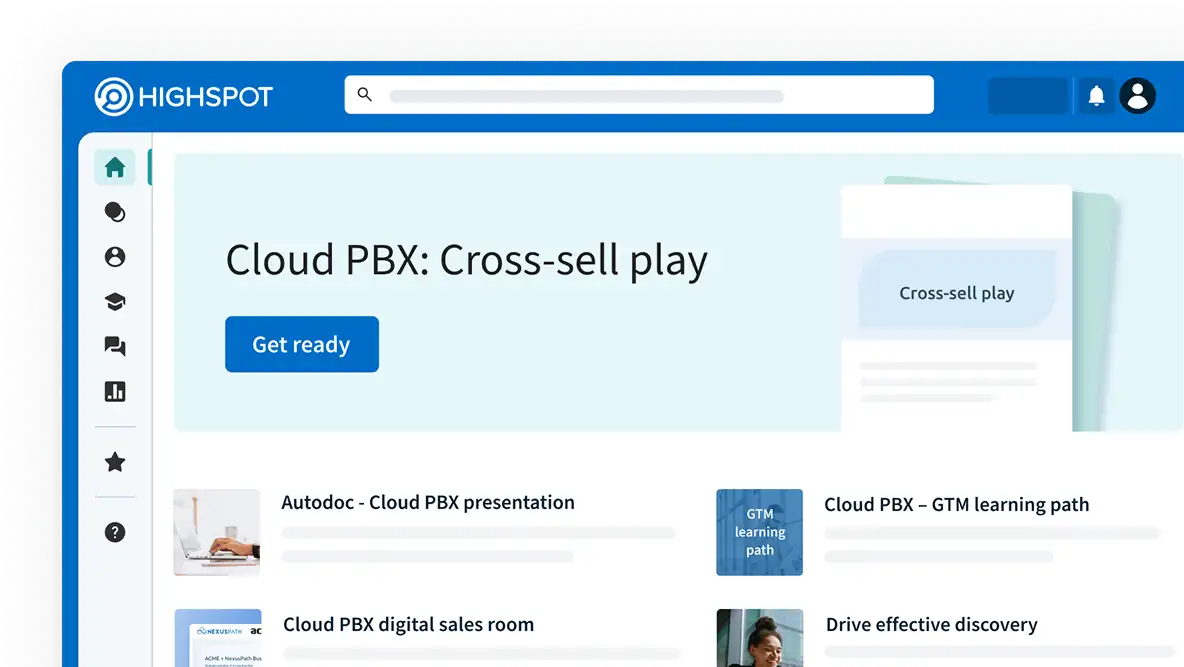
RS: Oh man, I don’t even want to think about that. No, I’m just kidding. It would’ve looked very different, because one of the initial things we did with Mythos was stand up a Highspot page where we could house all the information, the talk tracks, whatever, the FAQs. That response time is huge, and honestly, if we didn’t have Highspot in place at that time, it probably would’ve felt a little bit disjointed.
We would’ve had to figure out, okay, where are we sending the field to look for these things? What’s the instruction there? What are we telling them to do? And one thing that’s really easy with the Highspot Sales Play is the what to know, what to say, what to show, what to do, and that makes it so easy for, if I’m a seller, to go in and know exactly those steps, and where I can walk away feeling equipped and empowered to go and have that conversation.
Tying back to your original question, I just don’t think we could’ve stood something up fast enough.
RR: Well, I’m glad you had that on deck when straits were dire and things were tough. I want to loop back to something that you shared early on that I thought was a really interesting point, which is that it’s not necessarily that the way that things were done before was wrong, bad, not strategic. It just was built for a different kind of working.
So what does it look like to you now when you’re bringing AI into your workflows so you can match the speed that the business is asking you for?
RS: When I talk about the different pace of the business, it looks like moving from batch to real time. If you’re not familiar with batch, it’s like, okay, we’re gonna build this thing. We’re going to take time to do this, to get it built out. We’ll get the feedback at the QBRs that are happening, and then we’ll launch this thing a few weeks before that. It’s very much build the whole thing out and then deploy it at one time, versus real time.
So traditional enablement was built in sort of that batch cycle. AI collapses that entire cycle. Think about it as we can build training faster, we can personalize it to the seller in the moment they need it, and then we almost instantly know whether it’s landing instead of waiting a few months till our next offsite or something.
So the workflow doesn’t just get faster, it almost gets a new nervous system, something it’s never had before. And I think that’s the real unlock when I think about it. Not AI writing content for you, it’s AI closing the loop between what you built and what worked.
RR: Okay. So knowing that AI has, again, created a new nervous system, to your point, for the work that you do and the way that you deploy it, I’d be curious to hear about some of the capabilities that you’re leveraging with Highspot that fall into that AI camp. Things like Role Play, things like lesson generation.
What do you see these capabilities unlocking for you and the team?
RS: Couple of things come to mind. The ability to get more reps. Reps get more reps, and I think about things like AI Role Play, where they can go in and practice, build confidence, and feel super equipped before they even have a conversation out in the wild, and that is such a game changer. This means they don’t have to schedule time with their manager to run something. They’re not waiting for a coaching slot. Whatever it is, they can literally go into the platform, and as many times as they need, get those reps in.
The lesson generation definitely accelerates the build, and it’s a competitive shift, I think, in the market when it comes to building training. That’s been super helpful because now you can stand up training within hours, sometimes minutes, at least the initial lesson, and not weeks.
When I started, we were building online trainings, and we would have these cycles that would last up to 10 weeks. You think about that, you get the scope of the project. You start the project, you’re working on it, you have all these feedback touchpoints, and then 10 weeks later you have the package, and by that time, stuff could completely be different because it’s now taken you over two months to produce something. With AI, and using things like the lesson builder and the AI Role Play, we have poured accelerant on how we build and develop training.
RR: With the lesson generation, have you used that to build any recent training experiences, courses, et cetera? What have you used it for?
RS: I’ve used it for things like SKO pre-work, but we’ve also used it for our onboarding. We just redesigned our sales onboarding this past quarter. We redesigned our SDR onboarding, and we redesigned our pre-sales onboarding. Right now, it’s all built in Highspot, so that lesson generator came in super handy for some of those lessons.
RR: Yeah, especially going back to thinking, 10 weeks to build a learning experience, and you just listed off three key ones there. It would’ve been a lot of building. Looking at how much has been built in a few months, we’re still in the under-a-year phase.
What is the biggest impact you’ve seen from all of the work we’ve talked about?
RS: We now have a centralized hub that we can send all of our go-to-market teams to, and we have that real-time visibility and those analytics to help us make better-informed, data-driven decisions going forward. I think one of the clearest proof points, and this is a really simple one, it’s very basic, but our findability ratio of 18.2 to one, which means every minute an individual spends searching for content, they’ll spend over 18 minutes actually using it, means that they are able to find what they need in real time. Sellers aren’t gonna waste time hunting for the right piece of content. They’re actually gonna be able to spend time selling, which is what they’re supposed to be doing.
In addition to that, some of the impact we’re seeing downstream: over 5,000 pitches sent, nearly 300 Digital Rooms built for customers and prospects, and more than 400 hours of external dwell time across over 8,000 shared items. Those are all huge things. Just the fact that we even have those numbers and can speak to them is mind-boggling because we had nothing like that prior, where we could literally say, “Hey, here’s how many pieces of content our prospects and customers are engaging with.” We had nothing close to that level of data.
It’s proof that our buyers are engaging with what we’re putting in front of them. It’s proof that our sellers are engaging with what we’re putting in front of them. And honestly, Highspot has been the backbone of all of that.
RR: It’s amazing the granularity that you can get now. And beyond that, with those numbers in play, you can then start to think a little bit differently about what to do next, because you have those guiding numbers to say, “People are taking the actions that we want them to.”
But as we’re coming to our close, I would love if you could leave us with one takeaway for any other enablement leader that’s struggling to keep up. What would you want them to hear?
RS: Yeah. First of all, you don’t have to have it all figured out. Let’s just ground in that. It’s a learning process. Sometimes we’ll fail, and sometimes we’ll knock it out of the park. So I would just start with that.
Also, I think what’s really important is just building the loop that tells you what’s working, ’cause speed without that visibility is just chaos with good intentions. Let that sink in just a little bit.
But start small, prove it fast, and let the data build your confidence instead of your guesswork. Honestly, for me, it just ties back to why, why are you doing this? Never lose sight of why you’re doing this. And for me, it’s simple, that leaving people better than how I found them is so huge. And while the tools keep changing, the why you’re doing it, that’s not gonna change.
RR: What a perfect full circle, and we brought it all the way back to the beginning. All we’re doing is building people up, building them better, and I think that has really come through in everything you shared. I’m sure your sellers appreciate you, and I know I appreciate you for taking the time to come and share what you’ve been working on. It’s been really great to hear what your world looks like.
RS: Thank you so much, Riley.
RR: To our audience, thank you for listening to this episode of the Win/Win Podcast. Be sure to tune in next time for more insights on how you can maximize go-to-market success with Highspot.