

According to Salesforce, sales professionals spend up to 40% of their time searching for the information and knowledge they need to do their jobs. For go-to-market teams stretched across multiple products, multiple acquired businesses, and a sprawling tech stack, that number can feel like a conservative estimate.
So how does a solo enabler cut through the chaos and build something an entire go-to-market organization actually uses and actually trusts?
Riley Rogers: Hi, and welcome to the Win/Win Podcast. I’m your host, Riley Rogers. Join us as we dive into changing trends in the workplace and how to navigate them successfully.
Here to discuss this topic is Heather Darling, senior sales learning and development manager at HSI. Thanks so much for joining us today, Heather. Super excited to have you here.
Wondering if you can kick us off and just tell us a little bit about yourself, your background, and your role.
Heather Darling: Yeah, absolutely, and thank you so much for having me, Riley. Appreciate it. My background actually started on the customer side. I spent a few years in customer success at HSI, working directly with our customers, building relationships, identifying growth opportunities, and helping them drive product adoption.
So over time, I realized I really loved helping teams get better at that work and not just doing it myself. So I got my master’s, and I moved into the sales learning and development role, where I now design onboarding and ongoing learning for our sales reps and CSMs. And a big focus for me is practical application, so I spend a lot of time building programs around how to position our solutions with buyers, how to teach reps about our solutions without overwhelming them with information that they don’t need.
Recently, I’ve been focusing on how AI can help sales teams show up more strategically with customers, so I’m really focused on how you turn enablement into something that actually changes behavior. And because I came from customer success, I think a lot about the full customer life cycle. So a lot of my work is in helping teams connect the dots across sales, onboarding, and long-term success.
In enablement, I just think it’s important to focus beyond training and think about how we build a culture where people are continuously improving.
RR: Your intro tells me we’re going to have a great conversation about how you’re bringing all of that to life. But before we do, I’d love if you could maybe give us just a little high-level view of HSI, just so we have a little bit of a framework as we’re going into the conversation.
HD: HSI is a workplace safety training and compliance company in the environmental health and safety space. Ultimately, our goal is to help companies operate safer, smarter, and with less complexity. So we sell to SMB and enterprise organizations across a wide range of industries. Within those companies, our buyers are typically EHS leaders, HR and L&D teams, and operations leaders.
So basically anyone who’s responsible for tracking workforce performance, compliance, and risk.
RR: Love it, and that is, to your point, just about every company aims to do that, so broad customer base to serve, broad prospect base to target. One thing that you mentioned to me when we spoke last was that HSI’s growth has come from acquisition.
So can you tell us a little bit about what’s challenging about working in an environment that’s constantly changing and trying to enable your teams through that change?
HD: Honestly, it’s a tough environment to run enablement in. Growing through acquisition, you’re constantly dealing with new products, old branding, different messaging, new systems, and even different workplace cultures converging.
So, it sometimes feels like nothing is ever fully standardized. You’re always evolving, working towards a moving target, and the teams are always needing to absorb new information. So you’re trying to help reps understand what to sell, how it fits together, and how to tell a simple story even when the business itself is still getting aligned.
On top of that, priorities are shifting with a moment’s notice, products are getting rebranded, positioning is evolving. So enablement needs to stay really plugged into the business and be flexible. There’s long periods of waiting to bring a new product to market sometimes, and then suddenly it’s go time, and you need to be ready, and you have to get everyone else ready.
At the end of the day, it’s just a balance between driving consistency and accepting that some level of change is always gonna be your reality. So if you wanna be successful without driving yourself crazy, you work to have a structure in place to bring consistency to your own role in those moments.
RR: I would love to know what your personal process for creating consistency amid that chaos is. I think that’s something that’s often challenging to do.
HD: That’s a good question. I spend a lot of time meeting with our leaders. I touch base with them at least once a month. I go to team meetings when I can.
I just try to stay as plugged in as possible to all the different things that are happening within the organization. For me personally too, I have a mission, vision, and values for my team of one, and so it’s a touchstone for me to go back to. Like, “Hey, am I meeting the goals and the principles that I’ve set out for myself?”
Make sure that we’re doing the things that are not out of scope, but also that we are doing the things that we need to be doing to address what’s happening at the moment.
RR: I think that’s one of the things that’s really hard, and something that when you talk to solo enablers is probably one of the hardest things, is that wherever you are, enablement is a game of change.
It’s a never ending project. There’s always new things for people to learn, always new things for people to do. But when it is just you, and when things are changing fast, staying true to those north stars and that scope that you’ve set, beginning of the year, beginning of fiscal, gets hard.
So I really appreciate those tips for how to maintain structure, how to not go crazy, and how to keep yourself on a path that supports your work and the business. So thank you for that.
You alluded to a little bit of this in your introduction. Acquisitions aren’t easy. They add new product lines, they add new collateral, they add all sorts of different branding, messaging, et cetera.
So what are you seeing that cause for reps?
HD: For reps, I think the biggest challenge is just suddenly they’ve got a bigger portfolio of things that they can sell, but it’s not always clear how the pieces fit together, what they need to lead with. If you’re not on top of that as an organization, rep’s confidence drops, your sales cycles get longer.
You tend to see people fall back on doing and selling what they already know. People can be reluctant to bring up a new solution that they might feel like they don’t fully understand. And so again, I think that’s where it’s really important to make sure all those pieces are in place as much as possible before you bring the reps in, because they don’t fully understand something, they don’t feel confident in talking about it, so sometimes those new solutions, they don’t get brought up as much as they should.
That’s definitely a challenge. For the broader go-to-market team, it creates a lot of inconsistency too. We’ve got different messaging, different positioning, overlapping collateral. It’s really easy for marketing, sales, and customer success to get slightly out of sync, and that shows up pretty quickly in the customer experience.
Your risk really with that is not a lack of resources, it’s almost in having too many. It makes it hard for people to find or trust what’s relevant. So you might have reps sharing old collateral with legacy branding because they feel comfortable, they feel like that’s something that they trust.
They’re measured on results, so when something is working for them, they don’t wanna risk messing that up. And so change can feel like it really slows them down or it puts deals at risk. So when you’re introducing new products, new positioning, or new tools, especially all at once, that can create some hesitation.
Reps are gonna tend to default back to what they know, what they trust, what they’re comfortable talking about.
RR: Hearing all of those challenges and also some of those questions that you asked, when there are so many priorities swirling around, so many new things coming in, how do you find that clarity, and how do you create that clarity?
And I think one of the things that you shared was an answer to that was, “We needed some tooling.” And so you started looking for some tools to help with that, that problem of reps don’t feel confident with our new solutions. And so I think you were looking initially maybe for something more aligned to an onboarding tool, and then you wound up here with a sales enablement platform.
HD: Yeah. Yeah, it was an interesting shift because early on I really was thinking about this as an onboarding problem. So how do we get new reps ramped faster, especially with how complex our business has become? But as I got deeper into it, I realized that the bigger issue wasn’t just onboarding, it’s ongoing development, coaching, creating and tracking certifications.
So the challenge doesn’t stop after those first 30, 60, or 90 days. The business is still changing. We’re adding new products all the time, messaging keeps evolving, and that can be really a struggle for reps to keep up with. So there’s just so much information coming at them about buyers and products, and not to mention our internal processes that can sometimes change on a moment’s notice.
So my thinking shifted from how do we ramp people to how do we continuously enable reps in a way that makes it easy for them to consume and keep up with the pace of the business? I didn’t really know, I think, that enablement platforms were something that existed. Turns out that in addition to hosting ongoing learning and coaching, an enablement platform could help us centralize content, which is something that we were really struggling with actually.
So it really became clear that what I thought I wanted was actually not what I wanted.
RR: So when you did land here, and you found there is a tool that will support not just the initial ramp-up on a difficult business to learn, but also will keep our reps continually enabled, everboarding as things change, and then also able to access all of the content, resources, et cetera, that they need.
So you found something that worked, but that’s only step one. The next one is getting approval, getting the internal buy-in that this is the right choice, and it sounded like there was some degree of internal skepticism. There was a worry that it wouldn’t work.
So how did you make the case for enablement platform and say, “We need this. It’s worth it. I promise you, it’ll, it’ll work out the way we want it to”?
HD: We’ve had some challenges with platform adoption in the past, and so there was definitely some skepticism in the organization. And it’s always tempting to, we have a problem, let’s throw a tool at it. So I think for us, the turning point was reframing the problem.
So instead of just, “Hey, we need a new tool to address this,” it was a focus on what the leaders were already feeling and seeing, which was longer ramp times, inconsistent messaging and branding, reps struggling to navigate a more complex sales cycle and complex sales processes.
So we were incredibly lucky to find an internal champion, somebody high up and respected in the organization who also saw the problems that the sales org was facing firsthand. He believed in the impact that Highspot could have and really helped us connect the dots across leadership teams, and that made a big difference in building internal momentum and credibility.
When we could confidently say, “This helps us ramp reps faster and has the potential to increase cross-sell by even 10 or 15%,” that conversation shifted pretty quickly, and at that point, it was about solving a real business problem.
RR: Yeah, and there are a couple of really, I think, compelling things that anybody who’s trying to make a business case really for anything but for an enablement platform, expanding an enablement platform, anything like that. One, have a champion. That’s so huge when you have somebody who can speak the language of everybody else that you need to get bought in.
Two, be able to reframe it to the value to you, as opposed to, yes, we have problems, but what would it look like in a future state if we didn’t have those problems? And so once you did have that, that buy-in, you had that moment where everybody was like, “Okay, we see the vision. Let’s move forward.”
How did you drive adoption?
HD: We, like I said, we’ve had a history of challenging or failed software adoptions, so I think that goes back to the idea of sales reps being a little allergic to change. So we definitely had some skepticism. And I got that. I was nervous about it.
I had put myself on the line. So knowing that, I was just really intentional up front. I spent a lot of time organizing things the right way, building out Spots, overviews, Sales Plays, and Digital Room templates so that when our reps got in there, it actually made sense and it felt cohesive to them, like something that they understood and that they could use.
So I created pages that, as much as possible, mirrored a lot of our internal and external resources, so it looked familiar. We used team homepages that linked to a lot of the other sites outside of Highspot that they use in their daily lives. We were integrated with Gong and Salesforce, which added a lot of value for them.
So it was something where you could come in in the morning, you could open up your Highspot, you could have your links out to some of the other resources that you need, and you could start your day there. I also didn’t just blast it out to the entire organization at once. I launched to a small group of reps and got their feedback, made some adjustments based on that, and then after about a month, I started rolling it out more broadly.
I spent some time with each team, walked them through some of how to use Highspot, answered their questions, got them set up linking all of their accounts and setting up profiles to make sure everything was ready to go, because I wanted to make it easy for them to engage with it and to be ready to use it to engage with their buyers.
We started off slow, but reps started to see the payoff. So it was easier to find what they needed. That was really helpful. And at the same time, we gave them the ability to see how their prospects were engaging with content that they shared. That’s when I think it clicked for a lot of them.
And at the same time, we reinforced that internally. So I trained our internal teams, like marketing, finance, sales ops, to point reps back to Highspot. So anytime they were asking for help locating content or processes, I asked them, “Hey, instead of giving them the answer, please let them know that it’s in Highspot and that they can easily find it.”
I started to feel the shift a few months in. We would be in meetings, and people would say things like, “Hey, make sure that document you just showed us gets into Highspot.” Like, “Can you drop this PowerPoint deck in Highspot?” That’s when I knew we had crossed a line. It stopped being something that I was pushing, and it became the source of truth that sales team had been missing.
RR: Can you walk us through what you built, what the platform looks like today, and then what you would point to as some of the things that have contributed to the success you’ve found so far?
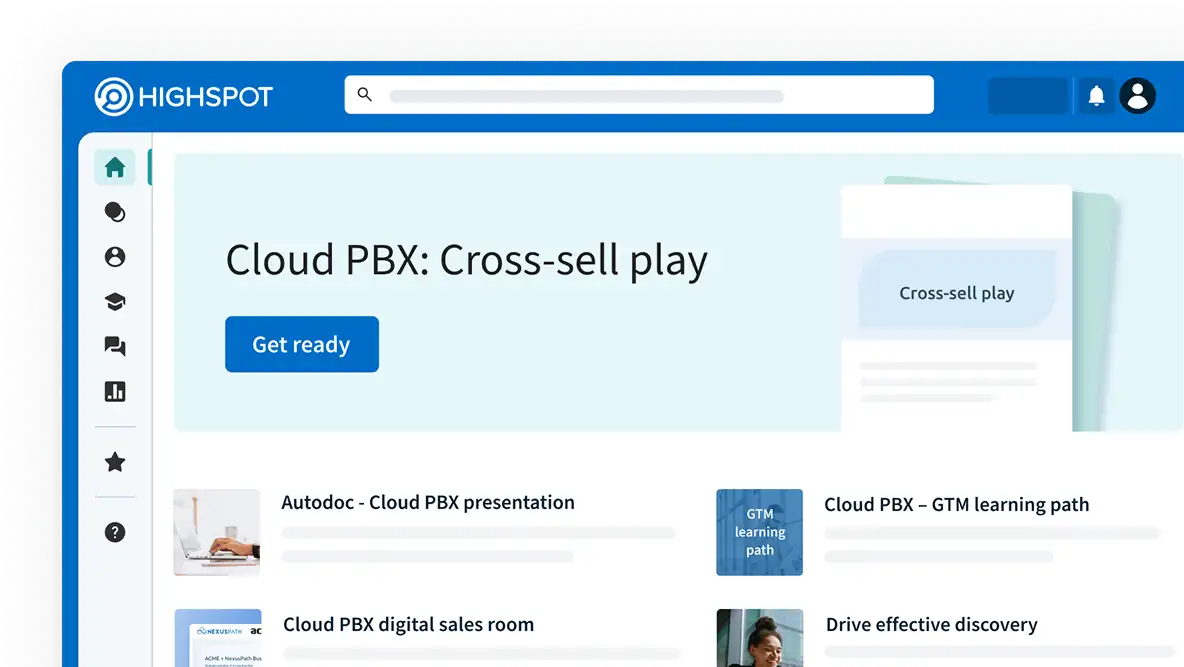
HD: The platform today is the central hub for how our go-to-market teams operate. We’ve got structured Spots with clear overviews, Sales Plays for all of our solutions, Digital Rooms that they’re using directly with customers.
It’s really become the place where a lot of work happens. So as far as what’s driven the success, I think the biggest thing for me is having the right mindset. This isn’t a set it and forget it project. If you go in, I guess, thinking like, “Hey, I’m gonna be done with this at some point,” it’s not gonna work.
It gets easier to manage over time, for sure, but it should always be evolving as your organization evolves, because you really have to keep refining, updating, and listening to your internal stakeholders. That ongoing care and feeding is what actually makes it stick and provides ongoing value.
RR: And that’s, I think, the bitter truth of enablement, is that you’re constantly driving to all of these goals, new objectives that come up, and you hit one and you go, “Great. We’re done.” And then there’s a new one that comes in, and all of a sudden, again, you have that bomb of Sales Play training, Digital Room template that I need to build and equip my reps to get out there and drive that new initiative.
So I think you’re 100% right to say that that is the right approach. And I would be curious, just because it sounds like in our conversation so far, you’re a firm believer that enablement is the connective tissue between marketing, sales, some other go-to-market functions that you called out.
And you mentioned being in team calls and keeping a good pulse on the organization, but how have you built such strong connections between all of these teams and the leaders behind them?
HD: Yeah, that’s a great question. A lot of what enablement does is really connect those dots across the business.
And so for me, it just comes down to staying close to the work. I’m regularly attending team meetings. I’m joining product updates. I’m meeting with sales leaders on a monthly basis. I try to spend time one-on-one with our reps as much as I can, just to understand what they’re dealing with day to day.
And that builds trust, but it also keeps me grounded in what they actually need and not just what I think they need. More importantly, I’m just thinking about how it can solve real problems for the different teams. So whether that’s helping marketing get their messaging in front of reps or giving sales ops and finance a better way to communicate priorities, it becomes a shared tool.
Not just a sales tool, but a way for everybody to get things in front of sales when they need to have their attention or they need something that’s going to live somewhere people can easily access it. And I think that’s really where the connective tissue happens. When those stakeholders see Highspot and enablement more broadly as a way to amplify their own work and reach across teams, they lean in, and at that point, it stops feeling like enablement is a separate function, and it starts to just feel like part of how the business runs.
RR: I really appreciate that call-out that you have to be able to put yourself in the shoes of your partners, understanding what they’re prioritizing, understanding what their KPIs are, what their goals are, what they’re driving towards, and then how can I serve that?
It sounds like you’ve gotten to a point that you can be proud of, and I would really love to hear a little bit more about what business impact or achievements are you proudest of?
HD: Yeah. This past year has been really exciting for us with Highspot, just to see the level of adoption and to see how often people refer to it.
When we first rolled it out, our goal wasn’t just adoption. It was actually to change how our reps sell and how our buyers experience us, and we’re really starting to see that come to life. We have reached 100% adoption across our North American team, which is great, but what I’m most proud of is it’s not just surface level usage.
The reps who are leaning in the most are seeing real results. So for example, reps who complete our learning path certifications are winning 15 to 20% more often. They’re generating more revenue because they’re creating and closing more opportunities. There’s a similar story with our Sales Plays.
So the reps who use them are consistently outperforming. And on the buyer side, we’ve completely changed how we show up. We’ve had over 6,000 external shares this year, including more than 2,000 Digital Rooms that have gone out, and those are not only sales meeting follow-ups. Reps are using them for everything from onboarding new customers to supporting partners to running webinar follow-ups and supporting platform migration campaigns.
Reps are seeing exactly how buyers are engaging with what they’re looking at, what’s resonating, and that helps them coach their champions internally. So it’s a much more informed, more intentional way of selling. Overall, it feels like we’ve built a system that’s actually driving better selling behaviors and better outcomes.
RR: I think the thing that’s most powerful about what you shared just there is when you were talking about how did we earn buy-in.
And you walked us through how you made that reframe, and you showed here is what is possible. And I think you threw out something there, like, “What if we could improve cross-sell by 15%?” And you can look at your data today and say, “Our training is actually increasing the number of opportunities we can create.”
So that initial stretch goal that you set to earn buy-in on the vision, you have achieved, and you can prove it out, which is crazy, and I hope feels very gratifying.
So with a strong environment in place, high adoption, less content chaos, an easy way to get folks ramped up, what’s next?
HD: Yeah. I mean, we’re in a good spot right now. I’ve been able to start to have some fun with things because the foundation is there. Adoption is pretty strong, so the focus right now is really shifting to impact. So a big area for me right now is expanding learning, and that’s what I set out to do over a year ago.
So I’m building structured learning paths with certifications so reps can prove readiness across different parts of our solution set. So ironically, my project had to take a bit of a backseat to building out the other areas of the platform, but I think that had to happen first to drive that learning portion and to see success there.
So we’re also starting to scale globally. We are bringing our EMEA team into Highspot in a way that aligns with how HSI as an organization operates but also still respects the differences in their processes and products. We’ve started to explore the AI coaching functions, which is really exciting.
So the goal there is to help reps tighten up their messaging faster, especially around product launches, and to support both onboarding and ongoing development. And at the same time, a lot of the focus is just continuing to evolve what we’ve already built, finding new ways to add value, keeping content fresh, refining Digital Rooms, making sure content stays aligned with the business.
So I’m always diving into analytics to determine some new ways to deliver value and prove impact. I think it goes back to the idea that this isn’t a project with a defined endpoint, so our Highspot will always be evolving in the same way our products and our sales org is evolving, and I think that’s what makes it such a successful and valuable resource.
RR: Such a full circle point to end on.
There’s a lot to look forward to, and the one truth and the one consistent factor is that it’s gonna change, and you’re going to adapt. So who knows what’s coming next specifically, but it sounds like you’re ready to face it when it does come.
Heather, it has been so wonderful to hear about your journey, the work that you’ve been doing, the way it’s showing up for HSI, so thank you so much for taking the time to come and share, and give us a little bit of a peek into your world.
HD: Yeah, absolutely. So happy to be here. Thank you so much, Riley.
RR: No, thank you. And to our listeners, thank you for tuning into this episode of the Win/Win Podcast. Be sure to tune in next time for more insights on how you can maximize go-to-market success with Highspot.