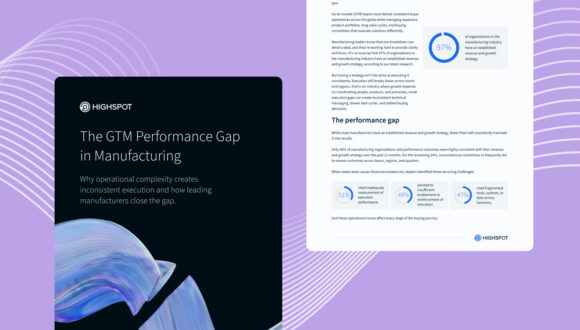


According to Highspot’s Go-To-Market Gap Report, 98% of leaders say their GTM strategy is active, but only 10% see it driving results. The reason for that? Strategy abounds. Real meaningful execution, not so much. So how do you overcome the go-to-market performance gap and bridge that growing rift between strategy and execution?
Riley Rogers: Hi, and welcome to the Win/Win Podcast. I’m your host, Riley Rogers. Join us as we dive into changing trends in the workplace and how to navigate them successfully.
Here to discuss this topic is Jacob Keith, senior revenue enablement specialist at HealthJoy. Thank you so much for joining us today, Jacob. I’m super excited to dive into your experience. So could you kick us off just by sharing a little bit about yourself, your background, and the role you’re in currently?
Jacob Keeth: Yeah, absolutely. Also, Riley, thanks so much for having me on. I’m really grateful and excited that we get the chance to chat about something so consequential and oddly kind of fun. So I’m just looking forward to it.
My name’s Jacob. Professionally speaking, I’ve been working in enablement for just shy of five years and worked in sales for a year prior to that doing SDR prospecting work. I’ve done all types of enablement, everything from onboarding-focused work to focusing on BDRs and prospecting.
Now at my current company, HealthJoy, it’s been so much fun. We’re operating in primarily a channel sales method, so we’re working through individuals who then sell our product, which has been a really fun and complicated task from the enablement perspective. We’ll dive all into that today.
RR: Awesome. So exciting that you’re in a role that’s challenging you and building on all of those skills that you were learning and picking up along the way.
Before we jump in, I’d love if you could set the stage for those of us not familiar with HealthJoy—who you are, what you do, who you serve, and then maybe a little bit of that sales motion that you touched on.
JK: HealthJoy is a benefits operating system, and really what we do is help make sure that companies’ benefits strategies and plans actually work as designed.
What do I mean by that?
Well, I’m sure, Riley, as you’ve experienced too, companies typically have a pretty fragmented benefits plan, right? There’s the medical plan, the dental plan, maybe individual solutions. Usually these companies all have different logins, different ways to access them, and there’s not necessarily a concrete place where you can go to get all that information inside of one environment.
Also, the reality is, if I’m debating whether I need to go to the ER right now, I can tell you the last place I’m gonna go is logging into my company’s intranet to figure out which ER is best applicable to me and which one is likely gonna work with my insurance. We make healthcare decisions through the path of least resistance, and frankly, they’re usually made in situations where we don’t have the luxury of time.
This is really where HealthJoy can come in.
With HealthJoy, companies can unite that benefits ecosystem into one seamless platform. We use an AI assistant called Joy AI, as well as human concierges, to give our end members or employees personalized guidance and proactive support.
That’s really where HealthJoy finds itself: being that benefits operating system that puts everything together and helps you, Riley, make the right decision at the right time. So that’s the big-picture view of what the company is and what we do.
Now, how do we actually do it?
The way HealthJoy operates is we work through what you’d call a benefits consultant. Your HR team at your business is probably working with an external benefits agency, consultant, or broker to help curate and strategize that benefits plan to maximize its effectiveness and cost for the business.
We work through them, build really meaningful relationships with brokers all across the United States, and then from there, when there’s strategic alignment and the broker believes in us and our message, they’ll introduce us to clients where they think we can help that company advance its mission because they align with the kinds of things we’re offering. So that’s what we’d call a channel sales methodology. We’re working with people who then sell in tandem with us.
From an enablement perspective, you’re not only trying to enable your selling team, but you’re also asking: how can I best train these folks to then go and enable the hundreds of brokers they’re all working with individually around the country?
RR: I think your marketing and comms team is really gonna be thrilled because that was a great pitch.
It almost seems like you have to, as an enabler, play a game of telephone. You have one message to share with folks internally that you then need them to get out the right way externally. It sounds like it’s quite the challenge, especially given that, like you shared, HealthJoy is in kind of a unique position at the intersection of tech and all of the wonderful complexity that comes with healthcare.
So how does that industry challenge shape the way your go-to-market teams need to operate, and what kind of challenges does that create for you on the enablement side?
JK: Yeah, that complexity gives me a lot of job security. So it is a real challenge. One thing HealthJoy has gotten really good at over the last year is defining who our ideal customer is. Is it the end-user employer? Is it the member who would experience it? Is it the broker we’re targeting? And it really is the broker.
Those are the folks we’re working with, building meaningful relationships with, and who can open up so much opportunity for us as a business. When a broker believes in us, it pays huge dividends in both effectiveness and outcomes.
At that intersection of tech and healthcare, another interesting element that often shows up in enablement is onboarding. You look at who we hire as our sales reps—we’re looking for people who typically have a strong background in healthcare and great existing relationships with brokers around the United States.
Then they’re coming into an environment where maybe they weren’t in a tech environment at all. So how do we equip these individuals to feel really confident in a remote sales environment that’s very tech-forward?
HealthJoy as a company is also heavily leaning into AI internally and externally. So convincing our sellers that the direction we’re taking as a company is one they can understand, intuit, and promote into the market is a real challenge.
It’s multi-step. An adage I try to live by as an enabler—and this is really a hallmark of adult education—is the question: what’s in it for me?
If it’s not relevant for that seller, they’re not going to retain it, even if they want to. Even if their boss is pleading with them, “You have to know this. This has to make sense for you.” If there’s not an immediate connection to why this matters for me and my paycheck at the end of the day, it’s not going to stick.
That’s not selfishness. That’s just the reality of how adults learn and prioritize what’s important.
So for us, we have to make sure the messages we’re positioning—whether they’re for the seller to use, for the seller to communicate to their broker, or for the end member—have a really clear through line. The rep needs to know what’s in it for them and who that message is for throughout.
It can be complicated. It can be a real challenge to make sure we’re nailing that every single time.
I get a negative shiver down my spine every time I hear a message about what HealthJoy is that doesn’t align with the message we’re putting out into the market. Because I know for every one rep who says that, there’s probably a dozen brokers who hear it too.
And we’re working with brokers over the course of years. So if that broker got a demo of HealthJoy three years ago and thinks, “I know it. I’m good to move forward,” how do we keep our existing brokers who love us educated on what’s happening across the market and how we’re evolving as a company?
RR: It’s kind of fascinating. I feel like sometimes you talk to folks and the challenge of bringing in sellers is getting them up to speed on the complex side of the industry. If I’m chatting with fintech customers, it’s understanding the financial environment. Or with health tech customers, it’s learning how to speak about healthcare.
But you have the reverse challenge. You’re bringing in sales reps who maybe were in the field or in more traditional spaces, and now you need to get them up to speed on all of the innovation that comes with a tech company. So it’s a very unique challenge, and it sounds like it’s one you’re well-equipped to tackle.
You described yourself as someone who really excels at turning ideas into repeatable, measurable processes. I’d love if you could tell us, from your perspective, how you’re connecting strategy to execution, because as that stat we opened with tells us, things tend to get lost in translation.
JK: For me, when it comes to turning things into repeatable and measurable processes—especially as an enablement team of one—my thought is this: pick really carefully and be ready to pivot. Especially in a startup environment, odds are if you’re an enablement team of one, you’re in a company that’s still developing.
There isn’t a strong adherence to “the way things have always been,” or a large team and lots of infrastructure supporting the organization. It’s you. You are the brand of enablement. Who you represent and how you show up is what enablement is perceived as by your organization every single time.
So with that, be really careful about what you choose to make repeatable.
I get so many asks every month: “Hey, I’d love to make a process on this,” or “Can we update XYZ?” But I have to be mindful of the opportunity cost of saying yes to developing more things, because all of those things have downstream maintenance and upkeep. It’s more to manage, which steals time I wasn’t intending to give six months from now.
So when it comes to measurable processes, we basically say: let’s take the idea and find a couple key metrics. As a team of one, pick one or two that really matter to your executives, then ask yourself: is this worth keeping track of? Is this worth my bandwidth over the next year or two?
There’s another line our CEO says frequently: “80% today is better than 100% two weeks from now.” Now, that doesn’t mean deliver lackluster work. But especially as an enablement person, I’m a perfectionist. I want things to look and feel really good. I want them to be intuitive and usable.
But sometimes the pace of the organization demands that we move faster. If I can embody the reality that 80% today is better than 100% later, I can deliver work that really matters, drives impact, and still allows me to pivot and adapt quickly.
Because the more perfect we make something, the more maintenance it often requires. That’s a profound hidden cost for enablement organizations: what does it cost to maintain the standards you’re presenting? That’s a lesson I’ve had to learn the hard way. I’ve done it well and really poorly at different points in my career.
And I think it can really make or break your own love of enablement—whether it’s something you can continue to grow in, or whether you end up stuck inside the castle you built yourself.
RR: I think you just gave us a framework of two very practical questions you can ask yourself as you’re looking at a request from your sales team or something coming cross-functionally: Is it going to be valuable for me to invest in this? And what does timely execution look like? How can I get something out that is useful and delivers business value, even if it doesn’t meet every single standard I have?
That’s really helpful for anybody who’s trying to ruthlessly prioritize, which I know is hard.
JK: Because it’s all important, right? Everyone has great ideas, but if 30 things fall in your lap to manage and maintain, congrats—you just built yourself three jobs, none of which have much capacity to strategically grow in the future.
It becomes about project and program maintenance, which is valuable and important, but as a team of one or a lean enablement team, it’s a non-starter. It can’t be part of the equation that often. And when it is, it’s gotta be really important to make it worthwhile.
RR: 100%. I wonder if we can ground this thinking in an example. Recently, HealthJoy launched a new go-to-market message. So, when you’re talking about scaling ideas and execution—in this case, a new message and a new market perception—what do you find are the key ingredients to success in making that strategy become reality?
JK: Yeah, absolutely. For 2026, our message is: “HealthJoy is the benefits operating system that makes your benefits strategy work as designed.”
I think the way we get this to stick in the market with these very disparate audiences is the same story internally as well. We have to make sure everyone’s on the same page. A couple of things stand out for me from an adult education and enablement perspective.
First, when you’re talking about large company-wide initiatives, you have to define the problem incredibly clearly. Why is what we’re doing right now not working? Again, getting at that adult education mentality of “what’s in it for me?” The reality is: what’s happening now isn’t working for you.
If it’s not a compelling and inspiring vision, people won’t care. They’ll stick with what they’re doing today because the status quo is always easier than change. I need to understand that changing my behavior and changing how I’m presenting messaging in the market means every demo and sales pitch now has to adjust because of this. That’s no small lift. So be really clear about what’s not working now, where we’re going in the future, why it’s better, and why sellers should care.
Second: repetition. I’m a really big fan of multimodal learning for reps. That means delivering content through stand-and-present sessions, team trainings, one-on-one conversations, learning management systems, videos—I’ve even recorded podcasts. You have to hit learners in different ways from where they are.
One thing I can never let myself forget is that I cannot assume people are paying attention the first time. They’re distracted with XYZ—you fill in the blank. We owe double the responsibility to be repetitive with our content if we actually want it to stick. Saying, “Well, I trained on it once. I sent the deliverable. I gave the email recap. That should be enough,” isn’t enough.
In enablement, we should be asking not whether we think we did enough, but whether it actually worked. And where we can, let’s let reps weigh in on the decisions.
Obviously, a single seller probably isn’t going to reshape your whole go-to-market message. But in our case, we had reps test this out in their markets first and give us feedback on what was resonating. Reps felt like they were part of the process from day one because they were brought into those conversations to help steer the organization.
When we do these things together, it creates a deep sense of confidence and a steady vision.
RR: Yeah, and it sounds like these are all layers of that foundational piece of “what’s in it for you?” How can we message that, and then how can I make sure that everywhere you’re working and telling our story, you have what you need to tell it the right way? I love that it all ladders up to that primary objective.
JK: Because it’s fundamentally behavior change, right? How do we actually drive real behavior change instead of just checking boxes that say, “Well, this should’ve changed the behavior”?
And in a remote environment, working with sellers who may be coming from non-tech backgrounds, this has to be done with excellence or it’s going to fail.
RR: Mm-hmm. And when we’re talking about behavior change, can you share where a tool like Highspot fits into the picture and how you’re using it to bring new programs, processes, and this messaging shift to life?
JK: The way I’ve positioned Highspot in the organization—and I think it’s gotten a lot of traction—is that it’s a beautiful place that reps can trust. That’s kind of my tagline for it.
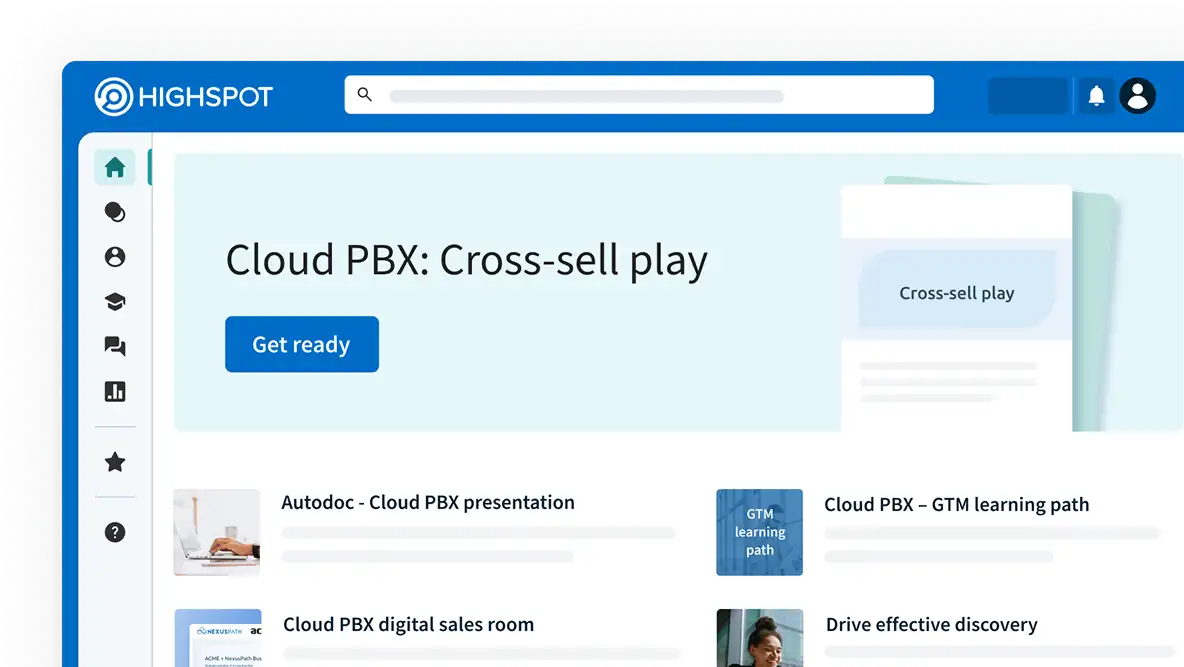
Primarily, we use Highspot to organize our internal sales policies, external sales collateral, Digital Rooms, and a couple of AutoDocs. How our reps mostly understand the platform is this: it’s the centralized database where they can trust they’re getting the most up-to-date content. They can send it out through the platform, track it, and see how it’s performing with customers.
When I was interviewing for this role, I talked with a couple other enablement leaders, and one thing someone said really stuck with me: “Beautiful things get used.”
Highspot, when you put in a little work, can look so pleasing and inviting. It’s just a great UI. When I came into the organization, there were three different versions of content in Highspot. It wasn’t well maintained for a variety of reasons. But I knew that to maximize the effectiveness of the platform, we had to clean it up and create a compelling vision for why reps should use this instead of their own private Google Drive with five downloaded resources.
How could I give them a compelling vision that centralization is better? We started by making it really appealing, really beautiful, and simple to navigate. So when we talk about driving behavior change, you need tools in a remote environment that categorize what great looks like, make it really clear, create centralized expectations, and stop reps from running off like lone cowboys and cowgirls across the country.
We need a central standard for what great looks like and what good content is. Highspot serves that role well because reps trust it. It’s cleaned up, it’s beautiful, and it’s enjoyable to use. And then on top of that, they get the tracking, benefits, and analytics on the backend.
RR: If you look at the data, it shows that what you’re doing is working and that these philosophies are really resonating with your teams because you’ve driven 93% recurring usage of the platform. Pretty much everybody is coming back time and time again. When you’ve made something people want to come back to and find real value in, that’s fantastic.
JK: It was honestly one of my proudest moments in my first few months here. When I joined HealthJoy a little over a year ago, Highspot was one of the first projects I took on as an enabler. I thought, “I want to revamp this experience.”
At that point, the main concern I was hearing—because I met with every rep individually—was: “I don’t know what content is up to date. It takes me forever to find what I’m looking for.” In my brain, because my previous company used Highspot, I immediately thought: ding, ding, ding. There’s an easy solution to this. We have it. We just need to make this the default behavior.
So I did a couple things.
One, I pitched and presented it. I met with reps one-on-one to understand their problems, then met with some of them again to say, “Hey, here’s the solution. This is kind of your idea because you said this was an issue.” They had buy-in.
Then, I built a treasure hunt, which was basically a 30-question quiz where reps had to navigate through Highspot, find resources, create pages, and complete tasks.
Naturally, reps didn’t love the idea of homework. Who would? But about two months into my role, we had an onsite in Chicago. At a team dinner, one of the managers said in front of everyone: “Jacob, we’ve been talking and we’ve all agreed—we’re gonna do your treasure hunt.”
That was a key turning point for us. If you want Highspot—or any tool—to work, reps need to have buy-in. And especially on enablement teams of one or two, you’re the brand. If they’re not bought into you, they’re not going to buy into what you’re implementing.
RR: On that topic of making life easier, you mentioned a few use cases where Highspot comes into play with both optimization and time savings, especially with Digital Rooms and AutoDocs.
With these capabilities fueling external sharing and customization to brokers’ processes, what workflow improvements have you seen, and how has that reduced complexity for the sales team?
JK: I’ll give one example. Alongside a formal price quote, we send out a proposal form. It’s the more beautiful, easy-to-read version of the formal quote. It gives the compelling narrative for why someone should use the platform and what’s included in their package.
Previously, the process was basically a Google Drive template where reps manually adjusted text boxes. I would hear stories of reps spending two to three hours realigning boxes into a single vertical line.
And they’re like, “This is so dumb.” I understood the frustration, but proposals still have to look excellent. There’s no excuse.
So that was the first AutoDoc we took on. In some cases, building a proposal was taking reps two to three hours. On average, probably about an hour if everything went well. We streamlined that process dramatically. Every prospect got a proposal, but the process went from 45–60 minutes down to at most 15 minutes, and on average about five.
It took me a lot of hours upfront to build, but the payoff was immediate. I think within the first year, something like 70 proposals had already been sent through that auto doc. When I calculated the time savings, I was thrilled.
And I could’ve built that AutoDoc six months earlier, but because we didn’t yet have the platform engagement and trust, nobody would’ve trusted what came next. We had to solve the foundational issues first: engagement and trust.
Once reps believed this was better than the alternatives, then we could deliver the “chef’s kiss” features. But we had to get them in the door first. Otherwise, we were dead on arrival.
RR: I really like that framing of building the foundation first and spending time building trust. Now that you have adoption and users are bought in—sending proposals, sharing content, tracking engagement—what impact would you say this work has had on the business overall?
JK: I think it was the first case under my stewardship of enablement at HealthJoy where I could say: “I hear you. This project was done in response to your needs. Trust me with the solution, and you’re going to see the positive outcome because of it.”
It showed a really clear way that, as a solo enabler, I could offer real value and build a strong partnership with the sales team. Because I’m not their boss. I’m their peer who’s here to think strategically alongside them and help them win revenue more easily.
I also think the Highspot rollout set us on a trajectory where we could repeat that process. The change in go-to-market messaging came on the heels of Highspot. Even though they weren’t the same project, that organizational muscle had already been exercised successfully.
RR: You’re in a fast-moving startup environment, and now you have that central source of truth so that as things change, you can help your reps change with them.
As we’re wrapping up, if there’s one crystallizing theme for enablement teams operating with limited capacity or as a team of one, what advice would you give on prioritization and focusing efforts to drive the most impact?
JK: I’m learning this lesson a lot right now. As an enablement team of one—or even two—have really great partnerships and open conversations across the business: with your CEO, your C-suite, sales leaders, marketing, and product. You really do serve as connective tissue.
One thing I can struggle with is getting so stuck in training, training, training that I forget to ask: what’s the highest-impact thing I can spend my time on to drive business outcomes? That may be training, but it may also mean joining tiger teams across the business, helping investigate new products or strategies, and bringing an enablement perspective into implementation planning.
So keep an ear to the ground. Stay responsive to business needs. Be open to pivoting quickly. Don’t pigeonhole yourself into saying, “In enablement, I do onboarding and training, and that’s it.”
Enablement is dynamic by design, and that’s why I love it so much. I’ve joked that any six-month snapshot of my enablement career would probably look like a completely different job description. That’s just the name of the game. So embrace change. Look for where the cheese is moving, and don’t get mad that your cheese got moved.
Also, champion your successes. Especially in a small enablement team, people want to know what’s happening. But in a remote environment, if you’re not shouting from the rooftops about the cool things you’re doing, they won’t get seen. That’s just reality. So especially for newer enablement pros, don’t be afraid to champion your work because it’s super cool.
And finally, going full circle to what we talked about at the beginning: only scale the things that aren’t going to steal your time. Scale the things you’re willing to continue investing in.
That’s what keeps you dynamic, strategic, and able to adapt to new opportunities while still helping champion your reps across the organization.
RR: I think it’s really powerful that every piece of advice you just shared ties directly back to examples from your own work. Even that last point—“scale what doesn’t steal your time”—showed up in your proposal example. Yes, it took time upfront, but it saved time down the line and was the right place to invest.
Thank you for such practical and applicable advice for anyone trying to prioritize, manage competing asks, and figure out where to focus their efforts.Really wonderful insights throughout this conversation. We’re so grateful you took the time to share them with us.
JK: Thanks so much, Riley. This has been a ton of fun.
RR: To our audience, thank you for listening to this episode of the Win Win podcast. Be sure to tune in next time for more insights on how you can maximize go-to-market success with Highspot.