

According to research by Forrester, when brand experience and customer experience are improved together, companies can achieve up to 3.5x revenue growth. So how do you build a trusted brand all while consistently delivering high quality customer experiences?
Riley Rogers: Hi, and welcome to the Win-Win podcast. I’m your host, Riley Rogers. Join us as we dive into changing trends in the workplace and how to navigate them successfully. Here to discuss this topic is Jessica George, Director of Marketing Communications at Avery Dennison.
Thank you so much for joining us today, Jessica! I’m super excited to dig into all of the experience you bring to the table. Just for our listeners, can you kick us off by telling us a little bit about yourself, your background, and your role?
Jessica George: Just a little about me: I have been working in brand marketing communications for—I almost don’t wanna say because it absolutely dates me—but it’s been 24 years now. This is my first role in B2B or B2B manufacturing.
So I’ve been with Avery Dennison for about eight years. Before that, I was doing all direct-to-consumer and brand marketing. So kind of both sides, I would say, of the sort of marketing spectrum there. And there are some really unique challenges in manufacturing, but for the most part, what you find is that marketing challenges are the same in both B2B and B2C.
So it’s been a really fun journey and there’s just a lot more to keep learning.
RR: Well, just looking at your background, it’s safe to say that you’ve been in some really cool roles, marketing some really interesting products.
As someone kind of in the tech world, I’m always so fascinated by—and kind of a little bit jealous of—folks who can point to very tangible things and say “I brought that to life” or “My team did that.”
I know you’ve developed a philosophy around brand awareness and performance excellence, both of which are very central to your work.
Can you talk us through why brand matters so much, and how a strong brand translates into business impacts, like we heard in that introduction?
JG: Yeah, absolutely. I would say this is probably an area where you do see some differences between direct-to-consumer and sort of B2B.
In direct-to-consumer from almost a psychology standpoint, you’re going to see faster, more tangible impacts with regards to things like media and marketing psychology, so how people react to ads, how often you need to show someone something.
You see, as a consumer yourself, sort of the impacts of all of that. Why do you buy the things that you buy? Why do you gravitate towards the brands you gravitate towards?
In B2B manufacturing, it’s definitely different. You are trying to build that same brand presence, that same brand consistency, and that same brand equity, but your audience is often a lot more narrow. It’s focused on a particular segment or industry or trade application, but still your brand integrity remains important no matter who your audience is.
And so that’s one of the common things between B2C and B2B. Avery Dennison operates in an industry that we invented by a technology we invented 91 years ago, so our brand has grown somewhat organically from that singular invention and sort of expanded from the center there.
We’ve also grown by acquisition. We’ve gone into adjacent categories and technologies, and now we’re massive. So now we’re, you know, $9 billion globally and 35,000+ employees. So, it’s really a completely different ball game.
Managing and protecting that brand as you grow from the center and grow out and kind of pull things in and pull in, that equity becomes a real challenge. And so the consistency of what you look like and what you sound like and how you talk about your business is really critical as your name kind of moves farther and farther away from you.
So it’s just absolutely critically important that you maintain control of how you show up in front of those audiences.
RR: That leads us very well into kind of my next question, which is: When you’re tackling marketing and brand building at large, multi-portfolio organizations like you have, what’s kind of surprising about dealing with brand at this scale and what lessons have you kind of taken away from this time now at Avery Dennison?
JG: I think what becomes interesting is that brand in the direct-to-consumer sense or in the B2C sense is really something that the person who’s using your product at the end of the day identifies with.
So within manufacturing, Avery Dennison is the brand, but within that brand we have so many different solutions that kind of ladder up to who we are as a company. And they all support our overall strategic vision, but they also mean different things to different people based on how they’re interacting with them.
And so I think what my biggest learning was, if you’re marketing brands like JIF and Smuckers, your frame of reference for who your audience is is a little bit different. They have a different understanding because they’re interacting with you.
Whereas if you go out into the manufacturing space, they’re likely interacting not necessarily with your brand name or what they consider to be Avery Dennison, but with a specific product subset.
So for me, the biggest shift when coming into this space was: Yes, Avery Dennison is critical to maintain as a brand, but equally as important are all of the attributes and value propositions for the products underneath that Avery Dennison makes. And so when you operate in so many different regions and so many different verticals and industries, it’s really your product integrity.
And the equity of those products, that becomes really critical. And so that’s a shift for sure, and I think it makes you think about your brand integrity a little bit differently, but also how important it is to make sure that every product has its own concise and clear value proposition.
And that’s really the biggest difference: If you go to market as Jif, everybody already understands a whole bunch of things about JIF. They already understand a whole bunch of things about Nike, so a lot of that legwork is done.
What we try to do in B2B manufacturing is make sure that the Avery Dennison name stands for quality. It stands for innovation. It stands for solving some of the world’s most complex challenges.
We want to make sure that we consistently know we’re standing for that. We then have another added responsibility to make sure that all of our products then stand for what they need to stand for and perform as intended, no matter who’s using them.
RR: Thinking about this shift from direct to consumer to where you are now, what was hardest when you were making that transition? What did you really have to learn, and what was most difficult when you were learning those lessons?
JG: The hardest thing to grapple with is the lack of data that exists in the B2B space.
In direct-to-consumer marketing and brand marketing, you’ve got access to IRI data. You’ve got access to Nielsen data, you’ve got all of your digital media and marketing data, and you can then check sort of your velocities and IRI and say: “Hey, you know, we turned on this campaign, we added this many GRPs to a TV.” You look at the impact of that and you see it five days later. You see it 10 days later represented in your actual business metrics and IRI. The ability to do that was something that I took for granted. And so when I came to manufacturing, you have to think a lot differently about how you’re determining what success looks like for things like your marketing campaigns.
First of all, you’ve got a longer purchase lead time, so it takes longer for a customer to make a decision usually on what product from Avery Dennison they’re gonna buy, or if they’re gonna switch from a competitive product to Avery Dennison. That decision, in essence, takes longer, so your sales cycle is longer, your negotiation cycle is longer.
When you are kind of doing all of these marketing things that you would’ve done in the direct-to-consumer space—turning on digital campaigns, reaching out in social, doing events and things like that—you don’t see the impact of that marketing right away, and so you don’t have the ability to make as many fast, data-driven marketing decisions.
So that’s the hardest for me: the data.
What we had as a major outage, I would say we maintain 250 pieces of collateral. Are all of those collateral pieces doing something for us? Are they all being accessed? Are they all being used? Are they all in the right condition?
Are they actually being used to influence purchase decisions for our customers? It’s not necessarily a learning curve, but it definitely is something that you have to get used to and you have to learn how to pivot differently and react off different pieces of information and different levels of information, often an incomplete picture to make informed decisions moving forward.
RR: It’s really funny. I feel like I talk to a lot of folks that have come up in the B2B space, so they’ve never had this influx of data where it’s like: “I know I can directly attribute.” It’s always just: “Okay, I’m puzzle piecing together what I have. I’m finding tools that can help me do better.”
It’s very interesting to hear that kind of directional shift looking back kind of when you’re seeing these gaps and seeing, okay, I’m having a hard time measuring these things. I’m trying to maintain 250 pieces of collateral and make sure that they’re all valuable.
Thinking of this, what signals told you it’s time to look for a platform? What problems beyond these—or just these—were you trying to solve?
JG: There were really kind of two things that happened and they were two things that happened completely independent of each other, and we were able to kind of marry up a root cause. And so what happened was on the marketing communication side, my team and I were dealing with the challenges of: “I wonder if our collateral’s working, do we need to be maintaining all of these pieces all the time? Can we set a different cadence for updating them?”
A lot of that was rooted in. Running the team efficiently. From the MarCom side, what we saw was the time efficiency piece of it.
The other thing that we started to see was you get a lot of like: “Hey, I don’t know if this is the most recent version. Hey, can you send me this? Hey, there’s four copies of this on the drive. Which one is the right one?”
And so all of this stuff started to look like, yeah, we can field all these questions, of course, and we know the answers to all this stuff, but is this really the best use of our time?
The sales team was seeing something a little bit similar to what we were seeing, so we said we need to start looking for a tool that’s gonna help us solve all of these problems. We’re kind of hearing through our relationship with Salesforce and some of these other tools that we have this tool called Highspot, and we were like, all right, let’s take a look at it and see what it does.
And lo and behold, it did everything that we were asking for it to do, so we started to explore a little bit more about the platform and we went: “I think it does everything that we needed to do.”
We were able to expand that value to the entire sales and marketing organization, and we’ve not looked back. Instead, we just kept expanding. So we found this tool that did the things we needed it to do, and then. We kept going: “Oh wait, it does this,” and “Oh wait, we can add on this.”
It just keeps getting better and better. We went in wanting it to do something and then we kept going: Oh, I wonder if it could do this, and then it could do that. And if it couldn’t do that at that moment, it was probably on the innovation horizon with the team.
All we had to do was call the team and call our point of contact and say: “Hey, we’re thinking about trying to figure out how our collateral ultimately influences purchase at our customers, is there a way to tie that sort of outbound send from the Highspot platform into what our customers are doing?”
And they went: “Yeah, because of our relationship with Salesforce, we can absolutely start to tie those things together and the metrics keep getting better, tighter, and more sophisticated, and our teams keep deepening their use of the platform.
We just kept solving problems that kept coming up or that we didn’t know existed, and the platform just kept adapting and growing with us as a company and with our needs, and I think that was really unique.
RR: Yeah, and I mean, I think that’s the ideal scenario, right? That the perfect tool falls in your lap and you’re like: “Oh, I just get to run with this.” I don’t think that happens often, so I love that that was an easy decision and has continued to be a great relationship over, you know, the last five, six years.
Looking across that period where, you know, you started with one use case and now you’ve expanded out as the need arose: At a high level, can you walk me through how you and the team kind of use Highspot to standardize execution across product lines?
And again, like you were talking about earlier, how does it help you ensure that reps show up consistently with the Avery Dennison message wherever it’s appearing in the field?
JG: The platform allows us a level of control and access, so right off the bat, we stop answering questions about, is this the most recent version of this?
I no longer have people who are pulling down decks from 2010 to 2015, even to 2020 because they know exactly where to go to find the most recent one, and they can trust that that’s the most recent one, and it’s fully up to date and a hundred percent available for their use. Because if they couldn’t find it and couldn’t see it, then it’s not, and that’s the way we kind of control that.
It stops that question of: “Am I using outdated visual equity? Am I not talking about the brand correctly or am I not talking about these products correctly?”
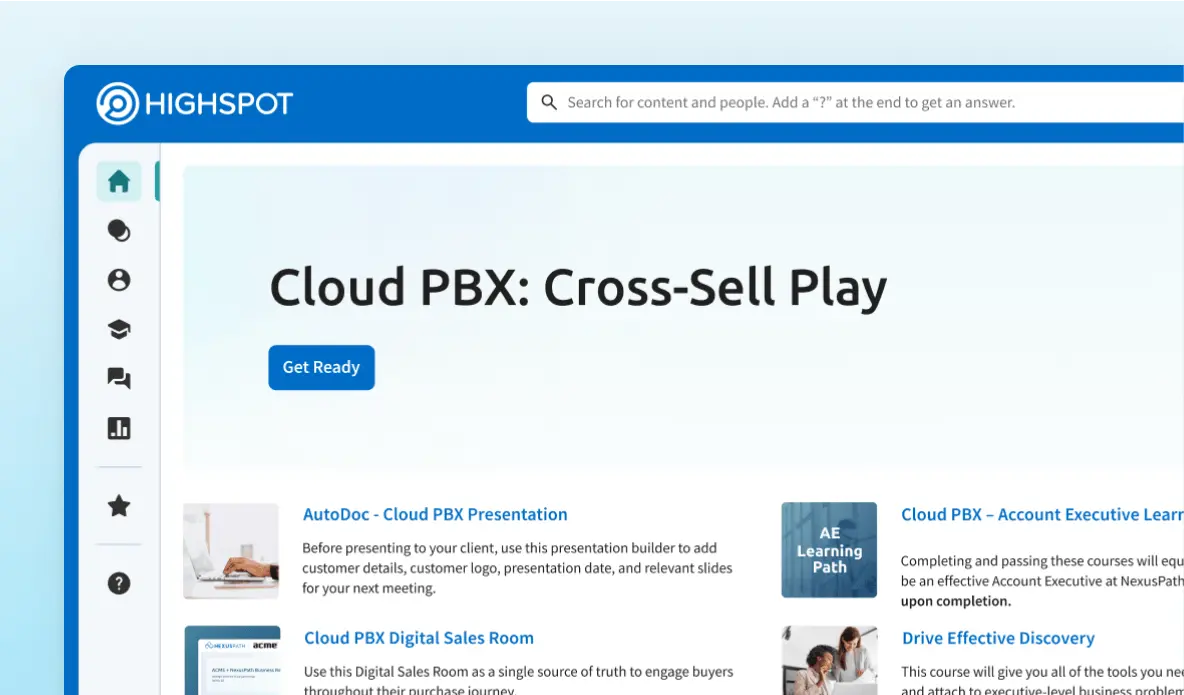
All of that is controlled because we have what we call the single source of truth for pushing out content to both our internal teams as well as our customer base. And so reps have the option to get right into Gmail and link into the Highspot widget and search and send for things that way.
But they also have the ability to see what all their customers have received in the past. So you prevent some duplication too.
So, if a customer received something as part of a campaign that was sent out, you can see in the customer record in Salesforce, oh, my customer already got that, but I’m gonna send them the second piece of information that’s kind of tied to the first one that they’ve got, but might help kind of further the conversation there.
We can control all of that now, which is something that we couldn’t control in the past. We have visibility to all of the touch points that a customer has. It all lives in our single customer record in Salesforce, which gives us one view.
Because we’ve got controls and permissions, it allows the marketing communications team to sort of be the owners of our equity once it leaves our four walls we can control anything that a rep has access to.
We’ve moved so far out of the idea of downloading things and into the idea of everything being cloud-based. And so it’s awesome from a performance perspective, and it gives everybody a lot of flexibility in the mobile space.
All of our reps actually operate on these cool tablets now, so they don’t even have full-functioning laptops, but they can still access everything through Highspot because it’s all the most recent version, and it can all be sent right from their tablet. So the rep doesn’t even have to say: “Is this in the right equity?”
They just pull it from Highspot. They know exactly that it’s the most recent, most up-to-date version of that deck. It just eliminates so many of the questions, and it eliminates the outdated versions that exist on hard drives too.
RR: So, thinking about what you just shared there of how that has changed the relationship between MarCom and sales, where it’s not: “Hey, where’s this thing, can you help me find it, or is this up to date?” Now, you are saving time there and sales are also saving time because they’re not waiting for responses and so on so forth.
What has that kind of done to the relationship between these teams, and maybe how has that saved you time?
JG: Oh yeah, absolutely. I mean, it saves us time every day from a MarCom perspective.
The relationship with sales is interesting because marketing communications is typically a marketing function. Makes sense. And it’s usually some either sitting alongside marketing or maybe a subset of marketing. And that was true at Avery Dennison as well.
About, oh gosh, four years ago now, we moved marketing communication into sales under a leader who’s now our VP GM of Labels in North America. But she has historically and continues to have just a real innovative mindset in the digital space, and is just a champion of digital innovation.
I think the relationship between marketing communications and sales shifted largely because of the direction of that leader and her endorsement of the things that we wanted to do in the digital space as being helpful to more than just us.
But if you can take a look at what your sales team needs. And see where they’ve got outages. So, you know, bringing the perspective of that sales leader and for us to be able to connect those dots because we have that relationship. And then also see moving forward how the reps are interacting with the platform has been really critical.
And I think we would not have considered the MarCom team at all equipped or even interested in some cases in sort of the idea of sales enablement and sales enablement platforms.
But we became interested because the digital innovation time period was absolutely spot on with what we needed at the time. So we found a tool, the tool did what we needed. It was innovating at the same pace that we are, and it was helping push us forward in areas that we didn’t even know were possible yet.
So, we kind of branched into this idea of sales enablement through the platform with Highspot.
We got to see firsthand how reps were interacting with the system and the platform.
And we got to say like: “Okay, I think if we were doing X amount of pitches per month, we’d see some traction in these areas, or we’re starting to really see this piece of collateral heat up and translate into sales attribution. We should start pushing this piece of collateral out to, you know, the reps and customers that would find it most valuable.”
So I think it strengthened our relationship with the reps. We were able to hear and see what they needed and where they needed support in a way that we probably wouldn’t have if we were in the marketing organization or if we were sitting off by ourselves.
There were certainly some relationship improvements that came as a result of that, but there was also just a whole eye-opening knowledge that marketing, communications and digital experience can play a huge role, not just in helping market your products, but also in helping your sales teams go out and market products.
Maybe they’re not using something that you developed, but if they can show up in front of a customer more consistently, more confidently, more accurately, and you’re enabling that through a platform, to us, that’s a win-win.
RR: So you’re asking that question of: “What can we spend our time doing to ensure that our reps are showing up the way we want them to?” You’ve mentioned a couple of things that kind of support this. You know, what reps are doing in the platform, what content they’re looking at, what’s being shared.
I would be curious to hear—you know, we talked about the absence of data—so, what sort of metrics and data points are you looking at to tell you that okay, we are reaching reps the way we want to?
JG: There’s a couple of different things that we look at. On the MarCom side, we’re particularly interested in attribution metrics.
So, are certain pieces of collateral being tied to closed one sales opportunities at certain customers?
That really helps us figure out if there is a specific type of content that’s really resonating, or if there is a product line or solution that’s really gaining a lot of traction. And I think that’s helpful for my team that builds that content.
On the other side of that, I will say what we look at from a behavior standpoint in the reps are things like: “Are they being appropriately trained on new products and innovations as they hit so that they can go out and sell those to customers?” And we do that training through the Highspot platform.
“Are they pitching things to customers? Are they pitching pieces of collateral? Are they using sales plays to go out and talk about hot topics? Are they using customized digital selling rooms to pull bespoke pieces of content and send it to one customer in particular?” All of that now is done within Highspot in a matter of minutes.
You know, we measure collateral efficacy on the MarCom side, but then we also look at, if the reps are kind of hitting all these behaviors, if they’re pitching the amount of times we want ’em to pitch, if they’re using digital selling rooms, if they’re completing their training, what’s the effect of that on their actual sales metrics?
And so the other thing we line up is: Is this sales rep performing against their sales goals and then also exhibiting these behaviors that we’ve established as the positives for helping drive your customer relationships?
We see a 100% overlap with the top performing sales reps from a business perspective and the behaviors that we wanna see within the Highspot system, there is a 100% overlap between those reps that perform at the top, both in Highspot and with their sales metrics.
Because we’re able to tie those things together. There’s confidence in the system that it is helpful. There’s confidence from a rep standpoint that if I do these things in Salesforce, if I do these things in Highspot, I have a better chance at hitting my sales goals and hitting my quarterly bonuses.
RR: It’s amazing that you’ve built a culture where that is baked in and known by your reps that: “Okay, I have the path to success. I just gotta. do X, Y, and Z, and I know that it’s gonna help me. I invest a little time here and it pays dividends down the line.”
You know, it’s been a journey—like you said, five, six years. From all of that work over the last few years, what key wins can you share? Any stories you’re super proud of?
JG: I honestly think that the entire implementation is a great story that we’re really proud of, and it’s one that we talk about in every commercial kickoff meeting that we have now.
If we would show up at a commercial kickoff and we’re giving a digital presentation and we don’t talk about something new that we’re doing in Highspot, we will get questions from our sales reps on what’s going on with Highspot. Are we adding anything new in Highspot? Can I get that functionality in Highspot to me? That’s a huge win.
From an attribution standpoint, I would say what we’ve seen that’s been really nice on the MarCom side is the attribution metrics, so the influenced revenue metrics within the Highspot platform.
From our standpoint, we are able to use that metric at least directionally to say our collateral is still proving to be valuable in these ways to our customers, and it’s still helping us influence purchase at our customers. And so I would say that sort of attribution or influenced revenue metric is really another huge success story.
And I kind of won’t get into the numbers, but we’re easily tens of millions of dollars of influenced revenue every year, and we just see that number go up.
RR: Yeah, and it seems like everything we talked about from the very outset of this journey, you’ve kind of solved those problems, and you’ve found the clarity.
I love to hear that as we’re kind of wrapping up. I know for me, I get on the line with you and I’m like, “Ooh, tell me how you did all of this.”
So, for anyone else listening, for all of those early career marketers aspiring to lead and to navigate complex organizations like yours, what skills, lessons have been really critical to getting you where you are and successful where you are?
JG: I think my advice is relatively simple. Take the opportunities that come to you early in your career and don’t overthink whether or not it’s the right thing, because if it’s even somewhat related to what you do, chances are from a story standpoint, you’re gonna be able to figure out how to connect those dots.
So when I went from fashion merchandising into digital marketing. That didn’t seem like a na, like a natural progression. And then when I went from digital marketing into data loyalty marketing, that didn’t seem like a natural progression. But as you get into brand marketing, you start to see those are all pieces of a whole pie.
Before you know it, you’ve kind of built a package, and the package is yourself. Now, you have all of these different skills.
It’s really hard to find people now on the other side, so moving from agency side to client side and being able to now hire agencies and hire people into my team, what I look for are really well-rounded people. I don’t look for people who have just. Moved up the same, the same linear progression.
I look for somebody who is a little bit more of a Swiss Army knife and has a bunch of different skills that we’ll find valuable because you never know what is gonna happen, especially in marketing. And I would say the other piece is leadership skills are the one thing that no one taught me or or more appropriately taught me that I was gonna have to learn.
Take courses on public speaking, learn how to build compelling presentations, do all of those things that seem not maybe exactly what your functional discipline is but will ultimately help you be a better leader.
Learn how to lead with empathy. Learn how to read people. Learn how to sort of listen to what people are telling you, because more often than not, everyone’s telling you what they need as long as you’re listening, you know.
Leadership and learning how to be a good leader is something that I think I’ll never be done learning.
RR: At Highspot, one of our guiding principles is learn it all. And I, I love that phrase because it’s very encouraging, to your point, about how opportunity strikes in weird places. The work you do today may not be the work you want to do tomorrow, but it will lead to those roles you’re looking for, and it will lead naturally if you can sell yourself and message that the right way.
Well, thank you so much for joining us today.
JG: Thank you to you and the Highspot team, honestly, for helping us kind of on this crazy journey.
RR: To our audience, thank you for listening to this episode of The Women Podcast. Be sure to tune in next time for more insights on how you can maximize go to market success with.