

According to research on organizational alignment led by LSA Global highly aligned companies grow revenue 58% faster and are 72% more profitable than misaligned companies.
So how can you cultivate an aligned culture ready to drive improved outcomes?
Riley Rogers: Hi, and welcome to the Win/Win Podcast. I’m your host, Riley Rogers. Join us as we dive into changing trends in the workplace and how to navigate them successfully. Here to discuss this topic is Julia Juliano, manager of sales enablement at Cencora.
Thank you so much for joining us, Julia! I’d love it if you could kick us off by telling us a little bit about yourself, your background, and your role.
Julia Juliano: Yeah, of course. Thank you so much for having me. I’m excited to be here today. My name is Julia Juliano. I live in the Philadelphia area with my husband, daughter, and two dogs.
I’m actually coming up on my seventh year with Cencora. I’m now a sales enablement manager, and I started with the company in generic sales within the New York Metro Territory, where I was a top performing rep.
That experience really ignited my passion for empowering sales teams to succeed, which ultimately led me to transition into sales enablement. I entered the enablement world as a specialist about four years ago, and worked my way into my current role as a manager. Over the years, I’ve had the privilege of supporting both community retail pharmacies and more recently our specialty distribution business.
These experiences have given me a comprehensive understanding of the challenges our teams face and the tools and strategies they need to excel in such a competitive and highly regulated environment.
RR: Well, we’re super excited to have you here and to dig into a couple of those things you’ve mentioned—transitioning into that sales enablement role from your desire to help sales teams win, navigating competition.
So excited to dig into all of that. I want to start with one of the first things you mentioned, which is that you’ve run the gamut from sales to sales enablement. So, can you take us back to your time as a pharmaceutical sales rep at Cencora? What challenges did you experience that shaped how you enable today?
JJ: Yeah, you know, it’s a really unique experience to be able to go from sales to sales enablement. As a pharmaceutical sales rep, I experienced firsthand the challenges of accessing the right resources at the right time.
Whether that was finding compliant marketing materials, navigating product specific information, or understanding how to position solutions for different customer needs, there was often a disconnect between the tools available and the realities of working in the field and the conversations that I was having with those customers.
That experience really allows me to approach enablement from the rep perspective, knowing that every minute they spend searching for content or trying to interpret complex messaging is a minute that they’re not spending with their customers.
My goal is to streamline their workflows, ensure they have what they need at their fingertips, and create alignment between the tools we provide and the outcomes that they’re driving in the field.
RR: I think that’s such an important call out: Every minute that you’re distracted with non-essential tasks takes you away from the work that really matters both to you and to our business.
I think bringing that kind of lived experience and empathy that comes with it to the table is so huge and helps you kind of build the programs and support arms that you’re like: “I wish I’d had that.”
And I know it probably can’t be easy to build those programs because Cencora unites six distinct business units under a single brand. So, from an enablement perspective, what kind of complexity does that create for you?
JJ: Yeah, so the complexity really lies in balancing the enterprise wide alignment with the unique needs of each of those six business units. So, the six business units are specialty, GPO, community, retail health systems, animal health, and corporate partnerships.
They each serve distinct segments of the healthcare ecosystem; their customers, products, and sales strategies vary significantly, which means that their enablement needs are equally diverse. At the same time as one unified brand, we have to maintain consistency and messaging, compliance and governance across the organization.
So from an enablement perspective, this requires a strategic and thoughtful approach to content structure, governance, and collaboration to ensure that we’re effectively addressing both the enterprise and each individual business unit’s priorities.
RR: When you’re looking across these priorities and trying to stitch everything together into a clear strategy and message, it’s obvious that alignment doesn’t happen by accident.
It’s a very intentional, thoughtful thing that you have to cultivate. So how do you use Highspot to break down those silos that could potentially appear, and then make sure that everybody’s running to the same drum beat at the same pace?
JJ: We’ve accomplished this by building a centralized Spot architecture that balances enterprise-level consistency with business unit-specific relevance.
So at the enterprise level, we house shared resources like compliance guides, org charts, corporate initiatives—things like that. At the business unit level, we provide more tailored content and tools designed to meet those unique needs of each team for their specific solutions.
Highspot Analytics further enables us to identify content gaps and redundancies, which allows us to continuously refine and optimize our approach By centralizing any efforts on Highspot, we’ve established a single source of truth that fosters alignment while maintaining the flexibility needed to meet those diverse needs across our customer segments.
RR: There’s so much in what you said that I really want to dig into in just a second. You know, about how you structured those Spots, how you determine what gets a Spot, what doesn’t, alongside the kind of specific, tailored tools that you’re building for solutions. But I want to start with the foundation, the baseline for all of this, which is that as part of your work, you led the creation of a formal structured governance plan.
Why did you see governance as foundational for driving alignment and helping Cencora drive a shared strategy?
JJ: Governance is truly the backbone of any successful enablement strategy, especially in a complex organization like Cencora. Without it, you risk content duplication, outdated materials, and a lack of visibility into what’s working and what isn’t.
When I joined the team, we had a ton of great content, but it wasn’t always easy for reps to find or trust that they were using the most current and up-to-date version. By implementing a formal governance plan, we established a clear process for content creation, approval, and maintenance. And this not only improved findability and adoption, but also ensured that everything we provide to our teams is compliant, up to date, and aligned with our strategic goals,
RR: So, you knew what it could achieve for you, and you’re starting to see those outcomes.
Specifically you’re seeing that in the data. You know, as a result of this governance strategy, you’ve seen meaningful improvements in content views, downloads, findability, and even platform adoption. So, what actions or parts of this strategy do you think made the biggest difference in achieving the results that you’ve named?
JJ: We implemented a consistent taxonomy or naming convention across all the different business units, which made it easier for reps to navigate and find what they need. We also introduced regular content audits on a quarterly basis to ensure that everything in Highspot is relevant and up to date. Another key action was also leveraging Highspot analytics to identify gaps in content or areas where reps were struggling to find resources.
And by addressing those gaps and continuously refining our approach, we saw significant improvements in engagement metrics, like you mentioned, the content views, downloads, and overall adoption of the tool.
RR: How did you identify those gaps in content that reps couldn’t find?
JJ: So, we created sales surveys and worked with our marketing partners and our solution owners to identify which solutions were being most searched for by reps, what materials they needed to aid in the customer conversations that they were having.
Then, you know, in the surveys we addressed: “What would you like to learn more about? What type of content are you unable to find that would be helpful in your day-to-day role?”
And so we took those surveys, partnered with marketing and those solution owners, like I mentioned, and were able to create those resources to better drive, you know, adoption and findability within the platform.
RR: Okay, amazing. I think that’s such an important approach where you’re building from the perspective of your users. It’s not just: “Here’s what we think works.” It’s: “Okay, what does this actually look like in your day to day and how can we make it better?” And actually that kind of leads me to that Spot architecture that you touched on, which includes enterprise-level and then business-unit specific spots.
So, how did you create this structure and then how does it help you create consistency like we talked about, but also keep things relevant to reps’ day to day?
JJ: Yeah, so we started by clearly defining what belongs at the enterprise level versus the business unit level.
Enterprise level Spots include resources that apply across the entire organization—this is our compliance guidelines, corporate initiatives, any distribution information, org charts, and training materials.
The business unit specific Spots are tailored to the needs of each team—this is your product specific collateral solution, information, sales playbooks, and any sales execution materials that we have for the teams to ensure consistency.
We developed a standardized template for all Spots so that reps know where to find what they need, no matter which business unit they’re in. The structure ensures that the reps have access to both the big picture, along with the details that matter most to their customers. Additionally, each business unit only has access to the enterprise level Spots, plus the materials that are relevant to their team.
For example, a rep in health systems won’t be able to see community retail content if it isn’t applicable to their role. So the targeted access keeps search results cleaner and more accurate, reducing noise and helping reps to get to the right asset faster. It also supports a smart marketing model. We may have one enterprise solution, but the go to market strategy, messaging, and customer facing materials can vary by customer profile and their buying environment.
So structuring the access this way allows marketing and enablement to maintain the consistent approach for enterprise positioning while still delivering the right version of the story and tailored assets for each individual audience.
RR: It feels like there was so much intention and thought put into this. You’ve kind of checked the box for everybody in the org. You know, sales is getting specifically what they need. They don’t have to filter through the noise and the chaos of five other business units.
Marketing ensures that their strategy is being executed to its fullest and that the materials they’re producing and investing in are seeing the usage they’d like. Then you as an enablement team have a much easier time governing and maintaining your strict policies because you don’t have that same sprawl, so I love to hear that; it’s a fantastic structure.
Not to get too in the weeds, but I’ve heard that as part of this Spot structure, you’re also empowering reps to land the value of Cencora’s different product lines by creating Richardson Methodology-inspired Plays for each solution.
What do those Plays look like in practice and how are they supporting reps?
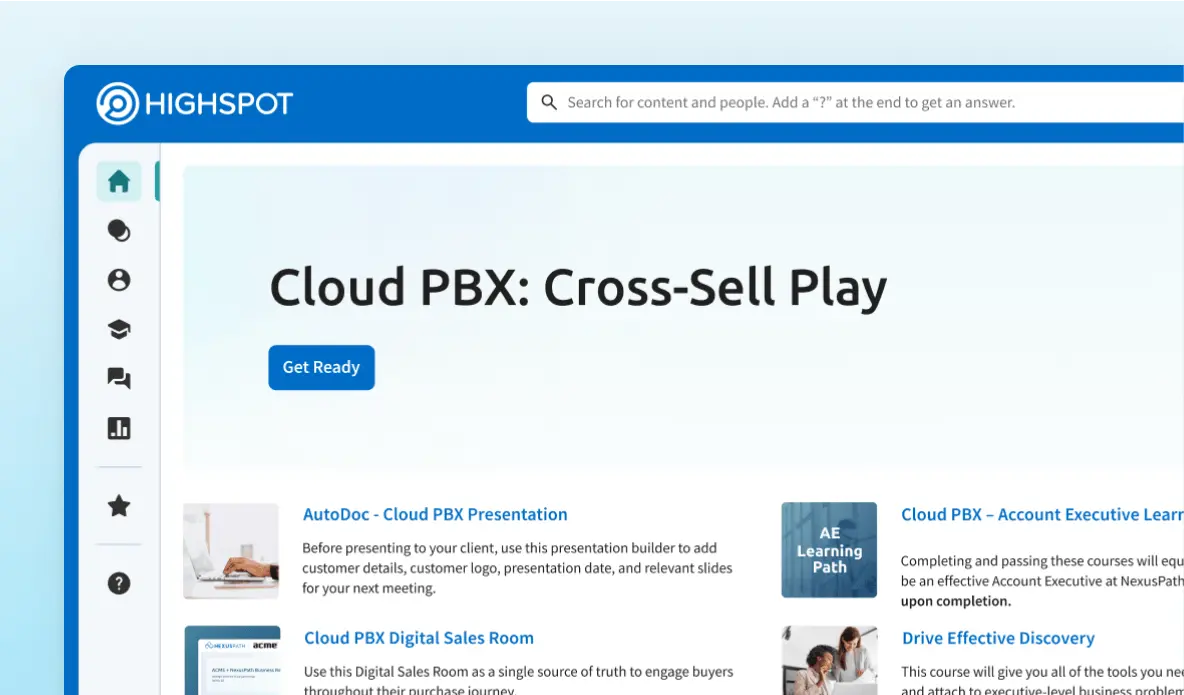
JJ: Our Richardson-inspired Plays are thoughtfully designed to guide reps through the entire sales process, all the way from discovery to close in a way that’s tailored to each specific solution.
Each Play for every individual solution that we offer is structured into three sections:Learn, prepare, and engage. The “Learn” section provides internal facing materials to educate the reps on the solution, ensuring that they have a deep understanding of its value and its applications. The “Prepare” section offers guidance on how to plan and strategize for customer conversations, so this includes tools like questioning frameworks and call planners.
And then finally, the “Engage” section houses our customer facing materials. So these are typically created by marketing, and they support reps in effectively communicating the solutions value to customers to support them in those conversations. And these Plays really act as a clear and actionable roadmap, equipping reps with the knowledge, preparation, and resources they need to have more meaningful, productive, and impactful conversations with our customers.
RR: So we’ve dug into the details. We talked about thoughtful governance, strategic Spot architecture, and solution-specific plays. When we look at all of this more broadly, how has this approach improved or changed how reps take Cencora solutions to market?
JJ: This approach has really transformed how our reps take solutions to market by making it easier for them to find trust and use the resources that they need.
With the governance in place, reps know that they’re always accessing the most current and compliant materials, and then the Spot architecture ensures they can quickly find content that’s relevant to their specific customers and sales strategies. The solution-specific Plays also provide a clear roadmap for engaging customers and addressing their individual needs.
Together, all of these elements have really improved their efficiency, confidence, and effectiveness, which ultimately has led to better customer outcomes and stronger business results.
RR: It really seems like you and the team have built an environment that you as a rep would’ve been like: “This is fantastic. I can go run and do my job and not spend time on the things that take me away from it.”
I’d be curious to add onto that impact piece: What key results have you achieved beyond everything that we just covered off on (which was a lot!). What particular wins are you especially proud of?
JJ: Yeah, so since we implemented Highspot in 2021—coming up on five years at this point—we’ve seen clear improvements in how our teams find, trust, and use the enablement resources that we’re able to provide for them. Like I’ve mentioned, the content is much easier to locate, adoption is stronger, and engagement is more consistent because reps know that they’re working from a single current source of truth.
We’ve talked about most of them today, but the wins I’m especially proud of are the governance foundation we’ve put in place, the Spot architecture that balances the enterprise consistency with the business unit relevance, and then those solution-specific plays that help reps move from learning to preparing to engaging with their customers.
Together, those changes have reduced friction for sellers, improved onboarding and readiness for new team members, and strengthened alignment across the organization.
The most important thing with having Highspot as our sales enablement platform is that, before we adopted this tool, different versions of materials were just kind of floating around on people’s desktops and an old platform that we used to utilize in Teams channels and through inboxes.
You never knew which one was the one that was most recently updated. “What should I be using? Has any of this messaging changed?” Now, there’s one place; I always pitch it to our reps as Cencora’s Google. You just search in the search bar, whatever you’re looking for, and the first result that comes up is what you’re looking for.
RR: I think it’s really important, that kind of domino effect that you touched on: “We did the work at the very beginning to make sure everything is accessible, to make sure it’s updated and to make sure it’s valuable to our reps and that they know it.” And now you’re seeing the entire progression from finding content to engaging buyers in a more meaningful, trusted way and creating more trusted relationships.
So you’ve kind of built that flywheel. Now it’s just kind of spinning and maintaining, which is fantastic to hear. Last question for you: For leaders building similar enterprise-level enablement strategies in a similarly complex competitive environment, what hard-earned advice would you leave them with?
JJ: My advice would be to start with the governance and the structure. Without a clear plan for how the content is created, organized, and maintained, it’s really easy for things to become chaotic, especially in a complex environment where multiple teams are involved.
There’s lots of hands in the pot. Things get lost in translation. So governance and structure would be the starting point. Additionally, it is so important to always keep the end user in mind. Enablement is all about making the lives of your reps easier. Take the time to understand their needs and challenges so that you can create solutions for them.
And finally, don’t underestimate the importance of analytics. Use the data to continuously refine your approach and demonstrate the impact of your efforts. Enablement is truly a journey. It’s not a destination, and the key is to stay agile and focused on delivering value both to the reps that you support and their customers.
RR: That phrase there: Enablement is a journey is so important to hear because, to our audience who are all at different stages in the process, maybe you’re building, you’re just writing that enablement charter or maybe you’re just trying to run and optimize. Either way, I feel like you need to hear that because everything is constantly changing and you are constantly adapting.
I think that’s a reassuring spot to end on, and I really appreciate you saying that. Beyond that, I really appreciate you joining us and sharing all of this wonderful experience. It’s been so amazing to step into the work that you’re doing and the impact that you’re driving for Cencora.
JJ: Absolutely. I’m honored to be invited. I’m so grateful to be here. Thank you for the time and asking all these thoughtful questions. I hope that can help many other organizations out there.RR: To our listeners, thank you for listening to this episode of the Win/Win Podcast. Be sure to tune in next time for more insights on how you can maximize enablement success with Highspot.