

Many go-to-market (GTM) leaders see AI as a “quick fix” for broken execution. According to Highspot’s 2026 GTM Performance Gap report, nearly all GTM organisations are using AI to some extent.
But it’s not a silver bullet. Simply adding AI tools to your tech stack won’t change outcomes if they don’t influence the decisions teams make inside deals, coaching, and pipeline reviews.
For many organisations, AI is magnifying the gaps between strategy and execution and perception and reality. Investment in new tools can create a false sense of progress that distracts from the system-level failures holding teams back.
Data from the 2026 GTM Performance Gap report shows that while 98% of organisations say execution is standardised across the business, just 53% of leaders report highly consistent outcomes.
To start driving revenue with AI, you need to move from isolated use cases to embedded execution. GTM organisations that stop at content generation and admin automation will see a limited return on their investments. In contrast, those that embed AI in sellers’ workflows where it can deliver real-time insights and guide next actions can multiply the gains.
Why AI shows up in strategy but not execution
GTM leaders have high expectations for AI, but sales teams don’t have what they need to translate that vision into reality. As leaders push ahead with their AI strategies, sellers are struggling to keep up with growing complexity.
AI can only deliver the results leaders expect when it can guide sellers inside live deals. However, siloed workflows and manual workarounds make it impossible for AI to interpret buyer signals or deliver actionable insights. AI should act like a powerful coworker, but its use is often limited to low-value tasks that improve productivity but not overall performance.
Sales leaders sometimes assume the more powerful tools teams have access to, the better the results. But for sellers in the field, an ever-expanding, increasingly powerful toolkit can create confusion. Teams don’t know which tools to use when, and a lack of governance and best practices adds to the chaos. Instead of accelerating deals, AI becomes a burden that slows sellers down.
In fact, 76% of leaders say their organisation is adopting AI faster than their operating model can support it.
To close the gap between leadership perception and field reality, you must prioritise automation and deep process integration over introducing net new features. The solution to broken execution isn’t more AI; it’s AI that drives action inside the deal.
From insight to execution
Most AI copilots operate from the outside, offering recommendations and content intelligence based on the context that sellers provide. But the decisions that actually change outcomes happen inside the deal.
When sellers have the right guidance at the right moment — what to do next, which stakeholders to engage, where a deal is quietly losing momentum — outcomes change. That’s what Highspot Deal Agent is designed to deliver. And it’s embedded directly in sellers’ workflows rather than sitting in a separate dashboard.
Deal Agent empowers organisations to:
Keep deals moving with recommended actions
Instead of juggling multiple tools and digging around for content, sellers get recommended next best steps based on calls, emails, and CRM data. And that gives them more time in front of buyers.
Catch risks in real time
It’s easy to miss the earliest signs that a deal is losing momentum. Deal Agent excels at reading those subtle signals, giving sellers time to trigger a fix before the opportunity stalls. Pipeline reviews stop being status updates and become productive, decision-making conversations.
Deliver deal-specific practice that actually improves performance
Deal Agent generates role-play scenarios that help your sales team execute strategy in their next meeting. By simulating objections specific to the deal, AI Role Play allows sellers to perfect the conversations that decide outcomes. Sellers can keep polishing their performance until it’s time to enter the sales call with instant, AI-powered feedback.
With Deal Agent, your sellers won’t waste time switching between tools or writing detailed prompts. Embedded inside the deal, Deal Agent has the context it needs to provide reliable, real-time recommendations and coaching that improves performance. Your sellers are better prepared to execute strategy inside live deals and bring field reality in line with leadership vision.
Success comes with maturity
After working with hundreds of organisations, we’ve noticed a consistent pattern. The organisations that see the most success with AI are those that have reached the highest level of organisational maturity.
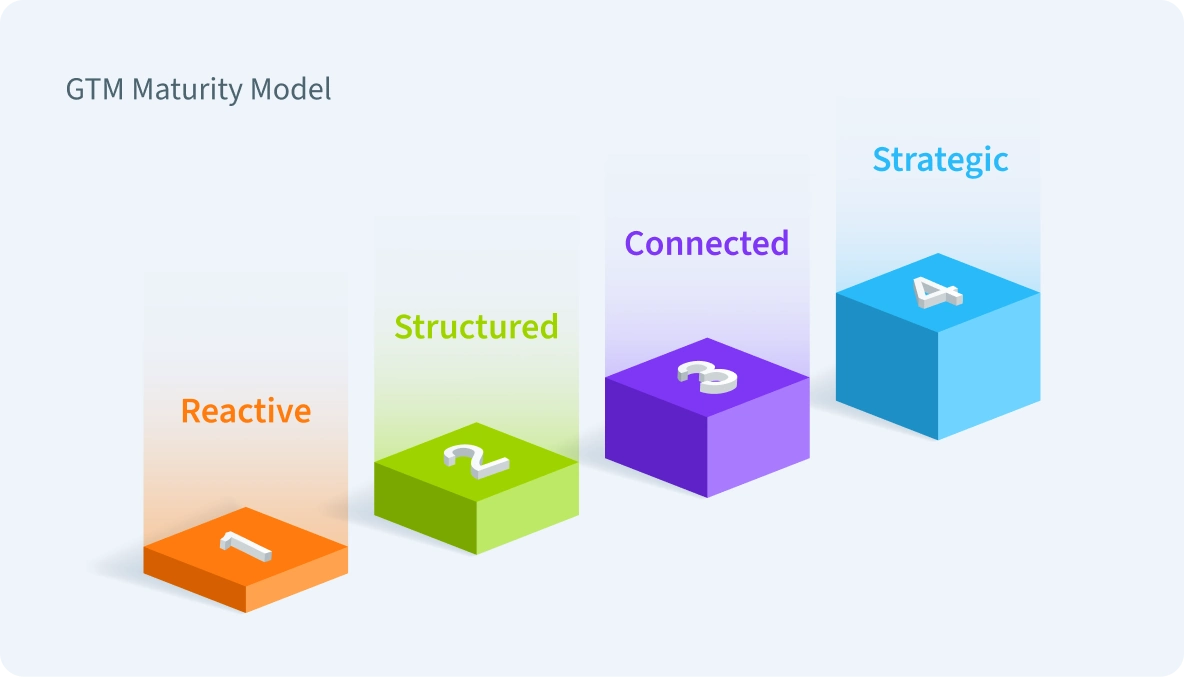
The Highspot GTM Maturity model breaks maturity down into four stages: Reactive, Structured, Connected, and Strategic.
The organisations seeing the biggest gains from AI aren’t necessarily the most sophisticated. They’ve just built a foundation that lets AI do its job. At the highest level of maturity (what we call Strategic), AI shapes execution in real time, constantly refining how teams work based on live data. One level down, at Connected, teams work from shared workflows and AI is starting to influence decisions as they happen rather than after the fact.
Getting from where you are to where you want to be looks different depending on your starting point.
If you’re already operating at a Connected level, the next step is making your system smarter over time: moving from fixed playbooks to workflows that adapt, using performance data to improve continuously, and personalising how sellers and managers develop their skills.
If you’re earlier in the journey, the priority is getting the basics in place: aligning your teams around shared priorities, standardising the core tools everyone works from, and introducing AI in ways that fit naturally into how people already work.
As you move through the GTM maturity model, the impact of your AI investments will continue to grow. When strategy, workflows, and performance signals start working together, AI can surface the predictive insights sellers need to make smarter decisions at every stage of the deal.
To learn more about how Highspot AI can help fix execution, read our new eBook: Why GTM Execution Gaps Are Killing Revenue in the Age of AI.