

According to research by Gartner, 70% of sellers are overwhelmed by the number of technologies required to do their work, and 72% are overwhelmed by the number of skills required for their roles. Put simply: It’s tough out there.
So, how do we create systems that make it easy for sellers to work and, more than that, to win?
Riley Rogers: Hi, and welcome to the Win/Win Podcast. I’m your host, Riley Rogers. Join us as we dive into changing trends in the workplace and how to navigate them successfully.
Here to discuss this topic is Luke Allen, Chief Sales Officer at ELMO Software. Thanks so much for joining us, Luke. We’re super excited to have you here.
Would you mind kicking us off by telling us a little bit about yourself?
Luke Allen: Yeah, thank you. And thank you for having me join you this morning.
My name’s Luke. I’m based in Sydney, Australia. Going to show my age a bit here, but I’ve notched up an almost 20 year career in SaaS sales and go-to-market frontline roles. So I’ve been very lucky in my time to be a part of two key organizations across that twenty-year period to be able to build successful and rewarding careers that have always challenged and stretched me, whilst always creating an amazing learning experience.
I’ve had a number of key sales leadership roles here at ELMO Software from a frontline sales leader through to SVP of Sales and, more recently, as you touched on as Chief Sales Officer. ELMO Software is a human resource and payroll benefits platform, and we service the Australia, New Zealand and UK business markets across SMB and mid-market.
Today, I am the Chief Sales Officer for the group, responsible for leading our sales and partnerships team, which sits just over 30 individuals, so quite a large remit, but it’s so super exciting. Often challenging, but definitely a very rewarding role.
RR: That’s a great way to summarize the job: Often challenging. Always rewarding. Really looking forward to digging into all the things that make it difficult, but that also makes it rewarding on the other side, when you’re solving those problems. I mean, as you said, it’s a large team and a large remit.
Heading up sales at an organization like ELMO Software can’t be easy, but knowing the career that you’ve had, I would be curious to start by looking back. You’ve spent your career in sales.
In that time, how have you seen buyers change and how have sales teams had to adapt in response?
LA: It’s a really good question. I’d say there’s probably two defining periods, certainly in my career.
The first one would be through the COVID era. In Australia, we had a number of lockdowns, some more severe in different states, but that was a pivotable point, certainly in the organizations that I’ve worked across. The buyer experience became more remote and more digital.
We were very much leaning heavily into going on site with customers, spending time, building rapport, and I’m a firm believer there’s nothing more valuable than actually connecting with someone in person. Being able to have the chat on the way to the lift or at the exit gate. Being able to find out the different intricacies of that individual that you don’t typically get to see in a 45-minute Zoom or an hour on a Teams meeting.
So in that expectation around being digital-first, I saw a fairly fundamental shift in that connectedness between buyer and seller.
The second period is the period we’re in, where large language models are making it far easier for organizations to conduct 90% of the research they want to complete when going through a buying journey before actually engaging with the sales rep. So, I’m seeing that as a real challenge to combat.
It means that our reps and our teams need to be far more effective in getting our messaging out in the market, creating a distinguished brand, and competing with competitors in a very tough market.
RR: Something interesting that kind of combines those two shifts is the need to forge a relationship even when times are difficult—maybe AI is making it more difficult, or maybe we’re restricted and can’t climb in the elevator and have the awkward chat up to floor ten.
Knowing that both of these things have kind of changed how reps engage during the sales cycle, what would you say are some of the most significant changes happening today or coming next?
LA: Yeah, I mean it’s super tough for organizations to stay ahead of the curve and that very much can be your competitive advantage against others in your market.
We are seeing real measurable improvements in automation, so being able to actually create real beneficial efficiencies, which gives our teams more time to actually sell in the market. We’ve adopted a number of platforms within our organization to make it far easier for our reps to be smarter and more effective with the opportunities that we’re working with the customers that we’re engaging with.
How do we reduce the mundane activities that don’t add value to our customers in the time that we can spend with our customers?
I think that’s a real competitive advantage, if you are ahead of the curve and you’re experimenting, you’re looking at ways that you can augment the process that you’ve always applied through your sales organization, then you’re gonna find it far easier to drive greater impact from each one of your sales reps.
RR: One of the things that’s most challenging, that I think you touched on, is the fact that there’s not really a playbook. Everybody’s trying to crack the same code, and you’re all scrambling to do it before your competitors do. And things change overnight, so no matter how much progress you make, you’re still growing, learning, adapting, and trying to figure out what technology works for you.
Now you’re in this CSO role and it’s kind of on you to take action to protect your teams and your business, what challenges right now feel really critical to solve?
LA: So, a big one for us at the moment is our repositioning. How do we position ourselves as an organization and as a service provider to the market?
Our key personas have got core priorities that they’re looking to solve and challenges they’re looking to fix, whilst underpinned behind that is a real appetite for AI adoption within, you know, HR or finance payroll space.
As an organization, we’ve had to look at all of our assets, all of our content material to understand what was the messaging effective? What do we need to reset and reform for the way forward?
And we use Highspot really effectively to ensure that our teams have got the right information at their disposal. We’ve got the right deployment of training enablement across the group. And so for me, it’s making sure that we’ve got the right messaging in the hands of our team. That’s probably key priority number one.
Priority number two has really been around resetting how we go to market and our pipeline generation activities have had better definition and better structure. Knowing that we are in, in a challenged market where AI is disrupting the way that organizations research and engage with potential vendors, we’ve had to upskill our team and retrain on the art of outbound prospecting, so that we can ensure that as a pipe generation focus, we’ve got our eggs in multiple baskets and we’ve got clarity around how our team can go out and generate opportunities for their own pipeline.
They go hand in hand in, in my opinion, but really two different priorities: We need to better upskill and enable our teams with the messaging that we want to go to market with, and we also need to make sure that they’ve got retraining and the right skills in order to be able to develop and drive their own pipeline activity.
RR: So, you touched a little bit on how a tool like Highspot can kind of fit into helping you drive those two priorities. Can you walk me through what it was like before having a tool like Highspot?
LA: Yeah, so I think our journey with Highspot is, is about four years, three or four years, and I think Highspot was actually one of the first software platforms within our tech stack, so it was quite a pivotal point in time where we were definitely operating with a lot less control and governance around how our collateral and supporting sales material was owned and, and version controlled.
As a sales leader, I was always worried about what version of marketing content or what version of a proposal template was being recycled and sent out.
We had no central library for our teams to be able to actually find information that enabled them to be the best seller they could be.
It was also then that the sales enablement team and I really evaluated how we’d set up our customer buying experience, so we started exploring how we could turn that into the best possible journey with us and actually turned that into a competitive advantage. And we really knew that most of our competitors weren’t doing this, and quite often our key decision makers were getting confused about who offered what or who did what, or what was the feature that I saw in this platform and the pricing associated with it.
So we saw an enablement platform like Highspot as the real core competitive advantage.
That was validated after we rolled it out because customers time and time again would compliment our team on how professional the process had been, how simple it was to engage with us, and the fact that they weren’t having to troll through emails constantly trying to find something that was shared or some information that was critical to their decision making.
But as many of your listeners would know, a typical buying experience can involve a lot of back and forth over email or text messages or phone calls or zoom calls or whatever it might be. So to have that all centralized in what we’ve created as a Digital Room, we found that to really be an effective way of engaging with our customers and making sure that they’re really supported along that journey.
RR: So, you and the evaluation team are really kind of ahead of the curve in terms of seeing technology as that competitive advantage, recognizing: “Hey, everybody else in our market may not be doing this and this is an opportunity for us to show up better.”
I would love to hear, you know, now that it’s been a few years that business is acclimated, Highspot’s here and it’s here to stay: What kind of role does it play in rep’s day-to-day, and how does it help equip them to win?
LA: It’s a good question, and since we brought Highspot on now, our broader tech stack has evolved.
So, we’re quite strong adopters as you’ve touched on with Highspot. And then we’ve got other contact enrichment tools as well to make sure that we’ve got our team set up with the best tech that, again, minimizes the amount of admin that they need to do, improves the customer experience and simplifies and creates as much efficiencies as possible, all aimed at trying to get more time with customers.
The key to success in my experience, is that you need clarity for your team around what tools are in place and what job purpose are they there to serve.
And so our sales process is quite well refined. We’ve got a really strong, methodical approach to engaging with a buyer and taking them through the journey to evaluate ELMO as a, as a vendor.
Highspot really sits at the very early part of that journey for a customer. So our reps know that once they’ve had the discovery call with a prospect, that’s the point where we need to start to share some information.
We’re gearing up for a demonstration and, in our process, that’s quite contextualized. It’s quite customized for that particular organization. And so as part of that, we need to gather some key information. We need to be providing core details around our security, our implementation experience, as the capability across our product set has some complexity to it.
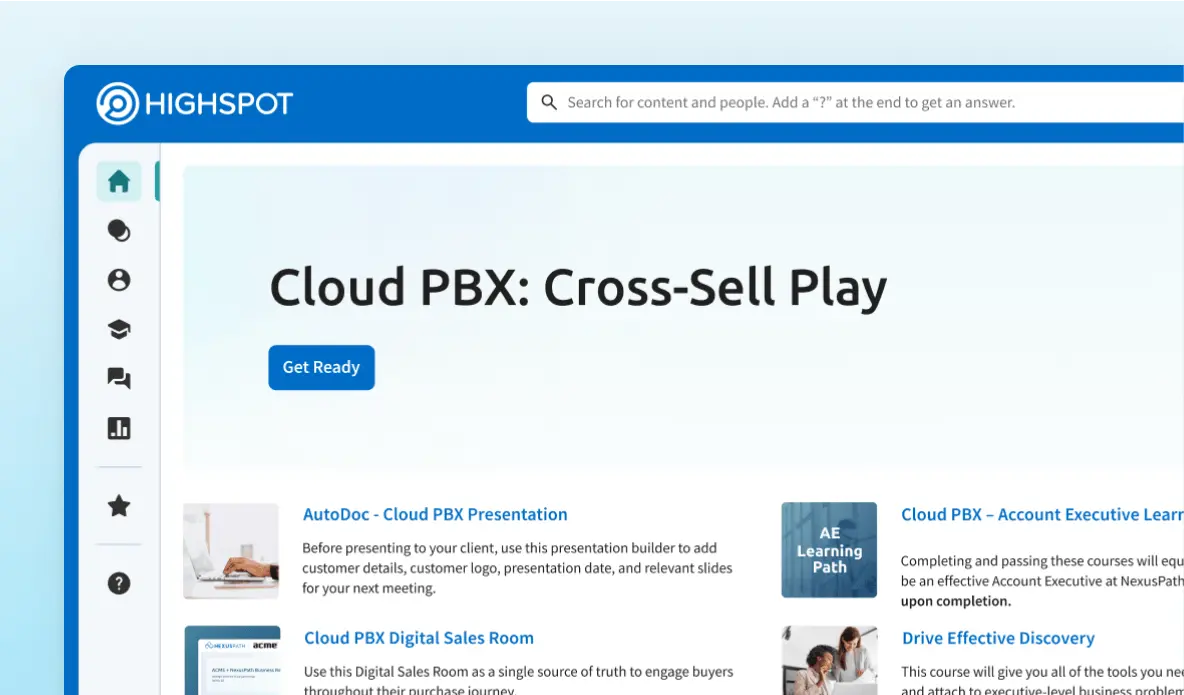
So, to be able to start centralizing that in Highspot ensures that the customer is then brought back to that portal, that Deal Room as we call it, so that anything they need to be serving up, be viewing, sharing with other stakeholders—which for us, can be anywhere from five to 12 different individuals.
What we’re trying to do is minimize the amount of time it takes to duplicate or replicate different steps of the process.
So again, we’re trying to cut down on having to re-sit the same meetings, and we find that quite a powerful way of getting multiple stakeholders into that particular Deal Room and start gaining analytics around what are they viewing, what are they engaging with?
And so that’s a nice subtle way for the rep trying to unpack and further engage to get clarity around what might be a potential blocker further downstream in the deal.
It’s quite a key part of our sales process, Highspot. It does live right through that buying journey to, you know, post-contract. The customer goes through their onboarding and their implementation approach, and then we hand over the Deal Room to the customer team so that again, they can continue to keep that as a live Room right throughout their experience with us.
And we’ll continue to update that Deal Room as further discussions or upsell opportunities occur, which, which we find is great continuity through the, through the handoff process internally.
RR: That’s amazing to hear that the one Room—from discovery through to convincing five to 12 buyers through to signature and beyond—kind of is that single source of truth. So, you’ve solved some of those challenges of: “I’m digging through my email, I’m control-F trying to find all of the sales collateral that I have.”
What was the process like of getting to this really seamless end-to-end digital strategy?
LA: The key really was there was clarity across the organization that we didn’t have a really good enablement hub, so we didn’t have SharePoint. There was no core library where people knew just to go there to get something. So, I was quite lucky in a sense that people were hungry for a system like this.
We had to have someone that could own the platform internally, which our sales enablement team really invested a lot of time and effort early on in making sure that this is a reset, so let’s review all the assets, make sure that they’re all current, that we’ve got everything we need for our team to be super successful.
And that whole process made it much simpler for all of our teams that the buy-in was quite simple, quite easy. I think spinning off from that then was the ability to leverage that content, pull it into a customer Deal Room.
For our reps to actually see when our proposal document was being accessed and what kind of engagement we were getting on it, I think really then drove stronger engagement for everyone to actually be using this consistently for every single opportunity. It snowballed very quickly and has had such a significant improvement on our velocity rate because we’ve got that really good experience set for the customer.
They know where to go to get the information from ELMO. They’re probably—hopefully—still trawling through emails from our competitors. And so we’re simplifying that whole experience for ’em, which again has been a really good driver for our teams to adopt and embed it within their process.
RR: Yeah, you’d mentioned that, you know, you heard directly from buyers and from customers that you guys are showing up professionally and you’re showing up more professionally than your competitors.
You touched on it a little bit, but is there anything else you can share in how that has changed the way that buyers engage with your reps?
LA: Yeah, I think like, and I can talk to my own experience having purchased software platforms here, and I’ve gone through that mixed experience of Digital Rooms, emails, and some combination of the two, and I do find it really, really seamless when you’ve got somewhere to log into and you know everything you need to revisit.
You’ve gone out to market and evaluated 4, 5, 6 different options. We all know that that can just blur the lines between who does what and which option has what. So if you’ve got that simplicity, then it makes it far easier to undertake the steps you need to, as a buyer to, to gain approval and actually make a decision.
I think that has been sort of the key for us in driving down our average time to close. In the last couple years, we’ve shaved nearly 60 days off, which in part is due to Highspot. And I think also the effectiveness our team has had in using platforms and tools to augment their approach and simplify the way that they follow up and, and manage a deal through its steps.
But definitely the position of the brand and the professionalism that is portrayed by having good structure and good setup in the way that you drive a sales process. And the velocity has been simplified because we have been able to point multiple stakeholders into the Deal Room to be able to get what they need when they need it without having to have a delayed back and forth approach with our team.
And then I suppose the other part of it really is that having an enablement core library for all of our information and content has meant that we’ve been able to cut down on the time it takes internally to rally and find and support our team with information they need.
But it’s also given us a really good framework on how we go to market with new products and new launches by having a really strong page set up for that particular enablement program around that product. And again, we point our team to that, to be able to undertake the learning, the training, or the information enablement that they need around that particular new launch.
So our go to market motion is simplified as well.
RR: For one, I think that’s kind of all of the things that you always hope to hear. But for two, you know, we opened with that stat about 70% of reps are anxious about their tools and another 72% are anxious about their skills.
What you shared there—you know, a 60 day reduction in time to close—that shows you what happens when you build that system.
So, I’d kind of like to flip that last question on its head. We talked about what you’ve heard from buyers. What about what you’ve heard from reps?
LA: We’re quite, I would say, proud of the fact that we’ve got really good tenure within our sales organization. So, I mean, I’m eight years with ELMO and I’ve got a number of BDMs or AEs that joined not long after I did, who have really forged their career here.
And I think what’s kept them engaged and motivated is the fact that we have been able to drive forward with innovation and with technology to make the selling experience so much greater. When you’ve got powerful AI tools that can really impact the way that you invest your time and the impact that you can have with your customers, that ultimately leads to greater success for them and ultimately, you know, more money, which in sales we’re, we’re all here to to make.
So, I think by setting the foundation with Highspot and showing that we are as an organization, investing in enablement and support and not just expecting people to show up and figure it out has meant that it has been a very fast, rapid moving environment, but it has brought with it a lot of success and we have gone from what was a much larger sales team to what I would say is a now a right sized organization.
We reduced our frontline sales staff, because we’ve been able to really invest in the improvement in skills and effectiveness from our team, which means we can actually drive greater impact and results at the backend.
Coming back to the original question, I think it’s the fact that technology and, Highspot in particular, has really narrowed that gap in understanding how companies engage with us: What are the triggers and signals that can help us potentially drive different levers or course correct if need be, so that we are having more impact with every interaction along the journey?
RR: I’d love to ask a question that maybe we’ve been dancing around a little bit. What results are you most proud of as a sales leader?
LA: I think there’s probably a couple of points that I can pin around the impact Highspot has made, certainly the reduction in our average deal cycle for cast back over that four year period.
We’ve gone through some challenging periods when we look at the COVID era. More recently, we’ve got the AI era and that is all impacting the buyer experience and buyer journey. But consistently at ELMO, we’ve been able to drive continual growth year on year with less sellers, which has been, you know, a significant outcome from the right technology and tooling.
Particularly with Highspot simplifying, as we’ve touched on, that back and forth process, that typically can drag out a deal cycle and opportunity. So for me, the ability to continue to drive that down year on year is definitely a key outcome from having Highspot.
We’ve also been able to ensure that our risk is reduced when you look at the governance around content that our teams had been sharing as horror stories that exist, not just at ELMO, but you know, many of my peers often share with me about misinformation from the wrong customer going to another customer because an old proposal template has been saved locally on someone’s computer and they’ve updated a few points and that can drive a lot of commercial risk.
So I think for us, where we’ve got a high degree of importance around data security and information management. Having that governance layer across our content in Highspot gives us really strong confidence that what is going out the door is actually moderated and accurate. So that’s probably one of the really important points is that there is.
Good cadence and confidence now around the relevance and currency of our information, and that is all controlled from an admin level within Highspot for our teams to be able to leverage the right information at the right time.
RR: So it sounds like you’ve reduced risk and, through that, increased velocity, so you know that your teams are doing the right thing and they’re doing it faster.
I would love to close on maybe some advice for folks in your shoes or in similar shoes. What is one piece of advice you’d give to sales leaders trying to help their teams, weather this ongoing disruption and consistently deliver strong results regardless.
LA: Probably reflecting on the last 12 to 24 months for me, like what a time it is to be operating in the sales leadership role.
Casting back five, eight years, totally different landscape, far less enabled, less technology. I think the key advice I would have is to make sure that you are able to drive your team forward by experimenting, trying new things, creating an environment where your team feels comfortable in having a go.
And it may not always work.You may not always find something that’s useful, but to have a culture that is empowered to actually give it a go is what’s gonna unlock real potential.
But all that said, I think the real driver of success is that less can be more. Don’t try and drive too much change all at once ’cause there’s only so much that reps and that us as leaders can actually absorb and effectively drive.
So, don’t boil the ocean. Identify one or two things that would really make a difference and then really lean in hard. And that’s where I think the positive outcomes will come.
RR: I think that’s great advice because everybody is looking out and, I think, feeling a little overwhelmed. There’s a lot out there, there’s a lot of problems to solve, so finding the one or two that are gonna be very impactful is going to be so key in running faster and closing quicker—all of the things that you covered today. So great advice to close on.
Beyond that, thank you so much for joining us. There were so many wonderful insights our listeners can take away from. I really appreciate you taking the time.
LA: No, thank you for having me. And again, thanks for all the help and support that Highspot’s provided us over the last four years. Here’s to the next.
RR: I’m sure there’ll be all sorts of wonderful things to hear next year.
To our audience, thank you for listening to this episode of the Win/Win Podcast. Be sure to tune in next time for more insights on how you can maximize enablement success Highspot.