


According to research from the State of Sales Enablement Report 2025, businesses with well-integrated enablement tech stacks are 42% more likely to increase sales productivity. So, how do you go about building an effective, well integrated tech stack?
Riley Rogers: Hi, and welcome to the Win/Win Podcast. I’m your host, Riley Rogers. Join us as we dive into changing trends in the workplace and how to navigate them successfully.
Here to discuss this topic are Nicole Cost, director of enablement and operations, and Becky Garcia, enablement operations manager, at Lantern.
Thank you both so much for joining us; it’s so exciting to have you here. I think there’s probably a really wonderful conversation to be had, and I’m excited to jump into it. I’d love to start by learning a little bit about yourself, your background, and your role.
Nicole, would you mind kicking us off?
Nicole Cost: My name is Nicole Cost. I’m the Director of Commercial Enablement and Operations at Lantern. At Lantern, our department’s primarily responsible for supporting our commercial new hires with their onboarding experience, process strategy, collaboration, and communications, and then in-person meeting operations and logistics.
I’m based in New York. I’ve been in this space for about four years, but prior to working at Lantern, I was at Carrot Fertility and I worked in a totally different industry in sport and entertainment; I was a teacher and worked on the business side in a very different world.
RR: Becky, would you care to tell us a little bit about yourself?
Becky Garcia: Yeah, definitely. So, I’ve been in the industry now, I’d say I’m going on my seventh year in the health services and health tech space. I’ve been kind of all over in terms of my background, but in the last seven years I’ve really been in an operations role.
Part of what I love doing here at Lantern is helping companies grow and scale. That’s really what I love to do.
RR: It sounds like you guys have been here before. This isn’t your first rodeo. You’ve spent the time not only in the industry, but also specifically in healthcare spaces, both at Lantern and in previous roles. I’d be kind of curious to dive into those previous roles and how they kind of affect today before we jump into your work at Lantern.
So, Nicole, what challenges have you noticed pop up that people in other industries might not expect?
NC: What I loved about this question to kick us off was because I was actually, like I mentioned, one of those people in another industry for about 10 years before pivoting to healthcare, and I will never forget my first manager asking me: “How much do you know about healthcare?”
And I responded—I remember it vividly—I responded with: “I know I have great benefits.” I quickly learned that great benefits were not a normal thing, and that is why so many companies either are being created or evolving to provide healthcare benefits that most people in the United States do not have access to.
And usually these gaps are incredibly expensive. They’re very emotional, and they’re non-linear in their journeys if everything is just very complex. So one could say that selling in healthcare is more difficult than many other industries. But when we ask our new hires—we ask: “Why did you choose Lantern?”
And I would say almost 100% of them say they wanted to be part of a mission-driven company because the work is meaningful. It might be more complex, longer cycles, everything’s a little bit more difficult and nuanced, but it is mission-driven and really meaningful.
All of this to is say that our enablement approach at Lantern focuses on collaborating with our friends in learning and development and our cross-functional partners to arm our internal team with tools that they need to succeed.
RR: I like what you said there about nuance. I feel like a lot of the time when we talk about difficult selling environments like healthcare, challenging, obstacles, difficulty—this is all kind of what pops up.
Those are the words that we use, but I love that reframe of like, “It just is what it is. This is normal and we’re doing our best to help people.” It’s nuanced, it’s not challenging. I love that reframe. As we talk this through, from your perspective, Becky, I know you’re coming in with a background in operations, which likely gives you a bit of a different perspective.
Can you walk us through what it means to drive operational excellence in the healthcare space and, again, maybe how that differs from other roles you’ve held?
BG: Definitely. From an operations perspective, I think driving excellence in healthcare really means building reliability into a very complex system. So as Nicole mentioned, healthcare isn’t linear and there are many moving parts.
There’s handoffs, regulations, nuance, and a lot of emotion for people that are going through it. So excellence really isn’t just about efficiency, it’s about making sure that the right thing happens consistently, even as you are scaling. Operational excellence is also what ensures that we can deliver on process, discipline, documentation, reporting.
And if that’s not strong enough, that’s really where scale breaks down. That’s where enablement comes in. And tools like Highspot really help us turn our best practices into the standard of work, and they help us give our teams confidence that what they’re saying in the market really matches what the organization is expecting.
At the end of the day, operational excellence is really how you make impact repeatable, and that’s gonna be for patients, it’s gonna be for customers, and it’s also going to be for our teams who are doing the work.
RR: That’s a great answer and I like how you look across excellence to understand how you build the systems to support it.
And for whatever environment you’re in, that’s the goal. How you get there maybe differs a little bit— and it probably differs a lot when you’re dealing with, like you said, highly emotional, highly impactful scenarios—but at the end of the day, you’re still driving toward the same things.
I’m excited to hear how you’re driving towards those, especially knowing that just a little bit ago, Lantern hit a period of extremely rapid growth. What kind of challenges did that create for the team?
NC: Growth is exciting. It’s a privilege. We’re excited to be part of that. And what was great is we already had the building blocks in place for our new hire onboarding experience. They were in place, and we were welcoming new hires on a weekly basis with custom 30, 60, 90 day plans.
But we learned quickly that that just was not sustainable for our small team to maintain a level of excellence that we pride ourselves in Just. Wasn’t gonna work because our new hire numbers continued to grow and our team is still the same: It’s Becky and I. So the biggest challenges that we faced, I would break into probably three categories: process lag, quality control, and then updated content and assets.
So, we continue to bring in the best talent and the industry, but it was incredibly important to us that we recognize these challenges as opportunities to redesign how the work gets done. So this is when we started to evaluate tools like Highspot. And even as recently, like our colleagues in marketing sing Highspot praises because it helps make their content more discoverable.
RR: Becky, can you talk to us from an operations perspective, you know, hearing some of these challenges, how did they influence the decision to invest in a platform and, and why was Highspot kind of the right answer for you guys?
BG: From my perspective, I think the biggest impact of rapid growth was really fragmentation.
We were scaling headcount, products and processes all at once. Information started to live in too many places. There were decks here, documentation there, and there was really a lot of knowledge in people’s heads. The lack of consistency really created friction fast. It resulted in people not being confident about what the latest and greatest was.
At the same time, like taking a step back, we were also going through a rebrand of the company, which actually made it a perfect inflection point. So we had an opportunity to really step back, refresh our message, and our resources all at the same time. And we really got to be intentional about how we showed up both internally and externally.
So rather than just updating assets that were in place, we wanted to start with a fresh source of truth. And that’s ultimately what helped us drive the decision to invest in Highspot as we discussed. Like we’re growing so significantly, we’ve doubled in size from our commercial team, and so we needed to onboard a lot of people with very unique roles and then also operationalize best practices as we grew.
RR: I knew a little bit about those early days. You’d mentioned hypergrowth and things like that, but knowing that you had doubled headcount, you were going through a rebrand, and you were implementing a new platform and evaluating a new platform at the same time, and it’s the two of you doing all of that.
I think there’s probably a lot of people that will listen in and be like: “How?”
Because that sounds like quite a lot. We’ve heard about all of the work that was being done, all of those initiatives that were kind of coming together to prioritize the need for a platform, the need to get reps up to speed quickly. So, what did onboarding look like before and why was it kind of time to make a change?
NC: So as I mentioned from just the beginning, but our commercial onboarding experience has always had a formalized program, and we’ve always had our building blocks that work really well to create a consistent welcome for all of our new hires, no matter the job title or department.
And our focus is who we are, what we do, and how we do it. And this gives all of our new hires an overview of our solution, external assets and collateral, and insights into many internal processes. But in the early days of our organization, when we were onboarding about maybe 10 to 15 people a quarter by 2025, this number doubled, and our old-fashioned Excel spreadsheet trackers and custom PowerPoint presentations that each individual got just was not cutting it.
We’ve had two iterations in Highspot. The first pass we simply transferred all of the great content that we had from this PowerPoint deck into an onboarding spot and a spot overview.
So we had that. That was like a main piece that we’d walk through with our new hires and we’d make sure we’d give them all this content. But we also had 30, 60, 90 day lesson plans, depending on the new hire’s role and department. We coupled this experience with a live welcome call that we still do. Our president works with our new hires, and we still do all of that and it covers a lot of basics around our company and the commercial culture, and would involve us sharing our screen of Highspot and like, here’s how you use it.
It’s a really nice, like way to introduce everyone to the platform and where they’re gonna be living. But after about six months of these custom lessons, we needed something that we could copy and paste, essentially so we could scale.
And I even spent time with Brooke Holland from your enablement team and she was lovely and she helped us bounce ideas off each other and just learn what worked really well for Highspot actually internally. And how she could look at our content was like: “This is great, let’s translate that.”
I think that was really helpful to now take us to our most recent iteration, which we’re in currently, and it took all of this quality content from our foundational onboarding spot. Into a course. So now we have a full course that’s all of this great content. We call it Bright Starts because we love a good light pun at Lantern.
And all of our new hires are enrolled in this course and have three lessons. So it’s their first 30 days, the next 30 days, and then that final days to today, 61 through 90 for their first 90 days on our commercial team.
I’m really excited because—as of this week—we have 100% new hire adherence to this course, and the average final score is more than 91%. It’s been such a hit, and Becky can attest to this. It’s just been a labor of love and it’s so cool to see it come to fruition and like.
RR: Yeah. I liked hearing about the journey it’s been. It makes me so happy to hear that. It sounds like you’ve built something really impactful. I mean, 100% adherence—those are impressive numbers and I hope that it feels like you’ve reached the point that you wanted to.
NC: Yes. I think it has. I’m so happy. I think—I don’t wanna put words into Becky’s mouth—but I think she is proud of it too. And I also just think what’s nice is we can now like, let it settle and it’s taken about a year for us to, I feel like, really get to that point. So here we are.
BG: Yeah, I think one point I just did wanna add on that is Nicole, earlier you mentioned how important our internal team satisfaction is and just like seeing the scores of the satisfaction that come out of this has allowed us to really tweak and where we need to and pivot and make changes.
And so, I think when you look at our scores, not only are people adhering to the course, their final scores are really high, but also their satisfaction is extremely high. Highspot really allowed us to easily tailor and improve the process and our team’s feeling it.
RR: Amazing. That’s the full picture you want, right?
So, we chatted about onboarding being kind of one of the primary drivers of why you started doing this in the first place. And we have also heard that you’ve kind of blown past that early goal. You’ve set up something that you can consistently run with.
Now, like you mentioned, it’s not just you in the platform. The content team is trying to do things, the marketing team is singing its praises. Can you talk to us about how other capabilities, things like AutoDocs help you improve the rep experience? And then maybe a little bit about what impact that’s had?
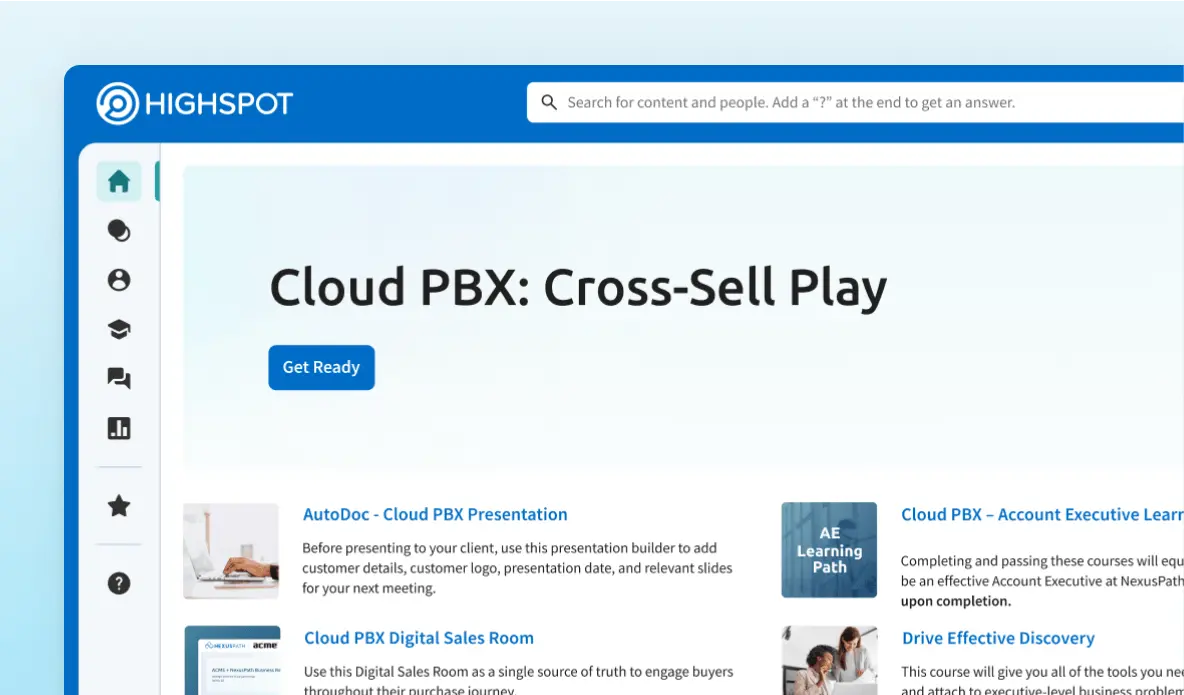
BG: We use AutoDocs with our client success team to help automate the marketing pieces that they send out to all of their clients.
And so really what our team is doing is they’re self-serving requests that were previously going through our creative and marketing teams. And so with AutoDocs, our client success teams can quickly generate client-ready, compliant assets using the approved templates that we’ve uploaded into the platform.
And they can automatically pull in correct logos, they can update client language and also make it contract and plan design specific. And so this really has enabled them to self-serve, but also just really produce some high quality marketing materials to our clients.
Today we have 41 marketing assets that live in AutoDocs as templates. Each asset on average generates about 20 documents. So what that means is that we have a variety of assets. Our team can come in here and pick and choose for their clients, which resources they want to customize, and then on average, they’re making 20 of those copies for the various clients that they support.
So, that really is about 820 client-ready resources that no longer need to flow through our creative or our marketing teams. This has really helped us one, by giving autonomy to our client success teams, so now they can move faster and respond to clients in near-real time, especially during high volume periods.
This is critical for keeping our clients happy, but also the team members who are doing the work, they don’t have to feel like they’re waiting around for marketing. When they can make these changes themselves. Also, this helps ensure that we have just continued to iterate on our brand.
So we’ve got brand compliance consistently across the board, no more awkward logos or off-centered logos. That would generally be like the outcome if our team had to go in there and make these manual changes.
Another big benefit I think is how we collect and act on feedback as a team. Generally, if we needed to handle like one-off conversations of like, we need to tweak this language on this one because of this specific scenario, that was done in a silo.
It went directly to creative and marketing, and then they would have to make these changes. But now everything really lives in a collaborative space, and so this has created transparency and a single feedback loop between our field and our marketing teams so our reps can see what’s already been flagged because the changes are made directly in the template, what’s been updated and what’s already been addressed.
So, there’s no need to have that conversation multiple times. Overall, our teams can self-serve confidently. Our creative team is really freed up to focus on the work that truly requires their expertise. I think all of our team is really happy with the product and when we’re looking at those numbers. It just speaks volumes to our ability to scale.
RR: Yeah, I think when you’re saying hundreds—800—assets that you can customize, scale and get out the door quickly, I think that does speak volumes. That is fantastic to hear.
And I can imagine that was probably a lot of friction that you were able to reduce for your customer success team and your creative team who didn’t have to be like: “Oh, another request in Slack for an improved logo or a changed color.”
I’m sure everybody appreciates that. So we talked about onboarding and what you’ve done there. We’ve heard about the way you’re scaling at AutoDocs. Looking across the work that you guys have done, what are you most proud of when you look at the data? What improvements, achievements stand out the most to you?
NC: So for me, there are two things that stand out and I’m incredibly proud of our patience as a small team to roll out and iterate our overall strategy using tools like Highspot to be nimble so you can have all the plans in the world. And then—boom—like change that you didn’t expect, or new solution or “we’re not gonna do this any longer.”
It just happens in this healthcare world, and it’s not for the faint of heart, especially for those of us—I think you heard our titles—in operations. We thrive on routine and process and formality, like rule followers, right? So it’s really difficult to have the ability to stick to strategy without patience and the ability to pivot.
So I’m really proud that we’ve been able to do this a lot. Since our functions started at Lantern almost two years ago, and we’ll continue to operate this way, but I’m also really proud of our colleagues’ willingness to keep learning.
I think, Riley, you mentioned it just like so much change happened at once and then poof! Now you gotta learn a new tool and a new way to do things. It’s not easy to adopt new tools and processes, but also managing that ever-changing landscape of our industry.
I’m really proud of the fact that not only as our team, like they have been so kind, honestly, and patient with us, but they’ve also just been great teammates. Our number one goal is always going to be to value add, not add more work. I believe a major reason that we have a high satisfaction rating as a team, as an internal team working with us is because of our colleagues’ partnership.
BG: What I’m most proud of is that we’ve built some real trust with our teams.
Highspot has genuinely become a place where people go first. We hear constantly, or at least I hear from managers and leaders say things like: “Did you check Highspot?” when their teams ask for help or for resources. Or even when team members have looked in Highspot, they’ll come to me and say: “Hey, I already looked here.”
It’s moments like this that truly bring me joy because it reinforces that we’ve created something valuable, something that’s reliable, and that’s really embedded in how people work day to day. Also, I think what stands out to me from an operations perspective, I’m always gonna come back here with what data we’re using to guide our decisions.
Whenever we receive feedback, we’re not guessing or reacting in isolation anymore. We can look at usage, we can look at engagement and patterns to really understand what’s working and what’s not. And then this also helps us drive, like where we can invest our time. So that really has allowed us to iterate thoughtfully, prioritize accordingly, and then also continuously improve.
To look at a couple figures, I think we’ve had tens of thousands of views across our entire platform of the resources that are in there. And so from looking at Q1 2025, we had about 55% of our audiences who had viewed the content. And fast forward, now we’re about halfway through this quarter, but comparing we are now at 93%.
RR: That’s amazing. And I’m sure just hearing the way that that was said, you guys are proud of that increase. You know, 55 to 93% recurring adoption proves that like you said, Nicole, your teams are patient with you, and to your point, Becky, you built the trust and you built the brand, so now you have that foundation that everybody reliably uses and can run with to do all of the things that you need to succeed.
Hearing all this, it definitely tells me that you’re qualified—more than qualified—to answer this last question I had for you, which is for other teams looking to build high impact programs kind of from the ground up, what’s like one piece of advice you’d share about getting started and building efficiently?
NC: Well, did I mention patience? My mom would be really proud of me that I’m mentioning patience and that I have been patient, since that’s just like a theme of my life—I don’t think I’ve ever been patient until I became a professional. My advice actually comes from an author that spoke to us at—we have a Lantern book club—and Max Yoder is the author who wrote the book Do Better Work.
It’s an awesome read. Totally recommend. One of his pieces of advice was to share before ready. So honestly, it’s been such a great mindset because of all of the change and when implementing change. We, of course, have always ensured clarity around the problems we’re solving. So I don’t want you to think that we don’t like, that doesn’t mean ‘share because we don’t know what we’re solving for.’
It’s more so we know what we need to do, but we’re taking the time to roll out programs and really being thoughtful about the tools that we’re selecting or what we’re adding on, or what we’re encouraging people to use. And when we’re rolling them out, we want it to be automatically useful and simple.
We just want it to be like, here it is. Now you have it, bookmark it and use it. And this has allowed us to become efficient in practice over time, and I think that’s what helped us earn our peers trust.
BG: I think my biggest piece of advice is to not start by trying to build everything at once. I think the best starting point is to become a trusted source for your teams, so that means solving real problems really well and making it easy for people to know where to go when they need help.
When team members trust that the information that they have access to is current is accurate and is. Actually useful. I think adoption follows naturally. From there, I think you can use data and feedback to iterate intentionally instead of guessing or reacting to the loudest request. I think building efficiently isn’t necessarily about moving fast for the sake of speed.
It’s about creating clarity early, listening closely, and then letting trust and insights guide what you’re building next.
RR: In everything that you have shared today, I think you can see the threads of this advice. You’ve mentioned feedback and trying to understand the experience from your user’s perspective and partnering cross-functionally to understand what people need.
So we’re seeing that, you know, share early and then we’re seeing that don’t boil the ocean when you’re facing doubling headcount and a rebrand at the same time as you’re launching an entire platform. You guys have this approach that is so measured and calm, so bravo for all of the work there and thank you so much for sharing it with us.
It’s been so wonderful to hear more about the world that you’re living in and the wonderful work that you’re doing in it.
NC: Thanks for having us, Riley. This was great.RR: To our audience, thank you so much for listening to this episode of the Win/Win Podcast. Be sure to tune in next time for more insights on how you can maximize enablement success with Highspot.