

According to the State of Sales Enablement 2025 Report, 20% of organizations see the sales process as a key strategic priority. So how can you optimize your sales process and drive higher win rates for your team?
Riley Rogers: Hi, and welcome to the Win/Win Podcast. I’m your host, Riley Rogers. Join us as we dive into changing trends in the workplace and how to navigate them successfully.
Here to discuss this topic is Aaliyah Patel, senior specialist, customer marketing at Ansell. Thank you so much for joining us. Aaliyah. I’d love if you could start by telling us a little bit about yourself, your background, and your role.
Aaliyah Patel: Absolutely. Well, thank you for having me. My name is Aaliyah Patel. I’m a senior customer marketing specialist here at Ansell, where I’m a part of the customer marketing team.
My role really centers on leading our sales enablement in digital MarTech operations, so ensuring that our systems, processes, and data flows that support our go-to market motion are aligned, connected, and easy for our teams to use.
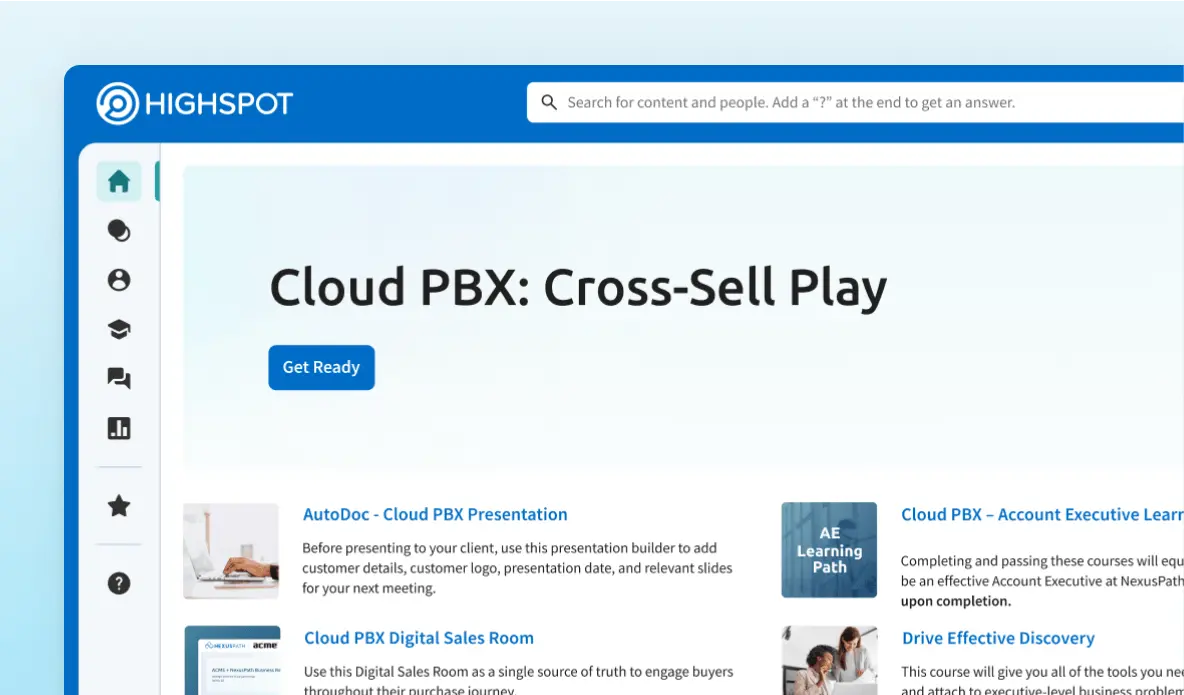
A large part of that includes overseeing the digital tools like Highspot in our tech stack, supporting content governance and building scalable frameworks that help reps access the right insights, messaging, and assets across the buyer journey.
The goal is to ultimately empower sellers and partners with the clarity tools and visibility they need to drive growth and deliver consistent customer experiences.
RR: Just from what you mentioned there, it sounds like we have quite a lot of ground cover in terms of your experience, your background, and then the work that you do with Highspot.
Before we kind of jump too far into the deep end there, I always kinda like to start by getting a sense of the environment that you’re working in. So I know that Ansell manufactures and distributes a really wide range of products.
What are some of the unique challenges that go-to-market teams face when selling in this environment?
AP: Absolutely. So, Ansell serves an extremely diverse markets, so anything from industrial safety to scientific to healthcare. And each customer group has different expectations, buying cycles and safety requirements.
Reps often need to shift between very different conversations throughout the day. And the challenge isn’t necessarily complexity, it’s clarity. Reps need to quickly position the right solution, especially when our portfolio is broad and customers span multiple industries with unique needs.
There’s also the constant need to stay current on new product developments and differentiators across categories; our priority has been making sure that our teams have a unified way to access information, understand messaging, and communicate competently no matter what business they’re supporting.
RR: I love the shift that you mentioned there: it’s not necessarily complex, instead the challenge is making things clear and easy to navigate because yes, there’s a lot going on. You can’t change that, but you can pull certain levers to make it a little bit easier for your teams. Knowing that’s kind of where you’re at, I’d like to turn towards some of the actions that you and the team are taking.
So, what are some of the key go-to-market initiatives that you’re focused on? And then how are you enabling reps to find clarity in Ansell’s sales environment.
AP: A major focus for us has been simplifying how our teams access and leverage content to drive more consistent, confident customer conversations.
We’ve strengthened our content governance, we’ve centralized materials, and we’ve made it much easier to connect the right message to the right audience.
We’re also aligning more closely with sales to ensure that our go-to market initiatives are really grounded in real customer challenges. Whether through targeted campaigns, sharper product positioning, or ongoing training and enablement, everything that we do is centered on helping our teams articulate our value across the diverse markets and products that we sell in.
We’re seeing the impact of that work in real time: We’ve had over a hundred thousand content views with almost a 90% reoccurring usage rate, which tells us that the structure we’ve put into place is resonating and helping our teams move faster and stay aligned.
RR: I love that you came in with the data to back it up—actually, not just the data to back it up but great data to back it up. That’s super impressive, especially knowing that you guys are a little bit early in your journey, that you’re already finding that significant success.
One of the things that we’ve heard is that a key focus is the sales process. So in your experience, what are some of the essential building blocks for creating a sales process that’s driving these business results that you’re seeing?
AP: For us, the foundation comes down to three things, so it’s simplicity, alignment, and insights.
When you bring clarity, consistency, and real data together, you create a process that’s scalable, repeatable, and tied to business outcomes, and it allows teams to adapt their approach, depending on the customer segment that they’re working with that day.
RR: I think you touched on some really compelling aspects there, and I think I’d be curious to double click into a little bit more of what you said and about how you’re bringing some of those building blocks to life, especially with a platform like Highspot.
So, can you talk about the role that an enablement platform plays in helping you streamline that sales process?
AP: So the value is truly structure and connection. An enablement platform brings content, people, and insights together, and it gives everyone one place to operate from. It reduces the time the seller spends searching for materials; it makes sure that our messaging is aligned across our campaigns and launches, and it also creates visibility into what resonates in the field.
So, it’s truly become the backbone of how we support consistent execution across the buyer journey.
RR: I always love to hear that consistency is kind of what’s coming out of your usage of an enablement platform. I think that’s really the goal, right, to help standardize your messaging and bring consistency to your teams.
I would love to dig a little bit deeper into that and kind of the benefit that you see of partnering with Highspot. How does this partnership help you drive some of those core initiatives? You touched on this a little bit already.
AP: Partnering with Highspot has been incredibly valuable because it gives us a partner who truly understands the complexity of a modern go-to market environment that helps us operationalize our strategy in a really scalable way.
For us, the benefit is twofold. First, Highspot provides the structure we need to centralize our content, our launches, our campaigns, and our customer facing materials, so our field teams can execute with confidence. It creates alignment across marketing and sales, which is essential when you’re supporting multiple markets and product categories.
Second, the partnership helps us accelerate our core initiatives. Whether we’re rolling out new product messaging or enabling our teams on evolving customer needs or programs, Highspot gives us the platform, analytics, and support to execute and quickly measure the impact.
We’re not just using the platform, but we’re truly maximizing it, and the collaboration has helped us build stronger governance, improve adoption, and really tie our go-to market strategy back to real behavior and engagement. It allows us to deliver a more consistent story, support our reps with clarity, and really create a unified experience across every touchpoint.
RR: That certainly makes me, and I think all of our teams happy to hear. One of the things that’s really interesting about what you said is that earlier you gave us the data to kind of back it up and say that yes, we’re seeing these things anecdotally, but we’re also seeing them empirically.
Thinking of that data, I know that it kind of speaks for itself when it comes to the work that you and the team are doing, but we’ve heard that Digital Rooms have been a key driver in your enablement strategy and in your strategy with Highspot.
In just 90 days you’ve generated like 3,000 views with your Rooms. How have you and your teams been leveraging Digital Rooms? Can you talk to us about what impact you’ve been seeing so far?
AP: Digital Rooms have become a core part of how we help our teams go to market. We use them to create curated experiences that package our messaging assets and resources into a structured, easy-to-navigate format that aligns with the story we want to deliver so reps can use them to deliver a clear and consistent narrative and everything they need is in one place.
This helps our teams guide customers and partners through a cohesive experience. That visibility supports stronger account planning, more intentional communication, and better alignment with customer needs. The engagement has been strong. We’ve created over 500 Digital Rooms with an average of 30 minutes of viewing time per Room.
Some have accumulated between 20–60 total hours of engagement, and several have been shared externally more than 40 times, which shows us that our customers and partners are engaging with the content in meaningful ways.
RR: I love to hear how you’re using that Digital Room scorecard to keep a pulse on how they’re performing out in the wild. When you are supplying go-to-market teams with these Digital Rooms, is it the marketing team that’s building them? And if so, what kind of use cases are you building for?
AP: It’s in partnership with both marketing and sales, so we can help them create them if they’d like, but then they also have full autonomy to go and create them themselves for their specific customers.
Use cases can include any specific interactions, follow-ups, trade shows, anytime that they’re meeting, any one-to-one interactions that they’re having, and any time that we want to consolidate a bunch of product brand information all into one curated microsite.
RR: Okay, fantastic. I’m always a little bit curious about who owns those things, how you’re kind of building templates, and what you’re building for.
I’d like to maybe switch gears from the digital rooms arena, knowing that you have the fun but kind of challenging job of being Highspot’s solution owner for Ansell. In that role, your major job is to drive adoption and effective usage of the platform.
Just a few months after launch, you’ve already reached a really astounding 85% adoption rate in Highspot, which—when you think about the breadth of behavior change that needs to be done—is super impressive.
What are some of the best practices, if you have any that you could share, that helped you drive that adoption right off the bat?
AP: I love change management and it makes it super fun. Our approach has been focusing on education consistency and advocacy, so we spent a lot of time with each of the different teams, showing them how to use the platform and how it connects to their daily workflows.
We essentially made it the single source of truth for our campaigns, launches, and content. So it became more of a habit and not an extra step. Our marketing team members and super users have also played a pivotal role in reinforcing usage, sharing wins, and hosting their own one-to-one training sessions with different groups.
Today we have an 85% recurring usage rate and strongly weekly recurring engagement from all of the different teams across the organization.
RR: Well, that’s fantastic to hear. I mean, clearly you guys are doing all of the right things, and I know you’re—like you’ve kind of alluded to here—keeping a really close pulse on those outcomes with weekly check-ins and things like that.
I also know that each quarter you’re putting together a presentation highlighting major wins and how things are going. Since implementing Highspot, what key results have you achieved and are there any particular wins or achievements you’re particularly proud of that you could share with us?
AP: We’ve seen strong engagement and alignment across the organization. We have over a hundred thousand content views and over 3000 external shares. 47% of our viewed content has been tied to opportunities. So truly, the materials that we’re producing fit into the real conversations that are happening.
Our top 10 assets have also shown strong engagement, with some assets exceeding a hundred shares or downloads, and our Digital Rooms remain a major win with consistent interactions and hundreds of curated experiences that support our ongoing conversations.
These results reflect the impact of a structured, aligned enablement approach that supports the way that our teams already work.
RR: As a fellow marketer, I think hearing some of those numbers and some of the things that you’re thinking about, I am feeling the impact of that, and I’m like: “Oh, you guys are definitely doing the right things.
I’m so glad that you’re seeing the impact and the usage of the content. I know that’s always so exciting and always makes the work feel a little bit more meaningful. Bravo, and thank you so much for sharing that with us. They’re, I think, again, really inspiring results, especially as I said so early in the journey.
To close us out, one last wrap up question for you: If you could summarize one crucial lesson, one key point from your experience with Highspot and using it to improve your sales process, what would it be?
AP: So the biggest lesson is that clarity fuels confidence. When our teams know where to go, what to use, and how to apply it, everything improves. The conversations, execution, and outcomes all become streamlined.
Enablement is truly about connecting people, content, and insights in a way that supports repeatable, scalable execution. When you build that structure and provide visibility, the results will follow.
RR: I think that’s a perfect way to wrap us up. Build your foundation and everything kind of comes from that.
I think that’s fantastic to close on, but before we do, I do want to say thank you again for joining us. I’m so glad we had the opportunity to learn from all of the impact you and the team are driving.
AP: Thank you for having me.
RR: To our audience, thank you for listening to this episode of the Win/Win Podcast. Be sure to tune in next time for more insights on how you can maximize enablement success with Highspot.