

If your go-to-market (GTM) team struggles to execute despite having the right tools and technology, it’s time to focus on operational maturity.
Mature organisations can handle complexity and innovate at speed. In comparison, organisations with low operational maturity are held back by siloed systems and reactive coaching. Staying at low maturity isn’t just frustrating for your GTM team; it also stops them from meeting their targets. Inconsistent execution and an uneven buyer experience put a hard cap on sales performance and potential revenue.
The Highspot GTM Maturity Model breaks operational maturity down into four stages — Reactive, Structured, Connected, and Strategic — with each defined by characteristic behaviours, execution practices, and operating patterns. In this article, you’ll find out why winning starts at Stage 3, and what it takes to reach the highest level of maturity.
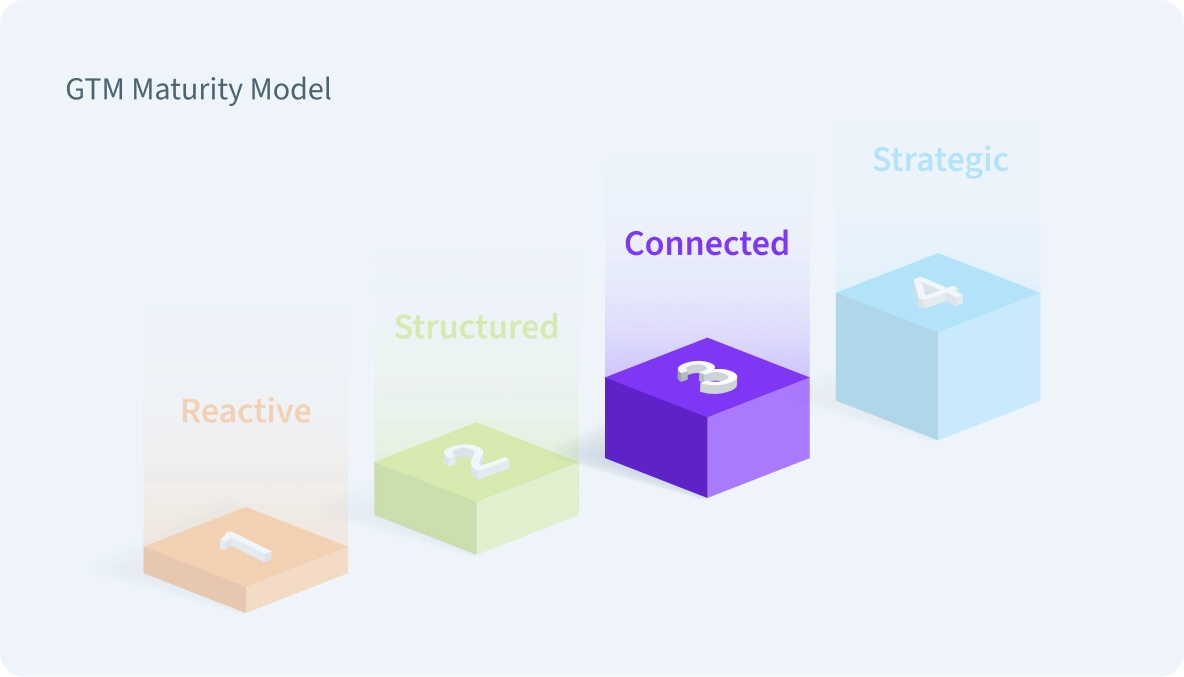
Start winning at Stage 3
Every GTM organisation should be aiming for Connected maturity.
At Stage 1 of the maturity model, tools, processes, and teams operate in isolation with little shared context and alignment. Even as organisations move into Stage 2, lingering fragmentation continues to make life difficult for sales reps and their leaders.
The turning point comes at Stage 3. In Connected organisations, AI connects activity, content, and data across functions and delivers recommendations and real-time insights in the flow of work. Teams are aligned on GTM priorities, and leaders can make decisions based on reliable, shared data.
Connected organisations have the advantage, but levelling up doesn’t happen automatically. Your people, processes, and technology need to adapt to meet the demands of Connected maturity. Here’s what changes at an operational level when you move from Stage 2 to Stage 3.
- Sellers make their next move based on accurate insights instead of educated guesses. Content, data, and training are gathered in a unified GTM platform, a single ecosystem that powers recommendations and enables alignment across sales, marketing, enablement, and RevOps.
- Accurate, clean data means sellers have easy access to the resources they need to take insight-driven actions. Tools like Highspot Deal Intelligence offer guidance directly in the flow of work, helping reps to take the best next step and get deals over the finish line.
- Managers take a consistent approach to training and onboarding so that no seller gets left behind. With a standardised coaching framework, sellers have access to the right support, and managers get time back to spend on strategic tasks.
- Some Stage 3 organisations take scalable coaching further with AI Role Play. Sellers can work on the exact skills they need for their next sales conversation and receive instant, objective feedback. When sellers are constantly practising and improving, they’re less likely to slip back into old habits.
- Sellers no longer have to think “which system” at every stage of the sale or waste time searching for content or tribal knowledge. Instead of constantly hitting roadblocks, sellers are always in motion and always moving deals forward.
When an organisation moves from Structured to Connected, it transforms the seller experience. Every rep now feels like part of a coordinated GTM effort with clear, common objectives. They’re more motivated, more productive, and take visible pride in shared wins.
AI that moves the needle
Connected organisations are prepared to get the most out of their AI investments. With a single platform for content, training, and sales plays, AI tools have the context they need to deliver reliable outputs. At low levels of maturity, AI creates conflicting outputs that contribute to an uneven buyer experience. By Stage 3, it amplifies the strengths of your data and infrastructure to help drive consistent execution.
Everyone has access to the same AI tools and uses them in similar ways and with shared best practices. When every team is using AI to deliver personalised content faster, the buyer experience is consistent across sales and regions. For sellers, it means equal access to sales coaching with on-demand practice and instant, actionable feedback.
The best part is that the results improve over time. As AI gathers information and adapts to your organisation’s way of working, the recommendations and insights become increasingly valuable. Sellers trust the outcomes more and gain the confidence to expand how they use their toolkit. As adoption increases, AI can finally realise its promise of delivering significant performance and productivity gains.
Aim higher
Becoming a Connected GTM organisation is a true achievement, but it’s not the end of your journey. Reach Stage 4, Strategic, and you’ll increase your lead on the competition with an adaptive GTM system that supports faster iteration and more predictable revenue.
Advancing to Strategic is all about finding the optimal balance between human skills and AI efficiency. In Connected organisations, AI surfaces signals and insights. At the Strategic level, sellers understand how to respond to those signals across the entire GTM lifecycle. Leaders and managers are also trained to interpret AI signals and use them to guide high-stakes decisions.
The GTM system is constantly self-optimising at Strategic organisations. AI draws on real sales conversations and other live performance data to continuously refine content, coaching, and workflows. For example, if meeting intelligence reveals that addressing a particular pain point early helps reduce friction, AI can make sure that comes across in training. Human performance improves, and that improved performance provides even better data for your AI tools to learn from.
Building a coordinated, insight-driven GTM organisation starts with Highspot’s agentic platform. To learn more about how we can help you reach operational maturity, read Winning with AI starts with execution: The GTM Maturity Model.