

Key takeaways
- Many manufacturing sales teams now use artificial intelligence to turn sprawling product libraries into a faster route from question to relevant materials. Purpose-built, AI-powered enablement tools tags assets by persona, product, and deal stage and gives sellers more room for technical conversations and relationship-building.
- Manufacturing sellers get more value from AI enablement when training mirrors the technical questions and buying roles they meet in active deals. Role-based practice, conversation insights, and targeted refreshers help new hires ramp with context while experienced teammates adapt to new products and objections.
- Channel teams at manufacturers benefit when AI enablement keeps distributors and internal sellers working from the same current content and messaging. Shared guidance helps partners handle technical questions with confidence, while field feedback gives marketing and product teams a smarter basis for future updates.
Manufacturing sales teams face long deal cycles with cross-functional buying committees who have complex product requirements. What’s more, they often navigate highly technical buyers, strict procurement processes, and tough competition.
That is why every interaction inside and outside sellers at manufacturing companies have with potential customers must be personalized, timely, and value-driven.
The issue manufacturing sales teams face, though, is a big one: Outdated systems and technology and data silos deter effective seller preparation, which slows everything associated with their GTM efforts down.
Fortunately, innovation in AI is helping to reduce the chaos and boost their sales efficiency.
When manufacturing sales teams, including distributors and channel partners, are prepared with relevant sales collateral, consistent messaging, and the tools and resources to build and maintain relationships with buyers, they ramp faster, work smarter, and close more deals by adding real value to prospects.
Whether you sell machinery, building supplies, or vehicle parts, leveraging a unified, AI-powered enablement platform with rich analytics is invaluable, as it can lead to faster deal cycles, higher closed-won rates, and more predictable revenue growth.
How AI-powered enablement improves manufacturing sales
An AI-powered sales enablement platform acts like a smart assistant. The solution automates repetitive, administrative tasks, surfaces relevant content, and gives sellers real-time guidance during the sales cycle.
Every follow-up becomes more tailored, with AI recommending sales assets based on what’s worked in similar deals. That way, reps can focus on building relationships, not time-consuming, back-office admin tasks.
A common concern when people hear “AI” in sales is that it might replace sales teams altogether, but that’s not the reality.
“When AI is everywhere, it’s the personalized, human moments that capture—and keep—a buyer’s attention,” Highspot by Seismic’s State of Sales Enablement Report 2025 explains. “Across the board, companies are implementing tools to support reps in delivering those moments at scale.”
5 ways to leverage AI across your manufacturing GTM team
Want to realize results like Hyster-Yale Group?
All you need is to adopt a best-in-class revenue execution platform and follow these five best practices leading manufacturing sales teams abide by to sell smarter and faster and better coordinate with their sales and enablement colleagues.
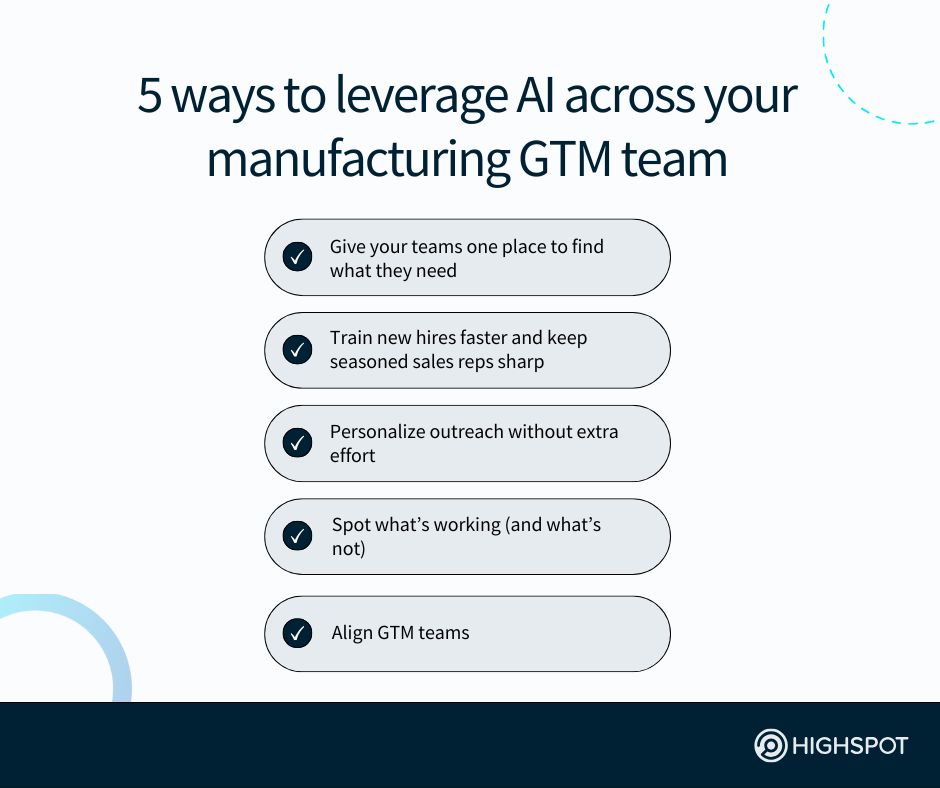
1. Give your teams one place to find what they need
Every sales professional spends way too much time searching for the most up-to-date tech specs, pricing, or region or industry-specific content.
When managing large catalogs and diverse product lines that change with each potential customer’s unique business, disorder can tank productivity.
Clean up content by using feedback from sales teams, usage metrics, and AI to tag assets by persona, product, content type, or deal stage.
Instead of spending hours manually tagging docs, videos, and other content, AI does the time-consuming work, so everything is easy to find, use, and keep up to date.
It reduces content waste because if a seller can find the resources they need, it’s far more likely they will actually use them.
For example, Ritchie Bros. improved content findability by 88% and boosted buyer engagement by 76% after centralizing all sales materials in Highspot by Seismic.
2. Train new hires faster and keep seasoned sellers sharp
Ramp times in the manufacturing industry are intense, especially when trying to grasp the long sales cycles, complex products, and layered buyer committees. Every extra week a new sales team member takes to get up to speed can often feel like lost revenue.
But as Forrester VP, Principal Analyst Peter Ostrow recently said, “the long-term deficiencies engendered by insufficient ramping quality are far more painful than the advantages of a week or two’s time saved on the front end of a seller’s multiyear career.”
The pressure is real, because the moment a seller starts drawing salary, most teams expect immediate ROI.
The good news? The right AI-powered sales enablement tool can enhance onboarding and accelerate time to value for your manufacturing sales organization.
Instead of relying on historical knowledge that new salespeople just don’t have or burying new hires in standardized onboarding decks, AI taps into conversational intelligence—insights pulled from real buyer interactions and call transcripts—to identify skill gaps and build personalized learning paths.
Using AI for sales helps new hires ramp faster by grounding their training in actual sales conversations and behaviors across the deal cycle.
It also keeps seasoned sellers sharp with continuous learning and coaching tied to events like launching new SKUs, expanding into new verticals, or handling technical objections.
Leaders also benefit from AI role play for sales managers that simulates real buyer scenarios.
McKinsey’s research found that organizations investing in AI-driven enablement experience a 10–20% increase in sales ROI, with increased productivity contributing as much as $660 billion in annual value across industries.
Start small with a few use-case-specific learning tracks for new hires, then expand as you learn what works.
SkinCeuticals cut onboarding time by 25% and saw a 15% shorter sales cycle by centralizing content and delivering consistent AI-powered training in Highspot by Seismic.
New sellers were ramped up in just 30 days, while seasoned sellers gained fast, in-context access to coaching resources without disrupting their workflow.
3. Personalize outreach without extra effort
Personalized outreach improves engagement, but in manufacturing companies, it’s rarely simple. The stakeholders involved have distinct roles:
- Sales and GTM engineers want specs and proof
- Procurement cares about cost, risk, and ROI
- End users (sellers) want an intuitive software UI
Decision-makers and buying committee members aren’t always communicating with one another, so each expects relevant messaging and content tailored to their pain points.
The challenge is that most sales professionals don’t have a deep understanding of customer needs, nor the time to tailor every interaction manually.
But AI fixes this by recommending the right collateral, messaging, or follow-up actions based on deal stage, persona, or buyer behavior.
If a salesperson or channel team is working with an engineering lead in the evaluation stage, AI can surface a technical comparison sheet and a case study from a similar vertical without digging through a content library or guessing what to send.
If that same deal moves into procurement review, the system might recommend ROI calculators, pricing FAQs, or some other form of value justification tailored to that persona.
Hyster-Yale saw a 19% increase in buyer engagement and a 68% increase in play adoption after using Highspot by Seismic to power AI-driven content recommendations.
Sales teams and channel partners could easily personalize every interaction, resulting in more relevant conversations, higher seller confidence, and better sales outcomes.
4. Spot what’s working (and what’s not)
It’s hard to improve what you can’t measure. Many manufacturing GTM teams struggle to connect content, training, and seller actions to actual deal outcomes.
Without data-driven insights, they have no idea what’s being used, what’s landing with buyers, and what’s stalling deals.
Using intuitive, AI-powered sales analytics give you that clarity.
By connecting outcomes to CRM records, you can track which content is used and when, which engagement activities move the needle, and what activities correlate to stalled deals.
This allows your sales leaders to focus on coaching, content strategy, and pipeline support where it has the biggest impact.
Of course, all of this hinges on trust. In manufacturing, where proprietary specs, buyer conversations, and sensitive customer data are involved, data governance is non-negotiable.
That’s why centralized GTM platforms are designed to meet SOC 2 Type II, ISO 27001, and GDPR standards. And, for manufacturing teams managing AI-specific risks, the NIST AI Risk Management Framework offers clear, practical guidance for deploying AI securely and responsibly.
5. Align GTM teams
Once you know what’s working, the next step is ensuring everyone is working together. Misalignment between sales, marketing, product, and channel teams often leads to duplicated work, inconsistent messaging, and lost opportunities.
Deploying AI across your sales and marketing teams helps break down those silos by creating shared visibility across GTM.
With centralized sales enablement platforms, field feedback is directly integrated into future content updates, product launches receive the right level of advocacy and support, and AI informs every team on what resonates with buyers. Instead of guessing, teams can quickly pivot when necessary and align around proven sales plays and strategies.
Siemens is a prime example.
By using Highspot by Seismic to improve partner enablement and go-to-market team productivity, the firm achieved over 100% improvement in annual revenue growth targets and continued long-term development momentum.
Unfortunately, distributors and channel partners are often on the sidelines, left to piece together outdated materials or guess at messaging that may or may not be current.
An AI-driven partner enablement strategy ensures they receive the same high-impact content, guidance, and support as your internal teams, without incurring extra overhead for your GTM teams.
By automatically surfacing the right resources and offering personalized coaching for continuous improvement, AI helps partners represent your brand consistently in the field.
GTM enablement readiness scorecard for manufacturers
Wondering where your team stands in terms of AI-powered sales enablement for manufacturing? This quick scorecard helps you evaluate how prepared your GTM organization is across the fundamentals.
For each statement, rate your organization as yes, somewhat, or no.
If you answer mostly ‘yes,’ you’re AI-ready; somewhat ‘yes,’ you’re getting there, and AI in sales can help connect the dots. If you answer mostly ‘no,’ start with centralizing content and onboarding, because that’s where manufacturers will see fast wins.
| Category | Details | How do you score? Yes, somewhat, or no |
|---|---|---|
| Content findability | – Sellers can find accurate specs, pricing, and compliance docs in under 2 minutes. – Our content is tagged by persona, product, and region. – Marketing knows what content sales actually use. | |
| Onboarding & coaching | – New hires ramp in 30–60 days using structured, role-based content. – Managers can coach using buyer conversation data and AI feedback. | |
| Personalization at scale | – Sales outreach adapts to the buyer role (think engineer vs. procurement). – Sellers are served smart content recommendations tailored to their deal stage. | |
| Data & deal visibility | – We can tie sales enablement activities directly to deal outcomes. – We track which assets drive buyer engagement. | |
| GTM team alignment | – Sales, marketing, and product collaborate using shared insights. – Our channel partners have access to the same enablement materials and central platform. |
How to make AI enablement stick in manufacturing
Rolling out effective sales enablement doesn’t have to be a massive overhaul. But, like any change, success depends on your starting point and how you prepare your teams.
The key is a strategic approach that focuses on one high-impact pain point that your teams experience every day, like content chaos or inconsistent onboarding. When you solve something that people genuinely care about, adoption builds naturally across the organization.
That said, there are a few common missteps to watch out for:
- Overloading sellers with too much, too fast: Even great automation tools fail when they’re introduced all at once with no clear use case.
- Forgetting to include channel partners: Distributors need the same clarity and resources as internal teams, or your brand experience breaks down in the field.
- Skipping early wins: If you’re not tracking quick, measurable improvements, it’s hard to build momentum or justify the investment.
Instead, think of implementation as a phased rollout. Start where the friction is highest and show how AI removes it.
As adoption grows, so does your confidence and ability to expand into other parts of the GTM and sales process. AI eventually sticks because it makes life easier for the people using it every day.
It’s time to equip manufacturing sales teams for what’s next
Manufacturing sales teams face complex buyer journeys, long sales cycles, and rising buyer expectations. To compete, you need a smarter manufacturing sales enablement strategy with integrated customer relationship management (CRM).
With a unified revenue execution platform featuring native AI analytics and enablement capabilities, manufacturing GTM teams can align around what works, eliminate manual data entry, and focus on equipping sales teams with relevant content that shortens sales cycles and wins more deals.
Bottom line: Incorporating AI into your manufacturing sales process is your best path to strengthen your sales operation and drive predictable revenue growth.