

Go-To-Market (GTM) organisations are working harder than ever, but they don’t have the results to show for it. Missed revenue targets, stalled pipeline reviews, and competitive pressure could all be evidence of a team falling short of its potential.
To close the gap between effort and execution, GTM organisations need to focus on operational maturity. The more mature your organisation, the greater its ability to manage complexity, adapt to change, and innovate at speed.
The Highspot GTM Maturity Model is designed to help you figure out where your organisation stands today and what you need to do to reach the next level. If you’re still in the earliest stages of maturity, you need to move quickly or risk falling dangerously behind the competition.
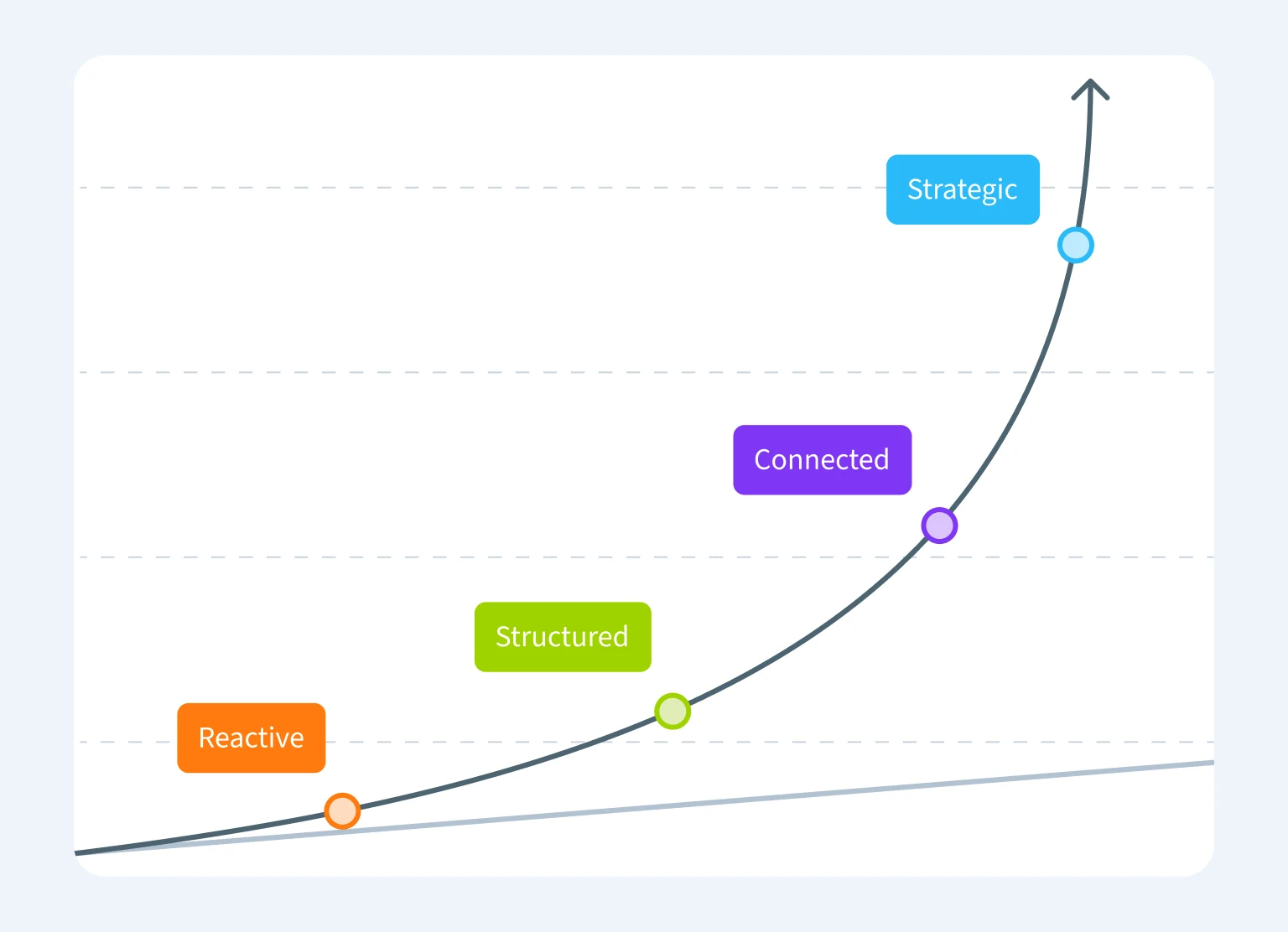
Stages of a go-to-market maturity strategy
Effort doesn’t equal maturity
The GTM organisations making the most effort aren’t the most mature. In fact, if teams are fighting hard just to keep their heads above the water, it’s a sign that they’re still in the earliest stages. In contrast, mature organisations can handle complex sales processes and drive innovation with comparatively minimal effort.
Effort without leverage is a clear sign of Stage 1 of the maturity model: the Reactive stage. For organisations at this level, achieving consistent GTM execution is difficult, if not impossible. Fragmented data, tools, and processes prevent teams from making real progress, no matter how hard they try.
At Stage 1, sellers spend too long searching for data in multiple siloed systems or recreating content that they know exists but can’t find. As well being a drain on your sellers’ time, decentralised content damages live deals. When reps pull from inconsistent or outdated resources, messaging can shift considerably from one touchpoint to the next.
Fragmentation also increases the burden on sales managers; when systems and tools aren’t connected, sellers rely on their managers to act as a single source of truth. Delivering coaching at scale is another major challenge. Reactive organisations lack a standardised approach to upskilling, with your reps receiving uneven coaching and feedback.
Even at Stage 2, the Structured stage, effort doesn’t always translate into results. Inconsistency across teams and regions means organisations are unable to apply all of their energy to achieving a common goal.
AI amplifies inconsistency
Artificial intelligence should make life easier for your sales reps, but at low maturity levels, they’ll barely notice the difference. With no shared governance or reliable data foundations, AI is limited to isolated experiments that have little impact on productivity or performance. Even worse, sporadic AI use can lead to low revenue predictability and an inconsistent buyer experience.
That inconsistency continues to be an issue as we move into Stage 2 of the maturity model. While there are some early guidelines and expectations around AI use at Structured organisations, individual sellers and managers still decide how to apply its capabilities to everyday tasks. AI assists tactically at Stage 2 — drafting, summarising, and providing basic insights — but it remains disconnected from strategy and unable to deliver value at a system level.
Imagine a Structured organisation where everyone has access to the same AI tools, but only one team is using them to create personalised proposals, PDFs, and presentations. Everyone else continues to use manual methods, delivering generic content or taking longer to respond to buyers. The buyer experience whipsaws from sale to sale, and your brand suffers as a result.
Why you can’t afford to wait
Staying at Stage 1 of the maturity model poses significant revenue risks to your business. At the lowest maturity level, operational costs are high, but productivity is low. Sellers get less done, and deals move more slowly than at mature organisations.
For managers at Reactive organisations, variable workflows and poor visibility into performance make it hard to spot behaviours blocking progress. Leaders often don’t realise sellers aren’t using a new launch play or up-to-date messaging until conversion rates drop. You’ve already lost the sale, and all you can do after is try to limit the damage.
Your sellers want to focus on closing deals, not searching for resources or working on repetitive tasks. That frustration builds up over time and can eventually lead to poor job satisfaction and decreased performance. At low organisational maturity, sellers also lack the consistent coaching they need to stay motivated and avoid burnout. High-performing sellers will churn and look for other opportunities if your organisation spends too long in the Reactive stage with no signs of progress.
Reactive organisations typically lack the foundational processes key to scaling AI. Stay at this stage, and you’ll have a hard time moving from experimentation to formal integration. The longer you wait, the greater the risk. AI is evolving fast, and the GTM organisations that can take advantage of new tools and capabilities will race ahead.
Once you reach Stage 2 of the maturity model, don’t take your foot off the gas. Your competitors won’t stop at “good enough,” so you shouldn’t either, maintain a sense of urgency and make sure complacency doesn’t get in the way of progress.
Moving from Stage 2 to Stage 3 (Connected) is a major milestone for GTM organisations. At this stage, every insight is informed by data, execution is repeatable, and AI has a meaningful impact on seller productivity and deal quality.
How to level up
Moving through the maturity model takes time; don’t expect to progress from one stage to the next overnight. Start by identifying where your organisation stands today and gradually build the structures and behaviours required to reach the next level.
Between Stage 1 and Stage 2, actions might include creating an inventory of all your content, tools, training, and workflows, deleting duplicates, and getting everything organised. Defining the end-to-end sales process and building simple plays for key motions will also help you progress. When it comes to AI, consider introducing “table stakes” capabilities, such as meeting preparation and call summaries, in the flow of work. You should also provide managers with the training they need to encourage and guide AI adoption within their teams.
Once these pieces are in place, you can begin the journey towards coordinated execution. Activities to reach Stage 3 include unifying content, training, and performance data into a single GTM environment and adopting shared dashboards and coaching frameworks. Deploying AI-supported guidance in daily workflows — recommended content, risk alerts, and coaching prompts — is another step in the right direction.
If you’re stuck in the Reactive or Structured phase, you have no time to lose. Read Winning with AI starts with execution: The GTM Maturity Model to understand where you are today and take action before the gap widens.