

Key Takeaways
- Legacy sales call recording systems worked wonders for go-to-market (GTM) organisations—until AI-powered conversation intelligence solutions emerged and rewrote what today’s GTM teams expect from call data, context, and connected insight across every sales cycle stage.
- Top-performing GTM teams use cutting-edge conversation intelligence, not old-school sales call recording systems, to identify coaching opportunities and equip reps with insights that drive sharper execution.
- Modern revenue teams at B2B companies now rely on actionable insights from deal and meeting intelligence in an AI-driven sales enablement platform like Highspot that offers real-time and historical data tied to deal discussions without ever toggling between disconnected tools.
Once upon a GTM tech cycle, sales call recording software felt like the future.
Finally, reps and managers could rewind the tape, hear things twice, and spot what they missed mid-meeting. For its time, this was game-changing—like DVR for deals. But the future has a short shelf life. And what was once revolutionary has aged into a digital archive: static, shallow, and stuck in playback mode.
Modern teams need more than just sales call recordings. They need motion.
Conversation intelligence tools with baked-in AI capabilities have taken the baton and sprinted ahead, turning passive audio into active go-to-market insight. We’re not talking transcripts with timestamps. Rather, we mean interconnected data that knows the difference between a pitch and a deal turning point.
Because when conversation data lives in a vacuum, your entire GTM motion starts operating with blinders on. You lose the ability to see how calls influence content usage, rep development, pipeline health, or buyer alignment.
And without that rich, robust context—threaded through your entire sales tech stack and woven into your GTM strategy—you’re working off snapshots instead of full frames. Which means the story of your deals never quite adds up.
What is sales call recording software?
Sales call recording software is a legacy GTM tool that captures discussions with leads for review through basic recording features. It gives sales managers and reps a simple way to revisit info shared and requests made by buyers from recent sales conversations, though most teams don’t rely on it for deeper insight.
These traditional sales solutions enable post-call analysis at a surface level and provide limited context around how conversations influence broader selling motions. Recordings highlight talk tracks and meeting flow but offer minimal linkage to broader go-to-market strategies or revenue aims across fast-moving cycles.
Sales teams find these platforms helpful for reference, even though they deliver narrow value due to limited structure, shallow context, and static playback.
Sales call recording software FAQs
Can sales call recording software support complex go-to-market initiatives?
These tools capture audio, but they lack the workflow intelligence needed to support strategic programmes across teams, content, and pipeline stages. Leaders require systems that map conversations to larger initiatives so they can see how efforts align with key priorities across roles and lines of business.
What features do traditional sales call recording solutions lack for B2B reps?
Most tools give raw replays, but they do not guide sellers through next steps tied to sales training, messaging, or deal context. They lack actionable feedback, role-specific support, and visibility into which conversations impact win rates or buyer readiness in current cycles.
How secure is GTM and customer data with a sales call recording platform?
Data security depends on the vendor’s infrastructure, permission logic, and how well it prevents unauthorised exposure through integrations or storage. Enterprise-grade tools should restrict access, encrypt transmissions, and ensure proper governance across global teams with audit-level compliance settings.
Why are GTM teams switching away from legacy sales call recording tools?
Legacy sales call recording systems capture conversations but fail to provide actionable guidance tied to ongoing deals, learning programmes, or content strategies. Teams move toward platforms that unify training, conversations, and content in one view to reduce tool-switching and manual tracking across workflows.
Does sales call recording software give managers coaching opportunities?
While managers can review call recordings, most platforms provide limited structure to connect rep conversations to skill development or deal success. Better tools offer a consistent framework to compare what reps say in meetings to defined expectations, helping managers scale guidance across teams.
Can sales call recording software identify GTM skill gaps in my sales team?
Recordings help replay calls, but identifying who needs support takes structured evaluation tied to observed patterns across calls, reps, and accounts. Leaders need frameworks that align meeting transcripts to role-specific skills so they can drive consistent development based on shared standards.
What are the benefits of moving away from dated sales call recording tools?
Teams gain greater visibility into what works by shifting to sales enablement platforms with native, AI-powered conversation intelligence capabilities that tie discussions to training, talk tracks, and buyer-facing content in one system. This upgrade allows everyone in GTM to align their actions with current goals and avoid piecing together key insights from separate sources.
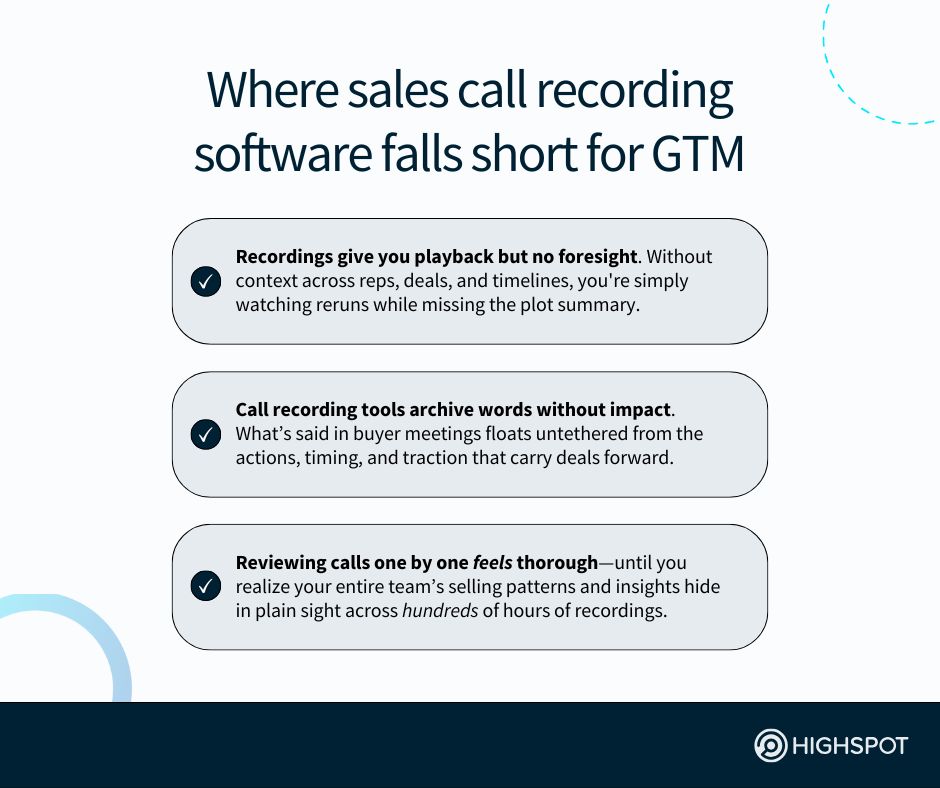
The downsides of legacy sales call recording solutions for GTM teams
SalesFuel’s 2025 Voice of the Sales Rep survey found nearly half (45%) of B2B sellers said “connecting with the buyer on an emotional/logical level is their top superpower.” But that goal becomes more difficult in deals when BDRs rely on old-school sales call recording software to analyse and summarise calls.
Simply put, sales call recording systems lacking AI for sales team members that makes their jobs far easier have a fair number of drawbacks.
Why AI conversation intelligence is better than sales call recording tools
Sticking with the status quo simply because of comfortability isn’t ideal. Upgrading dated tools (and related processes) with better solutions almost always leads to sales productivity and efficiency improvements.
Here’s why so many GTM teams are (finally) making the switch from limited sales call recording systems to more advanced conversation intelligence tools.
Cut the sales call replay theatre and give reps real-time insight they can act on mid-deal
Reps don’t need another stack of call recordings. They need insight they can act on while the deal is still alive, breathing, and in motion, not after it’s lost.
Advanced systems detect shifts in tone, cadence, and objections during sales calls, translating those into meaningful data and suggested actions for the rep. Call replays are a fine archive, though they rarely equip a BDR mid-convo or prep someone to pivot when a cold-calling sales script falls flat.
With real-time guidance stitched directly into the workflow, reps don’t miss beats—they swap angles, adjust timing, and guide buyers toward the next step.
Unlock better coaching that provides more intelligence coaching opportunities for managers
Most managers don’t have time to relive every phone call, much less pull insights from a dozen past conversations each week before their next pipeline review.
Modern conversation intelligence IDs trends in call quality, cadence, and delivery, surfacing valuable insights to guide and equip reps at scale. This shifts coaching from a reactive scoring session to proactive sales enablement, helping managers support reps based on key moments, not just final outcomes.
Sales coaching becomes less about grading tone and more about elevating best practices across the entire sales team, consistently and without manual lift.
Tap into AI-powered capabilities (far) beyond note-taking and reviewing recorded calls
Reviewing phone calls alone won’t help sales team members uncover patterns or adjust based on what’s working across different sales cycle stages.
The best AI-powered sales tools for enterprise go-to-market organisations go beyond mere transcripts to capture recorded-conversation insights from phone calls with potential customers, mapped to what actions follow.
Real examples from real conversations give experienced and new reps alike the ability to reflect, reset, and improve their performance with purpose. These platforms give sellers a deep-dive into what they said, how buyers reacted, and actionable insights that can help them adjust their sales techniques.
Improve GTM execution by connecting context that actually matters across reps and deals
Every call carries moments—requests, reactions, hesitations—that shape how deals unfold, whether teams notice them or not.
Smart systems capture those inflection points and tie them to context-rich metrics through CRM integration and connections with other sales tools. That connectivity helps teams cut through the blur of tasks and tap into what’s really happening across people, plays, and pipeline.
When those insights map to daily work, sales team members don’t just check boxes. They evolve how they sell, connect, and show up across the business.
Link rep performance to deal and revenue outcomes to drive accountability and results
Sales leaders rely on signals that tie what’s said on every call to what happens next across reps, meetings, pipelines, and revenue outcomes.
Systems that map recorded-conversation insights from phone calls with potential customers into trends help teams course-map without rewatching hours of video.
These tools shift sales coaching into forward motion by turning conversations into real-world traction: trackable, reviewable, and repeatable, helping sellers show up smarter and advance more deals ever-so-closer to the finish line.
By highlighting talk tracks across different sales cycle stages, teams give every rep a way to improve their performance with data that drives change.
Integrate seamlessly with enterprise GTM platforms for secure high-quality ingestion
The best insights don’t live in isolation. Instead, they sync across platforms, timelines, and teams so decisions flow with better timing and context.
Conversation intelligence tools rely on CRM integration and connections with other sales tools to weave critical insight into the daily motion of sales. That connectedness helps every conversation work harder, pulling context into the stack without lag, bottlenecks, or bounce-back.
Sales team members gain more from every input when successful calls, plays, and content align with how they plan, track, and execute across deals.
Tie AI-identified topics from calls to benchmark skills that guide the next-best actions
Every conversation brings teachable moments—words used, questions asked, pauses taken—that reveal strengths and sales rep skills in motion.
Modern systems that go well beyond legacy recording-tool features link those buying signals to skill models and training materials during onboarding, helping your entire team of reps ramp with purpose. The playback era gave us records.
This new era gives us recommendation engines with memory and a map.
That means managers get more than recaps. Rather, they also get timely, trackable, real-time coaching-moment cues, enabling them to pinpoint and act on relevant coaching opportunities across different call types, thanks to their AI counterpart.
Pull past activity and recommended content in seconds so GTM teams move faster
Meetings happen fast.
Sales reps rarely have time to sift through folders of call recording transcripts while they’re speaking with buying committee members live. Systems that pair past activity with proposed assets to share give BDRs the right context and materials mid-dialogue without skipping a beat.
These tools act like a well-timed whisper from a top seller.
It’s less about shortcuts and more about sales readiness.
Conversation intelligence software supports teams prospecting leads, sharing what has worked well in past calls and interactions and surfacing guidance related to lead management and buyer engagement before recorded sales calls wrap.
Modernising your GTM tech stack with AI-powered meeting intelligence
There was a time when sales call prep meant simply scanning handwritten notebooks, double-checking inboxes for messages from leads, and hoping you remembered what collateral has already been shared with buyers.
That moment has (thankfully) passed.
With conversation intelligence software like Highspot’s Meeting Intelligence, B2B sellers can now walk into upcoming meetings knowing which key points from past chats matter, which action items were agreed on at the end of those calls, and which objections still need addressing, without flipping through tabs.
Meeting Intelligence syncs to pipeline stage and recent activity. The AI-powered insights offered in Highspot’s tool, along with other sales analytics and intelligence served up by our AI agents for GTM teams, bring planning, sales conversations, and follow-up into one workflow. No detours. Just continuity.
The advantages afforded to each go-to-market team are many:
- Sales managers listen to how BDRs hold focus, pivot during pricing talks, and navigate product roadmap questions mid-discussion so they can—alongside our AI—offer sales performance improvement suggestions and coach reps more effectively.
- Sales reps can get auto-generated sales follow-up emails written for each prospect they speak with, immediately after calls finish, enhancing their customer communications and showing they are committed to addressing buyer’s challenges and needs.
- Sales enablement discovers where rep training hits or misses based on what’s said, shared, and skipped during potential-customer interactions, as they have comprehensive, accurate records of all content and sales messaging delivered to active opportunities.
- Marketing pinpoints the distinct pain points shared by prospects to inform future sales content they create with tighter alignment to buyer needs so that the team’s sales calls in the coming weeks are more impactful (and close more deals).
“For AI capabilities to add real value, sales organisations must ensure that opportunity scoring, deal recommendations, lead insights, and other features are relevant and rooted in data,” SAP recently wrote for Forbes, regarding the pros of utilising artificial intelligence functionality in the B2B sales process today.
Modern tech stacks connect dots that used to live in isolation. The go-to-market orgs that tap into conversation insight don’t just wrap up more deals. They modernise their sales approach and move forward in the funnel with purpose.
Fewer distractions, fewer delays, and fewer detours.
When the entire sales team works from the same source of truth, focus follows, rapport-building with buyers becomes a cinch, and win rates skyrocket.