

Key Takeaways
- A strong sales proposal crafted by B2B sellers answers the buyer’s core question (“Is this the right decision for our business?”) by translating value, context, and urgency into a clear, compelling narrative.
- The most effective sales proposals are ones that wholly reflect the prospective customer’s goals and challenges, aligns to each stakeholder’s priorities, and guides decision-making with structured, relevant detail.
- Using AI-powered go-to-market (GTM) solutions and sales proposal tools streamlines creation, reduces errors, and ensures every quote is accurate, compliant, and built around what leads have said matters most.
By the time a prospect is ready for a sales proposal, they’ve already invested plenty of time investigating the problem they want to solve.
They’ve completed market research, met with your team, evaluated your sales techniques, compared vendors, evaluated their budget, and in many cases, even spoke with your references. Now, you need to sum it all up into a proposal that seals the deal.
Converting late-stage leads into new customers is rarely straightforward. Budgets may be tight, and internal stakeholders may point out risks.
When they finally request the sales proposal at the end of the deal cycle, they are ready to answer a single question: “Is this the right decision for our business?”
Your proposal should help them reach that answer without hesitation.
What is a sales proposal?
A sales proposal is a decision-making tool that communicates the problem a client is trying to solve and why your solution is the right fit. It brings together all the information buyers need to evaluate your recommendation: the executive summary, the thoughtful explanation of the solution, transparent pricing, and the next steps that move the project forward.
The proposal should go beyond just describing what you offer. It must reinforce customer needs uncovered in earlier conversations and throughout your sales prospecting efforts. It acknowledges the complexities decision-makers face as they consider all options and helps the buyer visualize how your team, product, or service will work with theirs going forward.
A successful sales proposal shouldn’t be pages long and overwhelm target customers with lengthy descriptions that toot your own horn or individual feature breakdowns (those were available earlier in the sales cycle). Instead, it builds trust by highlighting what matters most and translating value into a coherent narrative that answers, “Why us, and why now?”
How sales proposal software strengthens your ability to close deals
Many sales organisations rely on sales proposal software to maintain a consistent sales process for proposal creation. Instead of building every proposal from scratch for every new opportunity, proposal software lets sales reps start with templates, pull in existing data, and keep the entire proposal on-brand and on-message, much like your approved sales scripts.
This helps teams save time and keep variables like pricing, service details, and product features aligned. It also minimises the risk of version conflicts that often happen when teams juggle documents across email, Google Docs, spreadsheets, and other siloed tools.
While no tool completely replaces a rep’s judgment, customer knowledge, or storytelling skill set, a streamlined proposal creation process gives sales professionals more room to focus on individual relevance rather than formatting.
And when sales proposal generation is supported by shared content, workflows, and business rules across GTM teams, reps spend more time addressing customer needs and less time chasing down mundane information.
Integrating your GTM tech stack gives your proposals real-time precision
When your GTM systems work together, sharing sales pitch assets, previous call data, discovery notes, or pricing information, your sales proposal reflects what buyers have actually said, not just what a template assumes.
This kind of integration helps sales reps carry forward the potential client’s priorities without asking them to repeat themselves, and it ensures the proposal highlights the details that matter most. Too often, though, organisations struggle with the opposite.
“Too many companies are still guessing their way through critical sales motions. Their systems are disconnected. They run plays inconsistently. They underuse or misapply AI. And they treat enablement as a support function instead of a growth driver,” Highspot’s Turn Strategy into Revenue Guide explained.
A well-connected tech stack addresses these gaps by streamlining collaboration with finance and legal, keeping every section of the proposal aligned with the organisation’s approved messaging, policies, and known data.
This alignment becomes especially valuable near the end of the sales cycle, when buyers have spoken with multiple stakeholders across your company, and accuracy directly impacts your overall sales conversion rate.
They aren’t looking for anecdotes at this stage. They’re looking for accuracy and confidence that nothing will change after they sign.
AI-powered enablement tools make sales proposals more innovative, faster, and way more effective
It’s no secret artificial intelligence is wholly reshaping every part of how we work across industries, and sales proposals are no exception. Its role isn’t to replace salespeople but to amplify their strengths and help them work more precisely.
As Inc.’s Bruno Nicoletti wrote, “With AI, businesses can identify who’s most likely to buy, not just who fits a demographic. Instead of replacing salespeople, AI amplifies them. It gives humans superpowers in personalisation and timing.”
- In the context of building a proposal, AI can suggest relevant content based on the buyer’s industry, recommend past case studies from similar customer profiles, or analyse conversation data to pinpoint the pain points buyers stressed most.
- It can also support automated follow-ups, ensure flow consistency throughout the proposal, and help sales teams gather insights that shape future proposals. Bain noted “AI can handle tasks that free up sellers to spend more time with customers, and early successes show 30% or better improvement in win rates.”
- Artificial intelligence tools can even create a first draft sales proposal that is already aligned with your branding, structure, and messaging, with appropriate product information and buyer details. From there, reps can personalise further.
TL;DR: Some think of AI sales tools merely a shortcut, but its value lies in helping you present the strongest and most personalised version of your story.
Digital sales rooms turn proposals into interactive buyer experiences
Static proposals no longer match how today’s buyers evaluate complex solutions. Digital sales rooms are centralised personal spaces where sales teams and potential buyers share mutual plans, review assets, and move through next steps together.
Instead of passing around a fixed proposal, buyers engage with an interactive experience that adapts as the conversation evolves.
They allow buyers to explore related content on their own terms, whether that’s a previously shared ROI model, a sales pitch email, or detailed explanations of product features that were flagged during discovery.
With everything in one place, both sides stay aligned on deadlines, responsibilities, and open questions to keep the sales process moving along swimmingly.
“Mutual plans keep reps grounded in reality,” Forbes Business Development Council’s Julie Thomas recently wrote on the value of MAPs in deal discussions. “A verbal ‘Yes’ isn’t a signed contract; there may still be legal reviews, budget approvals, or executives out of the office during critical weeks.”
Digital sales rooms support this mutual relationship by consolidating proposal elements and all supporting evidence into a shared space throughout the entire sales cycle. Clients will have everything they need to move forward without losing momentum in the final days.
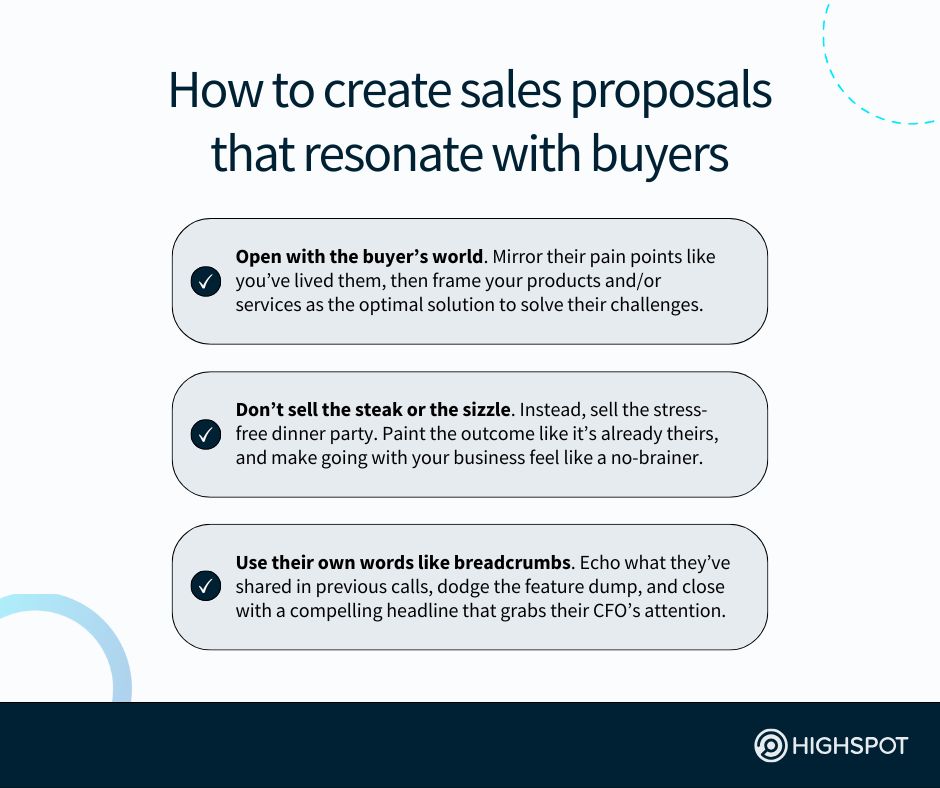
How to write a sales proposal that converts late-stage leads
While every organisation has its own sales tactics, strong proposals share a few common traits: clarity, empathy, relevance, and an intentional structure.
These elements help sales professionals communicate their proposed solution in a way that feels tailored to the prospect rather than systematic.
Nail the executive summary so buyers know what matters most
The executive summary is often the first section decision makers read, and in some cases, it’s the only one they read closely. At this stage, it helps to reinforce the core problem the buyer needs to solve, reflect the company’s goals, and summarise the proposed solution in a concise, confident way.
A strong executive summary orients the reader, gives them a reason to keep going, and demonstrates that you’ve aligned your recommendations to their business priorities.
For example, if a prospect has shared that rising operational costs are forcing them to evaluate new systems, your executive summary might open with a statement such as:
“Like many organisations navigating increased operating costs, your team is looking for a solution that reduces manual effort without disrupting existing workflows. This proposal outlines an approach that automates processes, increases visibility across teams, and lowers the total cost of ownership over time.”
A summary like this makes the buyer say, “You heard us, you understand us, and this proposal is clearly built for us.”
Clearly define the proposed solution in the prospect’s context
Buyers want to see how your solution maps directly to their pain points.
This section should reflect the personal data gathered throughout earlier conversations, including information discovered through discovery call questions.
Instead of listing all the components of your product or service, consider framing the solution in terms of outcomes: the challenges it resolves, the processes it improves, and the measurable value it creates for the buyer’s team.
For example, consider a prospect mentioning during discovery that their team spends “hours every week stitching together materials from email, shared drives, and messaging apps.”
The proposal can connect that pain point by stating, “To help your team reclaim time, our solution centralises content, removes version confusion, and gives reps a unified workspace for all sales materials and communications.”
When the proposed solution reflects the buyer’s own words, it feels less like a presentation and more like a partnership.
Highlight the service offerings and product features that support your case
This part of the proposal should help potential customers understand how your solution actually works. But rather than outlining every feature or service, focus on the ones that best support the buyer’s goals and connect them to business value.
You might emphasise capabilities that solve a specific workflow bottleneck or highlight domain expertise that reduces onboarding time. These details position you as a leading provider, setting your solution apart from the competition.
It’s aligned to the buyer’s particular industry, company size, and priorities.
Headspace’s revenue enablement manager explains how the company’s sales team enhances its sales pitches and proposals using our AI-powered agentic platform for GTM.
Use client stories and social proof to reinforce confidence
Relevant client testimonials, case studies, and examples from other customers offer reassurance. When a buyer sees that organisations with similar challenges have succeeded with your solution, it reduces perceived risk.
These stories don’t need to be long. A brief explanation of the client’s problem, the solution, and the results they achieved is often enough.
For example, “A mid-sized financial services company facing long review cycles implemented this workflow and reduced approval time by 40% within one quarter.”
You can even link to the full story in your digital sales room for further exploration.
Tailor your pitch with insights gathered throughout the sales cycle
By the time you’re drafting the proposal, you’ve likely uncovered plenty of information, including pain points, internal dynamics, team priorities, budget concerns, and the expectations of various decision makers.
Covering this in your sales pitch deck and proposal shows that you’ve been listening and understand the nuances of the buyer’s world.
When buyers recognise their situation within your narrative, the proposal becomes a clear path forward, built specifically for them.
Map key points to buying committee roles and what each one cares about
Most business proposals must satisfy multiple decision makers, including finance, legal, operations, and executive sponsors. Each has unique concerns and interprets risk differently.
This part of the proposal benefits from nuance: highlighting why the solution addresses the CFO’s financial concerns, how IT will ensure security and configure integrations, and why end users will have a more intuitive workflow.
A few sentences of framing can go a long way in supporting consensus. For instance, the integration with your existing SSO maintains security while reducing admin overhead.
Loop in finance, legal, and RevOps early to avoid last-minute delays
Avoiding bottlenecks late in the sales cycle often comes down to early planning.
When finance, legal, and RevOps get answers ahead of time on pricing, terms, and scoping details, you’ll avoid scrambling to resolve issues that surface days before signature.
Ensuring the proposal is accurate from the start makes it easier for buyers to approve. For example, buyers expect to see transparent pricing, scope, and commitment details that they can share internally without needing interpretation.
Write every section with one purpose: help the buyer reach a confident decision
Although every section serves a distinct role, they all contribute to gaining buyer confidence. Practical flow reassures potential buyers that they’re making the right choice for their org.
Instead of approaching the proposal as a standardised sales document, it often helps to position it as a guide that helps the buyer articulate why this solution is the right fit and how it will help the organisation reach its goals.
How to build a sales proposal template that supports more wins
A pre-built sales proposal template reduces unnecessary load on reps by pre-populating key information without extra effort. While every proposal will inevitably require customisation, start with a branded structure so you can focus on personalisation and storytelling rather than formatting issues like alignment, brand colors, or fonts.
A sales proposal template:
- Brings consistency across the entire sales organisation: Templates ensure shared structure, messaging, and expectations, so every proposal reflects the same level of quality and business alignment.
- Ensures essential details are never missed: With a defined framework, reps include indispensable elements—like basic company details, contact information, terms and conditions, the executive summary, pricing, proposed solution, value outcomes, and business justification—every time.
- Reduces time spent collecting data and formatting: Templates and AI cut down on the manual effort required to produce a proposal.
- Helps reps focus on customer needs, not layout: With the foundation already built, reps can concentrate on personalising content to reflect each buyer’s priorities instead of worrying about structure.
- Makes cross-functional reviews smoother and faster: Finance, legal, and RevOps teams can review proposals more efficiently because details appear in consistent, predictable places.
Just be sure to treat your template like a living document.
Regular updates every month, based on recent closed-won and -lost data, can help you fine-tune your reps’ closing pitches to increasingly resonate with leads.
Sales proposal readiness checklist
Is your sales proposal client-ready? Below is a checklist you can use to create a more consistent, buyer-friendly proposal experience. This checklist supports the discernment and confidence you build through closing sales training.
| Sales proposal checklist question | Yes or no |
|---|---|
| Does the executive summary reflect market research, the buyer’s problem, and desired outcomes? | |
| Does the proposed solution map directly to the buyer’s industry, goals, needs, and constraints? | |
| Are pricing and scope-related details transparent and easy for buying stakeholders to follow? | |
| Have you included relevant client testimonials or case studies to reinforce buyer confidence? | |
| Have finance, legal, and other departments reviewed the key sections for accuracy and attention to detail? | |
| Are the next steps clear, concise, and aligned with the buyer’s decision-making process? | |
| Have you included a cover letter, your company values, and contact information to make follow-up easy? | |
| Are all terms and conditions available to the client for internal review by their legal and security teams? |
Why great sales proposals are critical to closing more high-value deals
If you’re fortunate enough to guide a prospect to the bottom of the B2B sales funnel, a killer sales proposal can make all the difference you need.
More to the point, it becomes that final, essential part that consolidates the end of the deal cycle by tailoring the recommended solution in question and specific steps that move the buying committee toward proposal acceptance.
When every section reflects the buyer’s needs and conveys the value your solution offers, reps create the conditions for sales success: closing more deals in the sales pipeline with a streamlined process that naturally supports higher win rates.
At this stage, the proposal becomes an opportunity for buyers to provide feedback as they move closer to a purchase. And when you consistently deliver proposals that are easy for all stakeholders to evaluate, you position your org to generate even more leads and stand out as a leading provider in your category.