

Key Takeaways
- The cold calling process entails sales reps using relevant data and smart questioning to qualify prospects, identify intent, and move the right leads into the next step of the sales cycle with clarity and purpose.
- Cold calling success depends on sales professionals’ ability to prepare thoroughly and thoughtfully for initial conversations with leads, which helps them open with tailored insights and guide the discussion toward a relevant problem and pain point the prospect cares about solving.
- Conducting AI sales role play allows reps BDRs to practise real-world cold-calling situations—along with other buyer interactions—enabling them to better anticipate lead objections and improve their cadence, tone, and delivery so they show up polished on every prospect call.
Historically speaking, cold calling gets a bad rap from buyers and sellers alike:
- Decision-makers at B2B orgs often don’t want out-of-the-blue outreach from someone and some company they’ve never heard of or barely engaged with in the past.
- Sales reps don’t want to potentially waste time on poor-fit prospects who don’t fully align with their company’s ideal customer profile and very likely will hang up ASAP.
And both are right for having this outlook—at least for the traditional approach.
The good news is cold calling techniques have (thankfully) evolved a great deal in recent years, thanks largely to advancements in AI and automation and go-to-market teams relying much more heavily on accurate data and timely insights.
Put another way? The cold calling ‘game’ has changed.
Advanced tools incorporate artificial intelligence, tighter CRM integrations, and a sharper focus on signal-based sales prospecting that redefine how top-performing reps approach sales outreach altogether. The goal isn’t just to get someone on the phone. It’s to be instantly relevant the moment they pick up.
The issue is many BDRs don’t know how to adapt their engagement efforts to capture cold prospects’ attention and build trust with them from the get-go.
This challenge is magnified by the fact that many calls still lean too heavily on generic sales scripts, outdated assumptions, or misaligned timing, eroding any credibility that sellers hope to establish in the first 60 seconds of a sales call.
Most reps (yourself included) aren’t short on effort. They’re just short on the right approach. And in the current B2B sales environment, where every single minute spent dialling is a minute not spent closing, that distinction matters.
The question isn’t, “Does cold calling work?” It’s whether your approach does—and what technology and process changes are needed to help it thrive.
What is cold calling?
Cold calling is a proactive sales technique where reps reach out to potential customers who haven’t previously expressed interest in their company’s products or services but have likely engaged with their business in some manner.
The cold calling process for most salespeople involves attempting to connect with the right person at a target account to gauge their needs and see if it makes sense to advance the prospect in question to the next stage of the sales cycle, during which they can conduct a formal discovery call with the buyer.
The success rate of cold calling depends on the seller’s ability to quickly earn the lead’s time and establish relevance. At its core, effective cold calling hinges on building rapport within the first few moments of the conversation, as many prospects prefer quick conversations to determine their interest level.
Cold calling FAQs
How do I improve my tone and delivery during cold calls with buyers?
Use an AI sales role play tool like Highspot to practice maintaining a natural, steady pace while sounding confident and relaxed so your tone feels professional without becoming stiff or overly rehearsed. Record yourself periodically, listen back with intent, and focus on improving vocal energy, clarity, and cadence to boost credibility with each interaction with potential customers you engage.
Which open-ended questions work best during cold calls with buyers?
Cold calls perform better when questions invite buyers to explain priorities, constraints, and current initiatives in their own words. Effective prompts focus on business objectives, operational gaps, and evaluation timing, allowing sellers to guide dialogue toward relevance without forcing early product framing.
How can I capture leads' attention in the opening minute of cold calls?
Cold calls earn attention fastest by leading with context that proves relevance, such as industry shifts or peer outcomes. A concise opening grounded in buyer reality sets direction quickly and earns permission to continue, rather than relying on generic intros or company-centric statements.
Should cold calling efforts extend to social media outreach after calls?
Cold calling pairs well with social outreach on LinkedIn when follow-on messages reference prior context and buyer priorities. Thoughtful reinforcement through professional networks keeps outreach aligned and visible while supporting continuity across touchpoints without repeating the same language or approach.
Which kind of cold call scripts help sellers best connect with buyers?
Cold call scripts work best as structured, yet flexible frameworks rather than rigid talk tracks. Effective scripts define opening context, value direction, and exit paths while leaving room for seller judgment, allowing the dialogue to adapt naturally based on buyers’ responses and overall engagement and enthusiasm level.
How can cold calls reveal whether leads fit the target criteria or not?
Cold calls reveal the fit of potential customers by testing alignment around business goals, timing, and internal ownership. Focused qualification prompts expose urgency, constraints, and decision structure early, helping sellers determine a prospect’s viability without relying on assumptions or extended discovery sessions.
When does cold calling work better than sending out a cold email?
Cold calling outperforms email when immediacy, clarification, or urgency matters. Live outreach enables faster validation of interest and direction for reps, while email suits passive exploration, longer consideration cycles, or outreach tied to documented buyer research and previously stated priorities.
What approaches handle buyer objections during cold calls effectively?
Cold calls handle objections best by acknowledging buyer perspective and reframing toward relevance. Skilled sellers treat resistance as information, responding with context and examples that advance understanding rather than pushing rebuttals or scripted counterpoints.
Breaking down the traditional cold calling script used by B2B sellers
You know the script. (You’ve lived it.) You dial in and open with a warm(ish), “Hey, this is [name] from [company name],” then launch into the carefully rehearsed opener. The goal? Grab interest before the buyer shuts the proverbial door.
And from there, things usually get … formulaic. Not bad, but just predictable.
The harsh reality is reps at most businesses face this situation. Like you, BDRs often struggle to get beyond the initial cold call script and attempt to keep leads from tuning out after the opening line of their initial sales solicitation.
The plain truth is your initial cold call can make or break your shot at building something special with cold prospects. And by “something,” we mean a sales pipeline that doesn’t rely on miracles but rather data-backed engagement that leverages actionable insights from your go-to-market tech ecosystem.
Making headway with cold calling starts by asking better questions, having better timing, and reading the room. The cornerstone of a great pitch isn’t reciting features. It’s being present enough to unearth their pain points and adapt.
And that means anticipating the twists and knowing how to handle the classic buyer responses without sounding like you’ve said the same line 36 times today:
- When a buyer says, “Can you send me some materials instead”: Reps usually jump at the chance, email a deck, and log it as a ‘positive outcome’ in their CRM. Read between the lines, though, and it’s clear: No meeting means no traction, and that deck’s in their deleted folder.
- When a buyer says, “We’re all set.”: Most BDRs admittedly freeze, fumble a weak, “I totally understand,” and mentally start dialing the next number before the call even ends.
- When a buyer says, “I’m busy.”: Some sellers barrel through anyway, hoping persistence pays off. Others panic and back out without asking why the buyer took the call in the first place.
- When a buyer says, “We’re already working with [competitor].”: Reps often launch into a rapid-fire pitch on differentiators—fast, defensive, and usually without knowing if the buyer even cares about those gaps. This only tends to turn off potential customers even more.
- When a buyer says, “Sure, I’ve got a minute.”: Many BDRs launch into full monologue mode, forgetting the goal is building rapport, not reading a brochure over the phone.
Savvy sales pros treat these moments as invitations, not interruptions:
- Specifically, they ask open-ended questions like, “What made you curious enough to answer?,” or, “What would make a conversation worth your time?”
- These smart sales reps also have thoughtful follow-up questions and custom-tailored sales messaging ready to go, instead of a plan to ‘just wing it.’
- They know one potential customer may indicate subtle buying intent while another just needed a break between meetings. Your job is to tell the difference.
The success here isn’t just about handling objections. Rather, it’s also about earning the right to keep talking. If the buyer isn’t in the right mindset to speak with a salesperson, you need to spot that fast, then either pivot or gracefully end the call.
One prospect may say “I’m slammed” but linger, revealing interest with the right prompt. Another may be perfectly polite—and completely checked out.
Cold calling today is about building trust (and quickly) to create space for a future conversation. Keeping that top of mind with your buyer engagement, respect their bandwidth. Don’t waste the prospect’s time. Know when to move on to the next cold call and turn your attention to warm leads.
And above all, stay curious. You picked up the phone, so make it count.
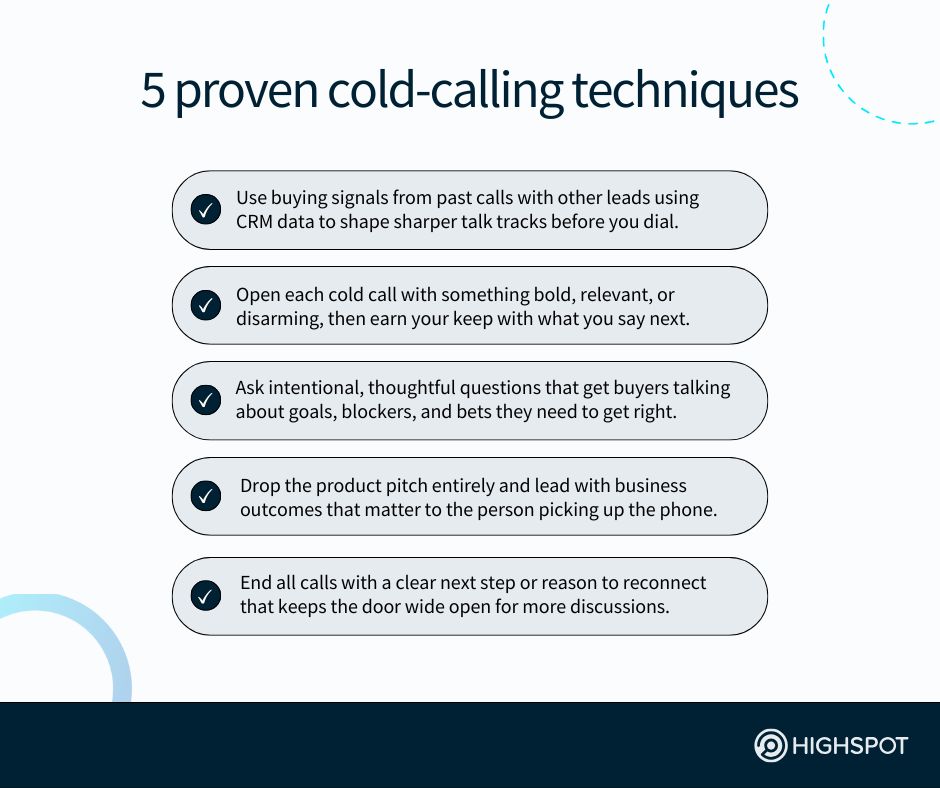
5 proven cold calling techniques used by top-performing sales reps
“With inboxes besieged by AI-generated noise and spam filters growing savvier, sales teams are rediscovering the power of human connection,” Forbes Technology Council’s Kaushik Tiwari recently wrote about cold calling.
If you need cold calling advice, we can help. Some common best practices for hopping on phone calls for the first time with net-new prospects include:
1. Using unified sales signals to shape sharper outreach and improve every cold call moment
Great cold calls aren’t lucky guesses. They’re mapped, measured, and modeled.
Top reps don’t just wing it; they bring receipts. When you pair AI-powered GTM insights with a sales enablement platform like Highspot, you stop shooting in the dark and start planning your outreach based on what messaging has resonated with similar leads.
That means layering in CRM data, company size, job title, industry and letting the patterns do some of the work before you even pick up the phone.
The modern B2B sales game isn’t about charming your way past the gatekeeper. It’s about knowing what gets a “Sure, I’ve got a second” from the right person.
A successful cold call pitch is both relevant and feels custom-built. When your openers reflect the buyer’s priorities and current initiatives, you command respect before you even get to your value proposition.
Cold calling tip: Use insights from your CRM, call history, and enablement tools to shape outreach before dialing. Your sales success in this situation depends on context that proves you did your homework.
2. Crafting opening lines that earn attention fast and shift prospects into a conversation
The first 5 seconds? That’s the whole game.
Most sales reps lose the call before they ever get to the “why I’m calling.” Your opener should never sound like a stranger selling something. Instead, it should sound like someone with a point worth hearing. That’s the bar.
Forget “How are you today?” or “Did I catch you at a bad time?” Those lines wave red flags and tell would-be buyers, “They’re desperate to get me to talk.”
Great openers do two things at once: Earn a pause, and make it personal.
They also lean into familiarity. Something like, “Hey, you’re probably getting a hundred of these a day—here’s why I still dialled,” or, “We’re seeing a pattern with [company type] around [problem]—curious if it’s showing up for you too?”
It’s a good bet that if they’re still listening after 10 seconds, you’ve bought yourself a little runway. And that’s all you need to turn a short call into more calls.
Cold calling tip: Grab attention quickly with an unexpected or relevant insight. Skip pleasantries, show intent, and have your calendar handy to propose follow-up chats if they lean in.
3. Leading with questions that reveal priorities early and guide the buyer toward clarity
Ask any business development rep who’s made President’s Club, and they’ll tell you they didn’t do so by monologuing on sales calls. They lead with questions. Not boring ones, either. Rather, the kind that disarm, provoke, and—done well—reveal what a lead’s objectives are before a BDR has said much of anything.
When a sales rep opens with, “What’s something your team wishes was easier right now?” or “What would you do differently if you had a solution like ours for your team?”, they’re miles ahead of the seller simply rattling off details from a product-centric sell sheet without showing a personal touch with prospects.
Cold calling requires restraint.
You’re there to open a door, not redecorate the house. If the buyer starts talking, you win. Your job is to frame questions that get them to articulate the functional and emotional drivers behind their current setup—the Jobs to Be Done they’re navigating.
If they pause and say, “Good question,” you’re doing something right.
Cold calling tip: Lead with questions that get the buyer thinking out loud. You’ll hear pain points in their own words and be better equipped to adjust your sales process accordingly.
4. Delivering value-packed talk tracks that align to buyer goals within seconds of pickup
You’ve got maybe 30 seconds to prove you’re worth the airtime. That’s where your talk track earns its paycheck—or flops. The trademark of a ‘good’ first cold call? It doesn’t sound like a cold call. It sounds like a heads-up from someone who gets the stakes.
Reps who shine avoid the overt sales pitch, instead delivering a crisp, relevant point of view on a problem their prospect likely wrestles with.
The key: Speak like a human. Be human. Drop the robotic phrasing.
Don’t pitch features and functionality. (They can check out your site or peer reviews for that.) Instead, speak to business outcomes that matter to them. You and others on your sales team might know your offerings inside out, but your buyer wants to know, “How does this help me stop fire-drilling my day?”
While a cold email could lead to multiple opens and decent response rates, it’s not nearly as effective as getting a lead’s ‘voice time’ to make your case in seconds flat.
Cold calling tip: Ditch the static script. Use a flexible talk track that ties directly to the buyer’s current goals, and deliver it like you’re talking to a colleague, not a sales quota.
5. Closing each call with a clear path forward that removes ambiguity and accelerates progress
Endings get overlooked on cold calls. Sales reps spend all their energy opening strong, holding attention, then forget to deliver a memorable closing line that sticks with leads and keeps the BDR’s company top of mind with them.
That’s like leading a great movie and rolling credits in the middle of the climax.
You need a closer that creates momentum. Give the buyer something to do (an action item), something to think about (a sales asset), and a reason to keep the conversation going (recognising their distinct challenge must be addressed).
Even a soft close like, “Would it make sense to reconnect in a week or two, see where you’re at?” can keep the door open without adding any pressure.
Your call to action doesn’t need to be, “Book time now!” It could be as simple as, “I’ll send over a few bullets on what we covered, and, if it’s helpful, we can go deeper later—sounds good?” The point: always leave a breadcrumb trail.
It’s the shrewd sales rep who leverages conversation intelligence from past cold calls to refine how they ask for next steps—and it shows.
Cold calling tip: Don’t drift into the goodbye. End with a next step, even a light one, that gives you a reason to follow up soon and prospects a reason to remember you.